

WET vs WHET: simple tips to remember the difference
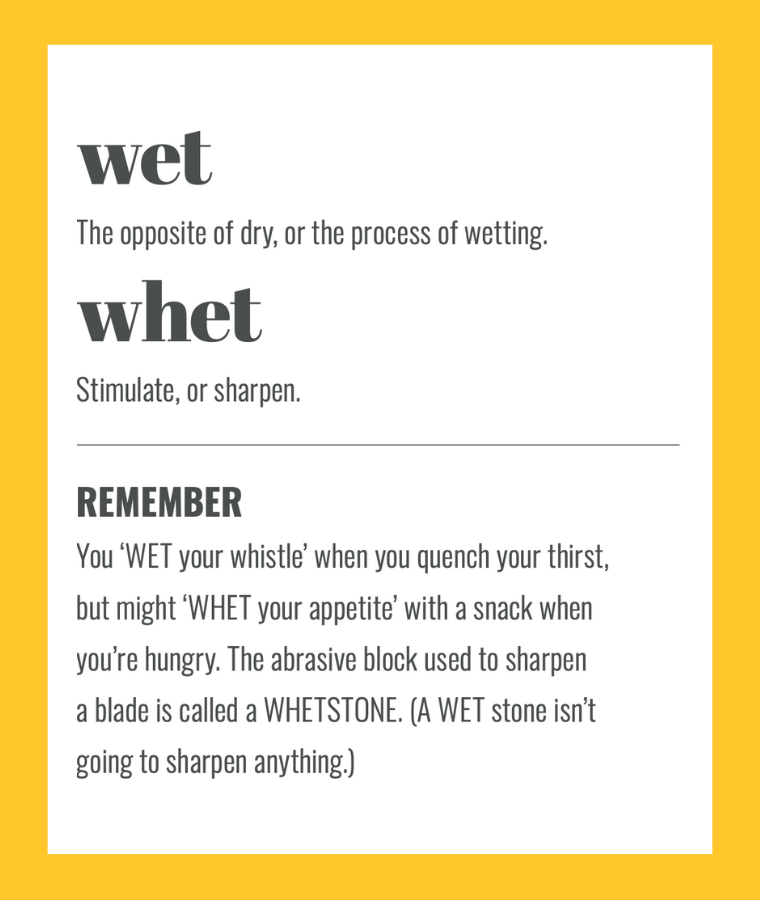
WET vs WHET: which is which? These spelling tips and usage examples will help you remember the difference
The words WET and WHET are easy to confuse because they are homophones – words that sound the same but mean different things. And, while WHET is far less common than WET, there are important differences in meaning that I can help you learn.
Here are my simple tips to remember the difference between WET and WHET.
When to use WET
WET can be an adjective or a verb.
It’s the opposite of dry, or the process of wetting. Here’s how to use WET in a sentence as an adjective:
“All the benches are WET – let’s keep walking.”
Here’s how to use WET in a sentence as a verb:
“Be sure to WET your hair before applying the conditioner.”
When to use WHET
WHET is a verb that means to stimulate or sharpen. Here’s how to use WHET in a sentence:
“The teaser trailer WHET the appetite of movie fans everywhere.”
Pro tip
You ‘WET your whistle’ when you quench your thirst, but might ‘WHET your appetite’ with a snack when you’re hungry.
The abrasive block used to sharpen a blade is called a WHETstone, not a WET stone. (A WET stone won’t sharpen anything!)
Now you know the difference between WET and WHET. I hope my tips help you remember the difference between these commonly confused words!
Get more simple, memorable spelling tips in The Little Book of Confusables 1 + The Little Book of Confusables 2
My four-times award-winning books take the mystery out of misused words for just just £11.95. You’ll wonder how you managed without them!

WET vs WHET. Excerpt from The Little Book of Confusables by Sarah Townsend.

More than 1,000 misused words demystified
Master 1,000+ confusing words with the multi-award-winning Little Book of Confusables 1 + 2 – jam-packed with memorable, fun spelling and usage tips: from ACCEPT + EXCEPT and OPTIMAL + OPTIMUM, to BARE + BEAR and PURPOSEFULLY + PURPOSELY.