

11 things you didn’t know about The Little Book of Confusables

Think The Little Book of Confusables is just a book about words? Think again. Here are 11 surprising reasons to buy the fun, invaluable guide to commonly confused words.
1) It’ll save you time
Mental block? Need to check which spelling you need? It’s quicker to get the answer you need using The Little Book of Confusables than Google.
Copywriter Matt Phil Carver put the book to the test and reported in his five-star review that it’s more than twice as quick as Googling.
Here’s Matt’s review…

2) It’s a godsend for comms teams
Comms teams, marketing departments, small business owners… make that anyone who writes.
Clare Laxton, Director of Communications and Influencing at Pause, tweeted:
“Starting the week with The Little Book of Confusables by the brilliant @STEcopywriting. An absolute must have for all Charity Comms teams – it helps me so much with all the writing I do in my role.”
Alison Relf from Taylor Alden PR loved her copy so much she treated her team to one each:
“Have just bought five copies on Amazon for ease! Cannot wait to give them to the team for Christmas!”
Boss of the year, I’d say…
Learning English as a foreign language? The Little Book of Confusables isn’t just a fab resource for translators and interpreters – it’s great for EFL students, and teachers, too.
Canadian reader, Jacqui, describes it as:
“Brilliantly laid out and a great addition to my writing guides collection. I highly recommend it for linguists and even ESL teachers.”
While MDGB says:
“As an in-house translator, colleagues regularly ask me to cast an eye over documents. An accessible usage guide as a desktop reference is very useful particularly as people ‘mishear’ a phrase that they wish to use. There are also helpful tips to help remember which homonym to use. Useful also for native speakers encountering the onset of language depletion in their mother tongue.”
Just four months after launch, The Little Book of Confusables has sold in 18 countries around the world:
Australia, Austria, Brazil, Canada, France, Germany, India, Italy, Japan, the Netherlands, New Zealand, Portugal, South Korea, Spain, Switzerland, Tenerife, the UK and the US.
5) Language professionals swear by it
Copywriters, editors, proofreaders, translators, marketing managers, authors… you’ll find glowing five-star reviews from all of them.
Because we all have language blindspots.
Tom Albrighton, author of How To Write Clearly, says:
“Every writer – in fact, everyone who writes – needs a copy of this book on their desk. It’s comprehensive, authoritative and, most importantly, great fun to read.”
Anna Gunning, director of Gunning Marketing, says:
“This book is amazing – no matter how many years you’ve been writing and no matter how much of a grammar nerd you are. It’s a book to keep next to your computer at all times.”
6) It’s jam-packed with commonly confused words
Almost 600, to be precise.
Starting with the obvious homophones, including AFFECT/EFFECT, PRINCIPAL/PRINCIPLE, ELICIT/ILLICIT and COMPLIMENT/COMPLEMENT.
Then there are the mishearings, like DAMPSQUID, DOGGY-DOG WORLD, WHITE AS A SHEEP and OUTER-BODY EXPERIENCE.
Finally, the word pairs that get misused time and again – from ACUTE/CHRONIC and LEND/BORROW to LIBEL/SLANDER and POISONOUS/VENOMOUS.
What’s your language blindspot? And which words have you been misusing your whole life?
7) It really is little!
Despite having 300+ pages, The Little Book of Confusables is a pocket-sized, easy-to-grab paperback.
Kirsty Brooks, owner of Little Batch, calls it:
“Concise yet packed. Chunky, yet pocket-sized. The best bits of Sarah’s Instagram tips in a cute and chunky book!”
And copywriter, Cat Roberts Young, says:
“No writer, English speaker or English language learner should be without a copy of this book. All the answers, perfectly pocket-sized, in a book that will never leave your desk.”
(You can even stand it up on your desk like a paperweight, should you wish to. Win–win.)
8) It’ll make you laugh
Yes, The Little Book of Confusables is a deliciously nerdy, wordy reference book, but don’t expect it to be dull!
It’s packed full of quirky, witty wordiness that’ll make you laugh out loud while you learn.
From examples like TORTUOUS/TORTUROUS/TORTOISE/TOTORO and WARRIOR/WORRIER/WARIO (and his world-famous fictional moustache) to catchy ways to remember the spellings that catch you out Every. Single. Time.
Sophie says:
“I didn’t realise until my mid-twenties that saying ‘bare with me’ was wrong and that it’s actually ‘bear with me’. I’d been propositioning people inappropriately for years! Loving this book as my new handy sidekick to avoid similar mistakes in future, and it’s got some brilliantly funny examples too!”
And Anne says:
“The definitions are silly and memorable and I will go back to this book just to remind myself of some of the differences – venomous/poisonous, marinade/marinate… but I’ll also go back to it for a giggle. Using sci fi, computer games, rappers… Ms Townsend entertains while making a point.”
JESTER of goodwill, anyone?!
9) It’s a fab gift
The Little Book of Confusables was awarded best stocking filler in the Christmas issue of WI Life magazine.
With a circulation of 200k, that’s a lot of stockings.
Nic H says:
“My 7 year old son and I read through this book together. We not only had a lot of fun but we learned some stuff i.e. became less confused about confusing words! This is a really nice stocking filler.”
And Eriketo says:
“Can’t recommend this book highly enough. Even if you don’t think you need it, you definitely do. And get one for all of your team/family/friends too while you’re at it.”
(Someone described it as ‘the perfect toilet book’. I didn’t know whether to be flattered or insulted – but apparently, that’s a good thing. If you’re into trivia and “I did NOT know that!” moments, you’ll love it.)
10) Your kids will pinch it
One dad says:
“This cracking little book by Sarah Townsend is MAGICAL for keeping in the car. Especially on drives and school runs with the kids. A super-accessible format! It’s like having a stash of word Haribos on hand to whip out whenever the kids are getting a bit bored.”
I’m not an academic or an English graduate. Instead, I’ve 30+ years’ experience of using real-world, human language to help businesses get noticed – so The Little Book of Confusables is always accessible.
Claire Handscomb says:
“I cannot recommend this book highly enough. It should be on every desk or bookshelf and on the essential reading list in every university. However good we think we are at writing, we all need a little help with some of the idiosyncrasies of the English language!”
And input from my 19-year-old son before he headed to uni (to study English and creative writing, appropriately) means The Little Book of Confusables is down with the kids.
Or whatever the kids are saying these days.
11) It’s gorgeous
Author of The Creative Nudge, Kevin Chesters describes The Little Book of Confusables as:
“The perfect mix of aesthetic and usability! I love it. You’ll keep returning again and again.”
Copywriter Catherine Every, says:
“What a brilliant little book that I suspect will spend more time on my desk than on my bookshelf! It’s a gorgeous thing too, with a distinctive size and a fabulous typeface, so it’s just lovely to browse through.”
I’ll leave the last word to William Morris:
“Have nothing in your houses that you do not know to be useful, or believe to be beautiful.”
The Little Book of Confusables is both. You’ll wonder how you ever managed without it.
Treat yourself or your team to a copy of The Little Book of Confusables from Amazon, or get a signed copy direct from me and end the confusion in your life!

More than 1,000 misused words demystified
Master 1,000+ confusing words with the multi-award-winning Little Book of Confusables 1 + 2 – jam-packed with memorable, fun spelling and usage tips: from ACCEPT + EXCEPT and OPTIMAL + OPTIMUM, to BARE + BEAR and PURPOSEFULLY + PURPOSELY.
Do you know your PRESENTS from your PRESENCE? Take my Christmas confusables quiz and find out
Question 1
a) “Whose coming for Christmas dinner this year?” b) “Who’s coming for Christmas dinner this year?”Question 2
a) “Santa’s making an appearance at the school Christmas bizarre!” b) “Santa’s making an appearance at the school Christmas bazaar!”Question 3
a) “Tickets to the carol concert are £10, and include complementary mince pies” b) “Tickets to the carol concert are £10, and include complimentary mince pies”Question 4
a) “We saw A Christmas Carol at the RSC. The guy who played The Ghost of Christmas Past was so talented!” b) “We saw A Christmas Carol at the RSC. The guy who played The Ghost of Christmas Passed was so talented!”Question 5
a) “Too many glasses of fizz at last night’s party have lead to a hangover!” b) “Too many glasses of fizz at last night’s party have led to a hangover!”Question 6
a) “The neighbourhood Christmas Eve party always attracts hordes of people!” b) “The neighbourhood Christmas Eve party always attracts hoards of people!”Question 7
a) “I’ve had so many compliments about my Christmas tree this year!” b) “I’ve had so many complements about my Christmas tree this year!”Question 8
a) “Ooh, yes please – I’m not adverse to a glass of mulled wine!” b) “Ooh, yes please – I’m not averse to a glass of mulled wine!”Question 9
a) “I’ll pass on dessert – last year’s Christmas pudding gave me stomach pains “ b) “I’ll pass on desert – last year’s Christmas pudding gave me stomach pains”Question 10
a) “Oi! Quit peaking at your presents – you’ll spoil the surprise!” b) “Oi! Quit peeking at your presents – you’ll spoil the surprise!”Question 11
a) “If you don’t behave, it’ll affect the amount of Christmas presents you get!” b) “If you don’t behave, it’ll effect the amount of Christmas presents you get!” c) “If you don’t behave, it’ll affect the number of Christmas presents you get!” d) “If you don’t behave, it’ll effect the number of Christmas presents you get!”Question 12
a) “Let’s go to the panto this year! It’s my favourite!” b) “Lets go to the panto this year! It’s my favourite!” c) “Let’s go to the panto this year! Its my favourite!” d) “Lets go to the panto this year! Its my favourite!”Question 13
a) “Are you inferring I’ve had too much to drink?!” b) “Are you inferring I’ve had to much to drink?!” c) “Are you implying I’ve had to much to drink?!” d) “Are you implying I’ve had too much to drink?!”Question 14
a) “Did you see what I bought for your mum from Etsy? It’s a secret, so be discrete!” b) “Did you see what I bought for your mum from Etsy? It’s a secret, so be discreet!” c) “Did you see what I brought for your mum from Etsy? It’s a secret, so be discrete!” d) “Did you see what I brought for your mum from Etsy? It’s a secret, so be discreet!”Question 15
a) “I wonder who’s doing this year’s alternative Christmas message on Channel 4!” b) “I wonder who’s doing this year’s alternate Christmas message on Channel 4!” c) “I wonder whose doing this year’s alternative Christmas message on Channel 4!” d) “I wonder whose doing this year’s alternate Christmas message on Channel 4!”Scroll down for the answers…
Answers
Q1) b Q2) b Q3) b Q4) a Q5) b Q6) a Q7) a Q8) b Q9) a Q10) b Q11) c Q12) a Q13) d Q14) b Q15) aHow did you go ho ho?
12 to 15: A* student: gold star for you 7 to 11: good effort: could do better 0 to 6: must pay attention in English class If you love nerdy, wordy fun, you’ll love The Little Book of Confusables 1 + 2 Over 1,000 words demystified in 600+ gorgeous pages.Get more simple, memorable spelling tips in The Little Book of Confusables 1 + The Little Book of Confusables 2
My four-times award-winning books take the mystery out of misused words for just just £11.95. You’ll wonder how you managed without them!
More than 1,000 misused words demystified
Master 1,000+ confusing words with the multi-award-winning Little Book of Confusables 1 + 2 – jam-packed with memorable, fun spelling and usage tips: from ACCEPT + EXCEPT and OPTIMAL + OPTIMUM, to BARE + BEAR and PURPOSEFULLY + PURPOSELY.
Lost in language? Caught in confusion? You need The Little Book of Confusables
English is a messy, confusing language, and we all have blind spots – however confident you are as a writer.
For you, it could be knowing the difference between LETS or LET’S, PRACTICE or PRACTISE, EFFECT or AFFECT.
Maybe you’ve spent your life saying ‘off your own BACK‘. (It’s BAT, actually.)
Or perhaps you didn’t realise there were two spellings – and two different meanings! – of DISCRETE/DISCREET, HOARD/HORDE and REIN/REIGN.
You’re not alone!
In the 30 years I’ve been a copywriter and editor, I’ve worked with thousands of smart people – many of whom simply don’t find language easy to grasp.
It’s really no surprise. Our language is full of lookalike and soundalike words that have different meanings. The problem is, using the wrong word can completely change your message – and lead to embarrassing mistakes!
- BALD men aren’t always BOLD.
- DISEASED may be bad, but DECEASED is a whole lot worse.
- Dramatic CORDS require the fashion police.
- And heaven forbid you ask someone to ‘BARE with me’ – unless you’re a fan of getting naked with strangers. (Yikes!)
I call these words confusables – and I’ve been sharing tips to help you remember them on social media since 2016.
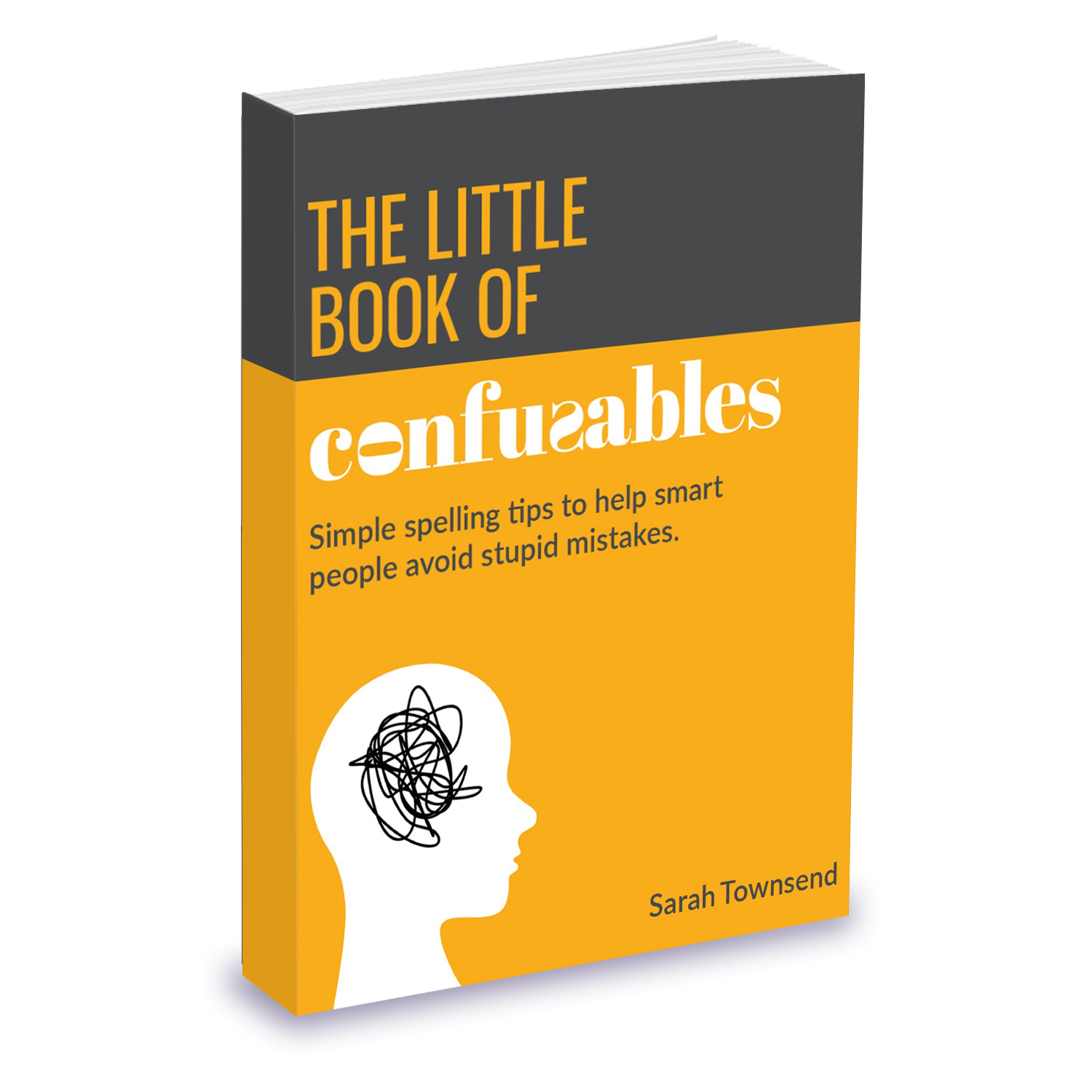
In 2022, I brought them together in The Little Book of Confusables: fun, memorable tips to remember 600 commonly confused words, in 300+ gorgeous pages.
It’s such a useful book, in fact, that it won GOLD in the 2023 eLit book awards!
Who is The Little Book of Confusables for?
The Little Book of Confusables is loved by teachers, editors, proofreaders, copywriters, authors, graphic designers, translators… as well as anyone and everyone who ever has to write emails or social media content.
It’s a book that’ll make you laugh and learn – and one that’ll help you avoid embarrassing errors.
As Leif Kendall, Director of ProCopywriters said: “This is the perfect book for anyone who reads, writes or speaks.”
I make that all of us…
What are confusables?
Confusables are any two (or more) words that trip us up when we’re writing or speaking. Here are my categories of confusing words:
Homophones: words that sound the same but have different meanings.
Homographs: words that are spelled the same but have different meanings.
Homonyms: which can be homographs, homophones or both.
Malapropisms: which occur when a similar-sounding wrong word is used instead of the right word, with nonsensical and often funny results.
Eggcorns: which occur when a word or phrase with a similar meaning is misheard or misunderstood.
Miscellaneous: the word pairs that defy categorisation but are still confusables. Words like ACUTE + CHRONIC, LIBEL + SLANDER and POISONOUS + VENOMOUS.
What’s included?
The Little Book of Confusables contains fun, memorable reminders for 500+ of the words you find most confusing, so you can boost your vocabulary, write with confidence and avoid embarrassing mistakes.
Learn tips to remember the difference between homophones such as COMPLIMENT + COMPLIMENT, DEPENDANT + DEPENDENT, avoid malapropisms and eggcorns like DAMP SQUID and DOGGY DOG WORLD – plus simple grammar lessons on commonly confused terms like LESS + FEWER and NUMBER + AMOUNT
…all in a gorgeous, flickable, fits-in-your-bag format.
Where can I buy The Little Book of Confusables?
Get more simple, memorable spelling tips in The Little Book of Confusables 1 + The Little Book of Confusables 2
My four-times award-winning books take the mystery out of misused words for just just £11.95. You’ll wonder how you managed without them!
More than 1,000 misused words demystified
Master 1,000+ confusing words with the multi-award-winning Little Book of Confusables 1 + 2 – jam-packed with memorable, fun spelling and usage tips: from ACCEPT + EXCEPT and OPTIMAL + OPTIMUM, to BARE + BEAR and PURPOSEFULLY + PURPOSELY.
How writing a bestselling book changed my life (hint: it’s not what you think)
Thinking of writing a business book?
It’s not always a case of ‘write a book, publish a book, go back to the day job’. I share five years of experience as a four-times award-winning business book author.
We hear it all the time: writing a book is the best way to position yourself as an expert in your field. Daniel Priestley* has a lot to answer for!
But I didn’t set out to do that.
Having worked in marketing for almost 30 years – and been a freelance copywriter for 25 of those years – I had a pretty decent personal brand, and an even better social media presence.
It was never about me. (And call me cynical, but most books written with an end goal of elevating the author’s profile come across as just that.)
Unlike most people, I always believed I didn’t have a book in me, so no one was more surprised than me when the idea to write one temporarily took over my brain.
How I got started
In 2020, I wrote my first self-published bestseller, Survival Skills for Freelancers – relaunched in January for 2025.
Since its launch, Survival Skills for Freelancers has helped freelancers and entrepreneurs in 28 countries grow in confidence and get more enjoyment from self-employment – without getting sucked into the six-figure hustle.
I knew from others who’d published business books that I wouldn’t make my fortune from self-publishing. My financial expectations were – quite honestly – pretty low.
But I wasn’t motivated by money.
I was motivated by using my 20+ years of experience to help others tackle the challenges and avoid the pitfalls of self-employment. The stuff no one talks about. Because there are plenty of books on the practicalities of self-employment, but still not enough (IMO) on developing the right mindset for success.
A mindset that prioritises your mental and physical health so you can do your best, most creative and most fulfilling work. A mindset that centres on setting boundaries, saying no, outsourcing, charging your worth and dealing with imposter syndrome.
I’d lived this stuff. I’d made the mistakes.
I could share my experience to help others do better.
And somehow that message just resonated.
People shared (and still share) the book on their social media. They wrote incredible reviews, explaining how Survival Skills for Freelancers had helped them grow in confidence and become more successful. They even shared stories of how the book had given them the confidence to take the leap into freelance life!
Call me naive, but I just thought I’d write the book, publish the book, and go back to the day job.
But that’s not what happened…
People invited me to talk to their book clubs, to deliver webinars and Q&As, to guest on their podcasts – even to become a mentor (which I did for both the FreelanceHER 100 project and the government’s Help To Grow scheme).
I’d never done any of this stuff before. I wasn’t sure I had the confidence to do it, frankly – but it turned out I could. And I was pretty good at it, too!
I said a big fat yes to every opportunity that came my way.
And I was loving it – but it wasn’t all positive. I became hooked on helping others become more successful, while completely overlooking my own success.
(Plus engagement is validation, right?!)
Most of the opportunities I was saying yes to didn’t pay – and I took my eye off the ball when it came to my copywriting work: the work that pays the bills.
The situation became so bad that clients I’d worked with for years began to say, “Looks like things are going great for you. But are you still doing the copywriting?”
As a result of the confusion, my income plummeted. Like, badly.
I’d been letting other people’s expectations eat away at me, and was feeling the pressure of should.
You know what it’s like:
- “You should monetise your network and create a paid membership group!”
- “You should design an online course, to capitalise on your knowledge.”
- “You should create a suite of passive income products, so you can make money while you sleep!”
I even paid someone a tidy sum to help me create these things – and it was only after I’d had three sessions that I realised it wasn’t what I wanted.
I missed writing web copy and transforming my clients’ documents.
My superpower. The work that makes me happy.
I’d lost my balance, but I didn’t want to let anyone down! Where did I draw the line?
Two years after the launch of Survival Skills for Freelancers, I had a lightbulb moment.
I was attending a goal-setting session run by Ruth Gilbey in her Online Business Collective when she asked participants to write down the things we wanted to let go of – anything we’d stopped enjoying, or that wasn’t serving us.
It was time to let go of that pressure. I didn’t have to start a membership, become a coach or create an online course. I could get back to the copywriting work I love, and that I earn a good living from.
And sure – I could still do the webinars, talks and workshops… but it was time to take my own advice and stop doing them for free!
It was a revelation
Letting go freed me up the headspace and time to refocus on the work I love.
And rather than feeling pressure to write a sequel to Survival Skills for Freelancers, I found myself revisiting an idea I’d had back in 2016: to create a book that unites my much-loved #confusables tips in one place…
In August 2022, I launched The Little Book of Confusables: 300 pages jam-packed with fun, essential spelling and usage tips to help you remember 600 confusing words.
Two years later, I released The Little Book of Confusables 2: demystifying 500+ more misused words in the same fun and accessible style.
Between them The Little Book of Confusables 1 + 2 have won four awards – including non-fiction runner-up in the UK Selfies book awards for independent publishers, and GOLD medal in the eLit book awards.
The Little Book of Confusables was also awarded Best Stocking Filler in WI Life (which has 250,000 subscribers).
Both books have sold in 22 countries worldwide, and are loved by language professionals, business owners, crossword fanatics and trivia lovers everywhere.
There’s no doubt that publishing my books has changed my life – just not in the ways you might have expected.
Next time round? I’m keeping my eye on the ball.
*Daniel Priestley wrote a well-known book called Key Person of Influence, in which he recommends writing a book as just one tool to help position yourself as a leader in your field.
A reality check!
People think you can get rich from writing a book. Maybe if you have the profile, the resources and the marketing budget of a New York Times bestselling author… or the back catalogue of Stephen King!
For context, The Little Book of Confusables 1 + 2 have a cover price of £11.95. From that, I make £7.17 a copy – that’s 60% in royalties. Not bad, eh? Until you deduct printing costs – and I’m left with a poxy £2.97 a copy!
The only way I’m getting rich from my books is if I sell them in the tens of thousands… anyone fancy placing a bulk order?! 😁
Got a brilliant idea for a business book? Need a helping hand to get you started?
If you’re feeling fired up to write your own business book but have a head full of questions, get in touch.
My 60-minute book clarity calls are your chance to borrow the brain of an award-winning, bestselling business book author, to kick-start your writing journey and get clear on your next steps.
Need ongoing support throughout the process? Invest in my author supercharge pack and I’ll keep you accountable, provide clarity, support and encouragement and answer your questions about the self-publishing process and beyond.
Discover my magical book powers for yourself
As founder of Seven-Figure Consultant, Jessica Fearnley, said:
“Sarah has magical book powers!
“We spoke when I was feeling a lot of clarity about my book concept, but a lot of uncertainty about the format and the details. Sarah was able to help untangle my thoughts and was a brilliant sounding board. I don’t think she could quite believe how much progress I had made the next time we spoke!”
Book your business book clarity session and make this the year your book comes to life.
More than 1,000 misused words demystified
Master 1,000+ confusing words with the multi-award-winning Little Book of Confusables 1 + 2 – jam-packed with memorable, fun spelling and usage tips: from ACCEPT + EXCEPT and OPTIMAL + OPTIMUM, to BARE + BEAR and PURPOSEFULLY + PURPOSELY.
ALLUSION vs ELUSION vs ILLUSION: simple tips to remember the difference
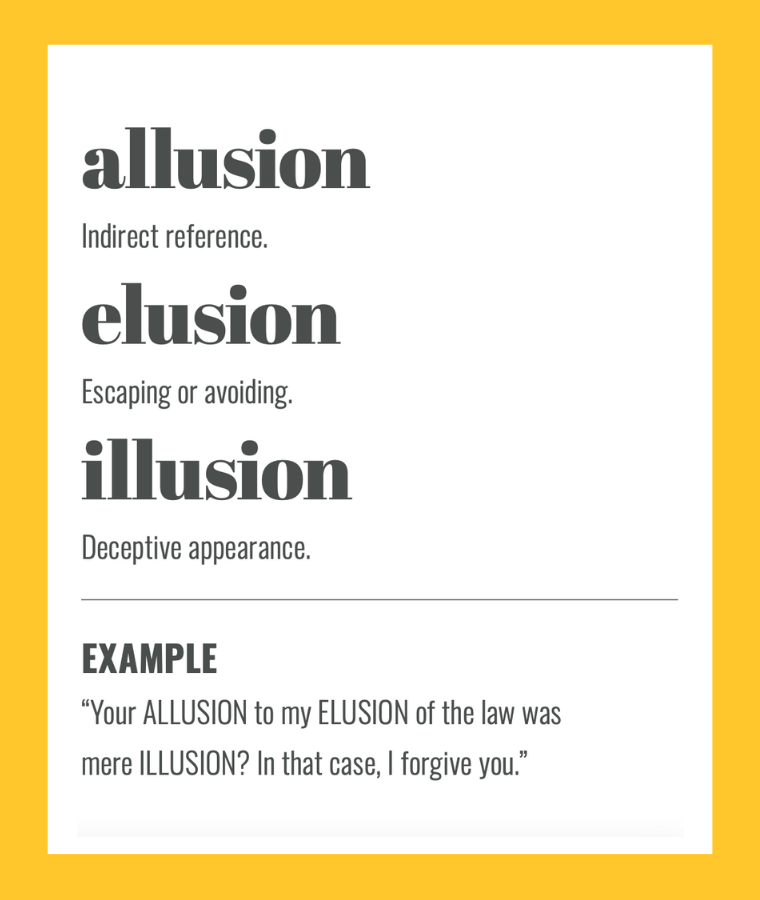
ALLUSION vs ELUSION vs ILLUSION: which is which? These spelling tips and usage examples will help you remember the difference
The words ALLUSION, ELUSION and ILLUSION are easy to confuse, given that they sound so similar – but there’s actually a world of difference in their meanings!
Here are my simple tips to remember the difference between the words ALLUSION, ELUSION and ILLUSION.
When to use ALLUSION
ALLUSION is a noun meaning an indirect reference. The verb form is ALLUDE.
You can use ALLUSION in a sentence like this:
“I noticed his tactful ALLUSION to the difficult situation with your client.”
When to use ELUSION
ELUSION is a noun meaning escape or avoid. The verb form is ELUDE.
To remember, think of the E of escape and ELUSION.
You can use ELUSION in a sentence like this:
“You handled that question well. Quite a tactical ELUSION!”
When to use ILLUSION
ILLUSION is a noun referring to a deception – often a visual one. To remember, think of the ‘i’ in ILLUSION and the ‘eye’ you use to view an optical ILLUSION.
You can use ILLUSION in a sentence like this:
“Come see! This optical ILLUSION is really trippy!”
Pro tip
Remember, while ALLUSION and ILLUSION are spelled with a double L, the word ELUSION – and the verb ELUDE – has only one L.
Now you know the difference between ALLUSION, ELUSION and ILLUSION you’ll know when and how to use phrases like ‘optical ILLUSION‘, ‘tactical ELUSION‘ and ‘tactful ALLUSION‘!
I hope my tips help you to understand and remember the difference between these commonly confused words.
Get more simple, memorable spelling tips in The Little Book of Confusables 1 + The Little Book of Confusables 2
My four-times award-winning books take the mystery out of misused words for just just £11.95. You’ll wonder how you managed without them!
2023 GOLD award winner at the eLit book awards.

ALLUSION vs ELUSION vs ILLUSION. Excerpt from The Little Book of Confusables by Sarah Townsend.
More than 1,000 misused words demystified
Master 1,000+ confusing words with the multi-award-winning Little Book of Confusables 1 + 2 – jam-packed with memorable, fun spelling and usage tips: from ACCEPT + EXCEPT and OPTIMAL + OPTIMUM, to BARE + BEAR and PURPOSEFULLY + PURPOSELY.
3) It’s a gold award winner!
This handy little book won GOLD in the 2023 eLit book awards, in recognition of its gorgeous design and all-round usefulness. Yay!
Tony R says:
No more asking your boss to “BARE with me”.
Yikes!
(Prefer to avoid Amazon? No worries! Treat yourself to a signed copy direct from me.)