Practice vs practise: spelling tips to help you remember
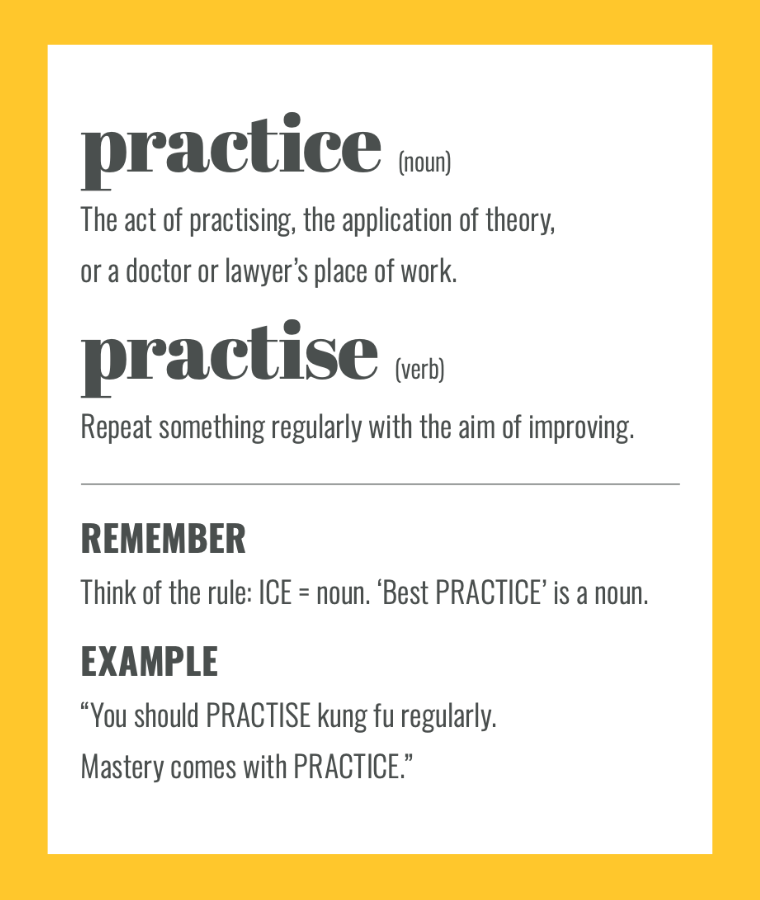
PRACTICE and PRACTISE are easy to confuse. The fact that both words sound the same trips people up time and time again.
Here are my simple tips to remember the difference between PRACTICE and PRACTISE.
(Important note: these tips don’t apply if you’re writing in US English, where both the noun and the verb are spelled PRACTICE.)
PRACTICE is a noun.
This is easy to learn when you remember that ICE is a noun.
“Mastery of any skill comes from plenty of practice.”
OR
“I have a meeting at my accountant’s practice.”
__
Bonus tip
If you know the trick for PRACTICE vs PRACTISE – remembering that ICE is a noun – you can apply the same C vs S spelling rule to other word pairs, like ADVICE and ADVISE or DEVICE and DEVISE.
__
PRACTISE is a verb. Use it like this:
“Have you remembered to practise your piano?”
OR
“It’s a good idea to practise your spelling.”
Want more writing tips?
For more language love, join my Clever Copy Club and get monthly updates direct to your inbox. Alternatively, email me, follow me on Twitter, connect on LinkedIn or like my page on Facebook.
Get more simple, memorable spelling tips in The Little Book of Confusables 1 + The Little Book of Confusables 2
My four-times award-winning books take the mystery out of misused words for just just £11.95. You’ll wonder how you managed without them!
PRACTICE vs PRACTISE. Excerpt from The Little Book of Confusables by Sarah Townsend.

More than 1,000 misused words demystified
Master 1,000+ confusing words with the multi-award-winning Little Book of Confusables 1 + 2 – jam-packed with memorable, fun spelling and usage tips: from ACCEPT + EXCEPT and OPTIMAL + OPTIMUM, to BARE + BEAR and PURPOSEFULLY + PURPOSELY.
Loved by writers and non-writers alike, these gorgeously accessible books have been described as “An absolute joy”, “The books you never knew you needed” and “Perfect for anyone who ever has to write anything!”.
BUY NOW
Complement vs compliment: spelling tricks to help you decide
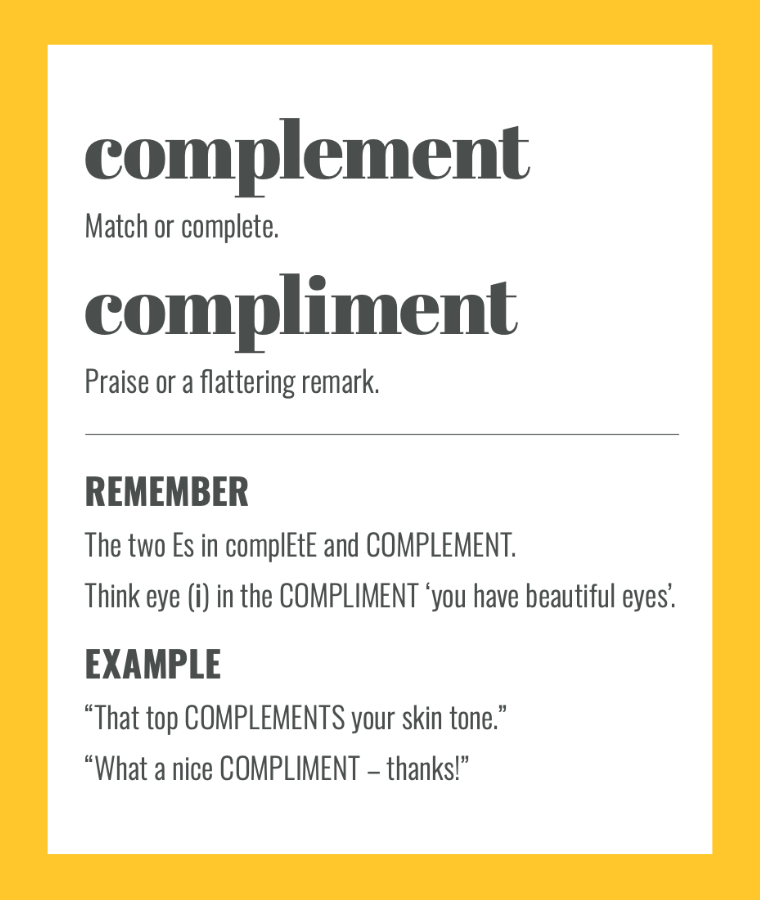
COMPLEMENT or COMPLIMENT: top spelling tips to help you remember the difference.
COMPLEMENT or COMPLIMENT – they sound the same but their meanings are very different.
So, what do these words mean – and how do you decide which spelling you need? It’s easy.
These simple spelling tips will help you decide whether you need the word COMPLEMENT or COMPLIMENT.
Complement
COMPLEMENT means to complete or match with something.
For example:
“This wine complements the dish.”
Remember the e of complete.
Compliment
Spelled with an i, a COMPLIMENT is a flattering remark or praise.
For example:
“You have lovely eyes” – think eye/i.
Complementary vs complimentary
When it comes to COMPLEMENTARY and COMPLIMENTARY, these meanings follow suit:
If something is complementary it completes the set, or matches…
“The room was furnished using complementary colours that matched the decor.”
…while a complimentary remark is a flattering statement.
“He was complimentary about my dancing.”
Note that the spelling complimentary has a second meaning. It also means free, like this:
“Help yourself to a complimentary drink”
I hope these tips help you to remember the difference between COMPLEMENT and COMPLIMENT.
Get more simple, memorable spelling tips in The Little Book of Confusables 1 + The Little Book of Confusables 2
My four-times award-winning books take the mystery out of misused words for just just £11.95. You’ll wonder how you managed without them!
COMPLIMENT vs COMPLEMENT. Excerpt from The Little Book of Confusables by Sarah Townsend.
More than 1,000 misused words demystified
Master 1,000+ confusing words with the multi-award-winning Little Book of Confusables 1 + 2 – jam-packed with memorable, fun spelling and usage tips: from ACCEPT + EXCEPT and OPTIMAL + OPTIMUM, to BARE + BEAR and PURPOSEFULLY + PURPOSELY.
Loved by writers and non-writers alike, these gorgeously accessible books have been described as “An absolute joy”, “The books you never knew you needed” and “Perfect for anyone who ever has to write anything!”.
BUY NOW
Licence vs license: top spelling tricks to help you get it right
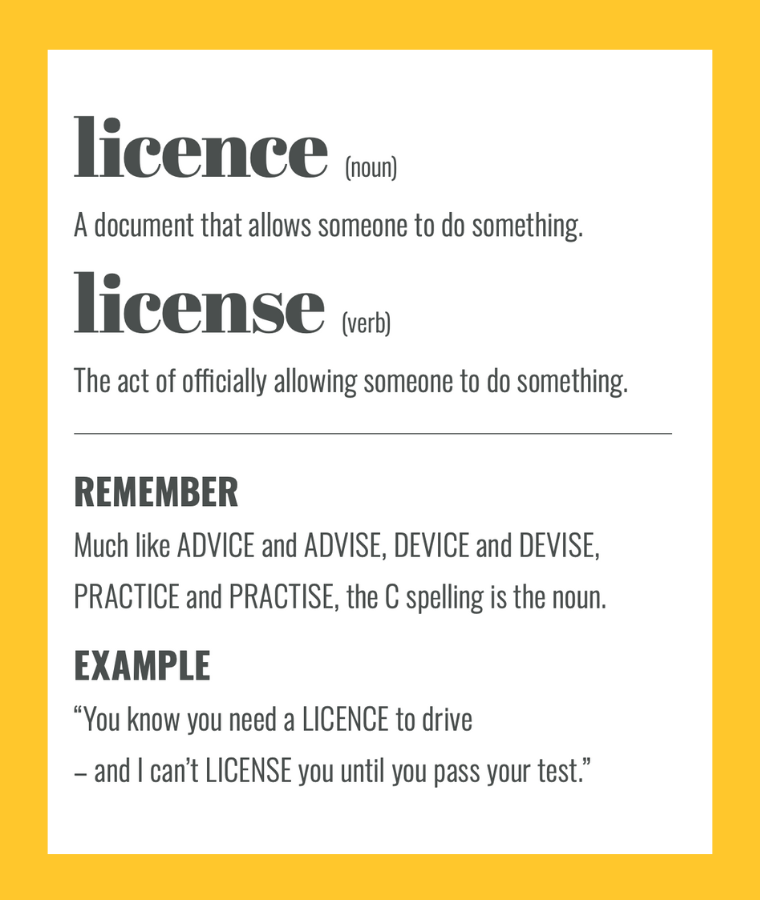
LICENCE vs LICENSE: simple spelling and usage tips to help you remember the difference
LICENCE and LICENSE are easy to confuse. The fact that both words sound the same trips people up time and time again.
Here are my simple tips to remember the difference between LICENCE and LICENSE*
When to use LICENCE
LICENCE is a noun.
You need a licenCe to drive a Car.
Also, remember that a licenCE is printed on paper, like a CErtificate.
When to use LICENSE
LICENSE is a verb that means to give permiSSion.
Remember the S in licenSe and permiSSion.
*Important note – in the US, both the verb and the noun are spelled LICENSE.
PRO TIP
If you know the trick for PRACTICE vs PRACTISE – remembering that ICE is a noun – you can apply the same C vs S spelling rule here.
You can also apply this spelling tip to other similar pairs, such as ADVICE and ADVISE or DEVICE and DEVISE.
Just remember, the suffix ICE means the word is a noun.
Demystify more misused words with The Little Book of Confusables 1 + 2
Get more simple, memorable spelling tips in The Little Book of Confusables 1 + The Little Book of Confusables 2
My four-times award-winning books take the mystery out of misused words for just just £11.95. You’ll wonder how you managed without them!
LICENCE vs LICENSE. Excerpt from The Little Book of Confusables by Sarah Townsend.
More than 1,000 misused words demystified
Master 1,000+ confusing words with the multi-award-winning Little Book of Confusables 1 + 2 – jam-packed with memorable, fun spelling and usage tips: from ACCEPT + EXCEPT and OPTIMAL + OPTIMUM, to BARE + BEAR and PURPOSEFULLY + PURPOSELY.
Loved by writers and non-writers alike, these gorgeously accessible books have been described as “An absolute joy”, “The books you never knew you needed” and “Perfect for anyone who ever has to write anything!”.
BUY NOW
Two become one: compound words and how to use them

In the process of writing a brochure for a financial services client, I found myself with a dilemma. Do I write healthcare, health-care or health care?
Ahh, those tricky compound words… are they one word, two words or hyphenated?
Let’s start at the beginning.
What is a compound word?
A compound word occurs when two or more words are joined to create a new or combined meaning.
There are three types of compound word:
- open compounds
- closed compounds
- hyphenated compounds
Open compounds, closed compounds and hyphenated compounds: what’s the difference?
What is an open compound word?
Open compounds are written as two separate words. Here are some examples:
- ice cream
- door frame
- full moon
- dining table
- coffee mug
- phone call
- test tube
- first aid
What is a closed compound word?
Closed compounds are written as one word, like this:
- sunflower
- toothbrush
- moonlight
- fireplace
- notebook
- flowerpot
- redhead
- teacup
What is a hyphenated compound word?
A hyphenated compound occurs when two or more words are joined by one or more hyphens. Here are some examples:
- self-confidence
- mother-in-law
- check-up
- train-spotter
- half-mast
- pre-dinner
- non-starter
- ex-husband
The tale of the incredible disappearing hyphen…
Many words that begin as hyphenated compounds become so commonplace that the hyphen ends up being dropped – it’s a natural part of the evolution of the English language.
For example, all these words started off with a hyphen (and some dictionaries still use one):
- online
- mindset
- proofreader
- secondhand
According to a 2007 article published by Reuters, the OED dropped 16,000 hyphens in its sixth edition of the Shorter Oxford English Dictionary.
Some hyphens disappeared from compound nouns, which became a single word (for instance, pigeon-hole became pigeonhole, chick-pea became chickpea and bumble-bee became bumblebee) while other compounds, such as ice cream and test tube lost their hyphen and became two words.
In the article, the dictionary’s editor, Angus Stevenson, explains that the hyphen’s demise reflects current usage: “We have been tracking this for some time and we’ve been finding the hyphen is used less and less.”
Care to make any predictions on what could be next? With the growth of online shopping, I predict that next-day – in the context of next-day delivery – will become nextday. Sure, it looks wrong now, but give it five years
Using hyphens in compound adjectives
When two words are joined to modify a noun (forming a compound adjective) and are placed before the noun, they’re usually hyphenated, but take care – when the same two words are placed after the noun, they don’t need a hyphen.
For example:
- “Benefit from a tax-free lump sum” BUT “the proceeds are tax free”
- “Fresh from our in-store bakery” BUT “you’ll find bread in store”
- “She has a long-term illness” BUT “her symptoms will improve in the long term”
Advanced tip
An exception to this rule applies when the compound adjective is formed using an adjective that ends -ly, in which case it’s always written as two separate words with no hyphen.
Here are some examples:
… a successfully applied formula
…a newly formed group
…a widely used tool
Compound words vs portmanteau words
So, is a compound word the same as a portmanteau*?
Nope. Here’s why.
Sometimes called a blend, a portmanteau is a new word that’s formed from part of one word and part of another, like this:
Brunch = breakfast + lunch
Sitcom = situation + comedy
Smog = smoke + fog
*According to the OED, Lewis Carroll was the first to use the term portmanteau in this way in Through the Looking-Glass (1871). Here, Humpty Dumpty explains to Alice the portmanteau word, in which “two meanings are packed up into one word”. (His description comes from portmanteau – a large bag – which is itself a blend of the words porter and mantle.)
Compound words in British English vs US English
In the process of researching this article, I came across many words spelled differently in different dictionaries. Generally speaking, British English dictionaries tend to be more cautious – clinging on to the hyphen (mouth-watering) when US English has dropped it (mouthwatering).
So, if you’re not sure of the current recommended spelling of a compound word, check your favourite online dictionary. Just don’t be surprised if they don’t always agree…
More than 1,000 misused words demystified
Master 1,000+ confusing words with the multi-award-winning Little Book of Confusables 1 + 2 – jam-packed with memorable, fun spelling and usage tips: from ACCEPT + EXCEPT and OPTIMAL + OPTIMUM, to BARE + BEAR and PURPOSEFULLY + PURPOSELY.
Loved by writers and non-writers alike, these gorgeously accessible books have been described as “An absolute joy”, “The books you never knew you needed” and “Perfect for anyone who ever has to write anything!”.
BUY NOW
8 quick and dirty tips to help you write better emails

Don’t outsource your brain to ChatGPT. Follow these simple tips to write better emails – and boost the impact of those everyday messages.
Hands up if you love writing emails?
Thought not.
Yet you probably write dozens of functional emails every day.
Before I share my advice for writing emails that get results, I’m going to be controversial: pick up the phone.
Sometimes it’s easier, quicker, and all-round more efficient to have a two-minute chat than it is to spend time struggling for the best way to give feedback, make plans, or express your feelings in writing.
Convinced email is the best method for what you need to say?
Then let’s crack on.
(Note: I’m not here to tell you how to write cunningly convincing sales copy – that’s a whole other post. Get in touch if you need help with that.)
1) Grab attention
The subject line is the place to summarise the content and objective of your message, so don’t leave it blank.
Be clear on what your message is about, right here.
And remember, your goal is to encourage your reader to click. What’s in it for them?
2) Start with a goal
How many times have you finished reading a long, rambling email only to realise you’ve no idea what the sender wants you to do? Pretty frustrating, eh?
Before you start writing, be crystal clear about your goal.
What action do you want your reader to take after reading your message?
This will help to focus your writing and write better emails.
3) Get to the point
Your readers are busy people – don’t waste their time. A little planning goes a long way.
Imagine you’re telling your customers about a launch event for a new product that could really help them. What do you need them to know?
As well as providing a teaser of the benefits of the product – to pique their interest – they’ll need to know where and when the event is taking place, whether it’s free or paid for, plus other information such as a link for directions and the fact that parking is free at the venue.
Think about summarising the key points of your message upfront.
Include the who, what, when, where, why and how in the first paragraph, if you can.
4) Keep it short
We’re all suffering from information overload. Your message needs to cut through the chatter – so keep it brief.
- Use short, punchy sentences and paragraphs.
- Make every word count. (See my 18 simple word swaps to help you ditch the waffle.)
- Avoid filler words that add nothing, like THAT, JUST, REALLY and VERY.
❌ “I JUST thought THAT I’d write to suggest THAT we meet up to discuss the project further.”
✅ “Let’s meet to discuss next steps.”
5) Keep it simple
- Use clear language and plain English.
- Avoid business speak, buzzwords and jargon. They’re meaningless to your customers and create a distance between you and your reader.
- As a general rule, if you wouldn’t say it in person, don’t write it in an email.
❌ “We would be delighted to assist you in this matter.”
✅ “We’d love to help.”
❌ “We apologise for any inconvenience caused.”
✅ “We’re sorry.”
6) Know your audience
The most powerful and persuasive emails are those that address the fears and desires of your audience – because it’s these that motivate them to take action.
Think of your writing as a one-to-one conversation with your audience. It’ll help you get inside their head, as well as getting the tone right.
As Nelson Mandela famously said, “If you talk to a man in a language he understands, that goes to his head. If you talk to him in his language, that goes to his heart.”
7) Include a clear call to action
Make it blindingly simple for your reader to take action.
Avoid giving them too many choices – information overwhelm is one of the main reasons emails go unanswered.
Instead, guide them gently but firmly to act.
- Need to book a conference call? Suggest a couple of alternative times for the recipient to choose from.
- Providing a quote for a piece of work? Tell them you’ll follow up with a phone call in two days.
- Want your reader to book tickets for your event? Include a link to the booking page.
8) Check, check and check again
Check your language, spelling and punctuation. Read what you’ve written out loud – or get your computer to read it to you. You’d be surprised how easy it is to hear mistakes you can’t see.
Don’t rely on spellcheck as a substitute for proofreading. Spellcheck doesn’t know if you’ve repeated a word, or left one out; neither does it know if you’ve used the right word.
Beware of homophones – words that sound the same, but have different spellings and different meanings – such as:
- your, you’re
- to, too, two
- there, they’re, their
- sight, site
- board, bored
When it comes to these tricksy words, my Little Book of Confusables 1 + 2 have your back.
For just £11.95, my four-times award-winning books take the mystery out of over 1,000 misused words with fun, memorable tips that’ll help you avoid embarrassing mistakes.
In summary…
Keeping your audience and your goal in mind from the off will help you write better emails. You’ll soon start getting better results from those everyday messages.
Let me know how you get on!
More than 1,000 misused words demystified
Master 1,000+ confusing words with the multi-award-winning Little Book of Confusables 1 + 2 – jam-packed with memorable, fun spelling and usage tips: from ACCEPT + EXCEPT and OPTIMAL + OPTIMUM, to BARE + BEAR and PURPOSEFULLY + PURPOSELY.
Loved by writers and non-writers alike, these gorgeously accessible books have been described as “An absolute joy”, “The books you never knew you needed” and “Perfect for anyone who ever has to write anything!”.
BUY NOW

