How to win at social media without losing your mind

We freelancers have a love–hate relationship with social media.
On the one hand, it’s a vital source of connection, information, and even business. On the other hand, it’s a giant pain in the backside and a sinkhole that swallows up wasted hours doing god-knows-what when we should be nailing those deadlines.
What’s the secret to making social media work for you, without losing your day – and your mind?!
We all know where we’d be without our online friends: out in the cold, isolated world of working alone in our sorry little home offices, is where. Those Facebook groups, Twitter chats and timelines provide everything from office banter to “your-client-did-WHAT?!” support.
They’re life support for freelancers.
But, social media comes with a warning.
If you’re not disciplined – hell, even if you are – social media can be a dangerous distraction.
It’s also an enormous source of pressure. It sits on your devices like a digital conscience, taunting you with all the things you should have done:
- “Have you updated your LinkedIn profile recently? You know you should’ve asked that client for a recommendation by now!”
- “Why haven’t you shared something fresh and funny on Twitter this morning? What’s wrong with you?”
- “C’mon, you know there’s no point even having a Facebook page these days unless you’re prepared to advertise!”
- “Your Instagram grid is looking tired and you haven’t posted for days… surely you have something to share?!”
Social media wants a piece of you. And it wants it now.
But listen up!
Unless you have literally no work – and if that’s the case, I humbly suggest you have bigger problems than how to manage your social media presence – stop trying to do it all!
You’re not omnipotent. Or is it omnipresent? Maybe both.
The secret to social media success is to pick no more than two platforms and do them really well.
There’s nothing wrong with establishing a profile on every platform – it certainly won’t harm your Google ranking. But as long as your information is up-to-date and relevant, and you check in regularly to respond to any messages from potential clients, don’t be afraid to leave it at that.
So, which platforms should you choose?
Good question.
It makes sense to hang out where your clients are. If you’re a B2B business, LinkedIn and Twitter are likely to be the best fit, while B2C freelancers will have more luck finding their audience on Facebook, Instagram or Pinterest.
Run your social media – don’t let it run you
Once you’ve picked your platforms of choice, here are a few tips to help you get the best out of your social media marketing.
LINKEDIN
Whatever business you’re in, you should have a personal profile on LinkedIn. Think of it as a virtual CV that showcases your skills and experience. You don’t have to spend time engaging, liking and posting, but at least be present.
If you want to do LinkedIn well, start by optimising your profile. There are plenty of people out there – experts such as Jonathan Pollinger or John Espirian, for starters – who’ll happily tell you how to do it.
Once you’re set up and ready to roll, check in at least once a day:
- Like and comment on relevant posts
- Ask your clients for recommendations (I had 109 at the last count)
- Congratulate people on their new jobs
- Create your own thought-provoking posts
- Share long-form articles
…and remember to keep your profile up to date.
INSTAGRAM AND PINTEREST
Great social media content doesn’t require expensive gear. Once you know your audience and you’ve got to grips with the basics, get busy with your smartphone camera and start creating engaging posts that reflect your personal brand.
Free tools like Snapseed and Afterlight are great for editing your pics, while apps such as Canva and Spark Post help you combine text and images for eye-catching posts.
Experiment to find the hashtags and posts that work for your audience, and take inspiration from businesses that do Instagram and Pinterest well (but no outright copying – remember, your brand should be unique to you).
TWITTER
Twitter gets a bad rap; commonly from people who use it to advertise, then slate it for being a waste of time. Go figure!
If they dialled down the desperate, and started engaging, informing, and entertaining they’d have a very different experience.
So, be real. Build relationships. Show your personality. Share tips, tricks and advice. Reply to questions. And be nice!
If you carefully curate who you follow (god knows there are some hate-filled people out there, and no one needs that) Twitter can be a great source of inspiration and support.
FACEBOOK
I remain unconvinced about Facebook pages as a tool for service businesses, but if you’re in the business of selling cupcakes, jewellery, or some other photo-friendly product, it can work really well.
Keep your page up to date, and aim to post daily. Funnies and thought-provoking questions traditionally get good engagement, though it’s getting harder to achieve without paying to advertise (and that’s a whole other blog post).
If you combine this advice with the discipline to check in on social just a couple of times a day, you’ll soon notice the difference it makes to your productivity and wellbeing.
This article was first published on Digital Drum.
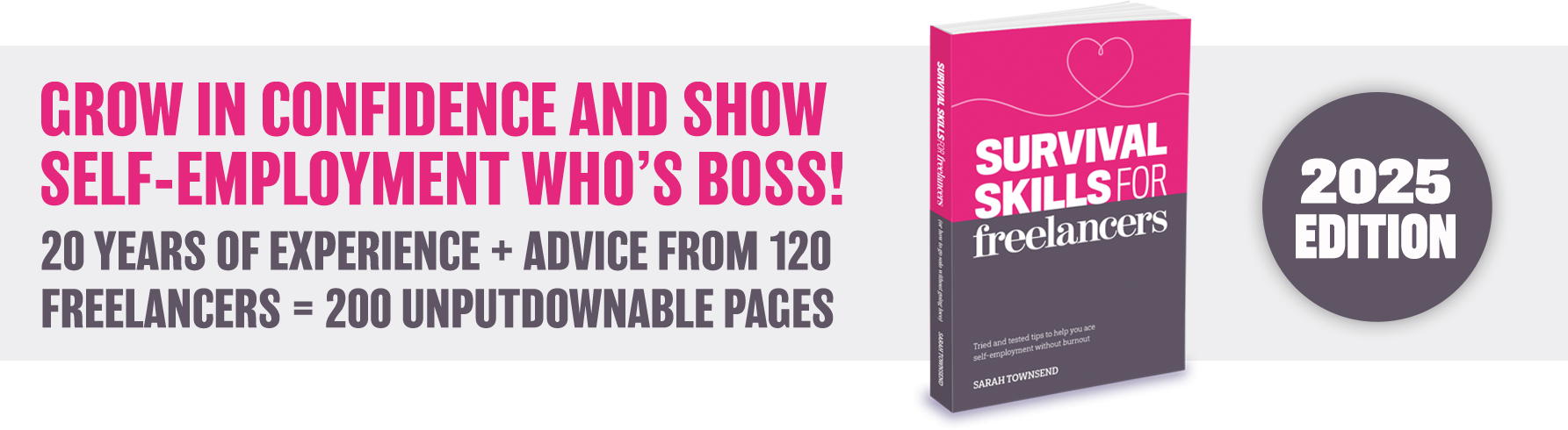
Grow in confidence and show self-employment who’s boss!
With 20 years of freelance experience + advice from 120 entrepreneurs, Survival Skills for Freelancers is your secret weapon to get more enjoyment from self-employment.
The 2025 edition is out now, with a new lower price (£11.95), updated stats, links, references and resources, and all-new advice from another 20 successful freelancers.
Get your copy in paperback, Kindle or Audible today.
BUY NOW
Writing the book on freelancing… quite literally!

Fellow freelance copywriter, Nigel Graber interviewed me on the launch day of my guide to self-employment – Survival Skills for Freelancers – and shared the post in the Copywriter Stories segment of his website. Did he get any sense out of me on the most exhilarating day of my career?! Here’s the interview…
“I always thought legendary Cotswolds copywriter and editor Sarah Townsend wrote the book on freelancing. But now she’s actually gone and done it. It’s even been released on National Freelancers’ Day. Let’s turn some pages.”
You can’t imagine. It’s like a milestone birthday and Christmas all rolled into one. Everything has been leading up to this day for so long, and I can’t wait to see how well Survival Skills for Freelancers performs in the real world!
Can’t say I’m quite as excited about the inevitable adrenaline crash that will follow, but hey – it’s all good!
Did you always plan for publication on National Freelancers’ Day?
I did. There are five million self-employed workers in the UK right now, and over two million of them are freelancers. That’s a lot of us going it alone with very little support.
I needed a publication date to focus on, and National Freelancers’ Day seemed like the perfect date.
What inspired you to write it?
Last year I wrote a blog sharing the things I’d learned from 20 years of freelance life. It proved to be by far my most popular post, and generated an overwhelmingly positive response.
People loved the honest, no-frills advice, combined with the heart-on-your-sleeve confessions.
I realised I could use my experience to create an indispensable guide to the highs and lows of self-employment. A book that 29-year-old me would have loved at the start of my own freelance journey.
Does it deal with freelancing in general or is there a bias towards copywriting and editing? Is it as useful for, say, a freelance web designer as it is for a copywriter?
It’s very much aimed at freelancers in general. While the anecdotes and stories relate to my experiences as a freelance copywriter, the advice is relevant to anyone who’s already self-employed, or who’s thinking of going solo.
What else can we expect?
It provides advice on the issues we all experience as freelancers, such as:
- Strategies to deal with isolation
- Knowing your worth – and what to charge
- Trusting your instinct, and learning to say no
- Achieving balance and avoiding burnout
- The importance of investing in your business
- The qualities that help you survive and thrive as a freelancer
It’s a crowded market. What makes your book different?
Think of all the books you’ve ever read on copywriting. Do you ever say to yourself, “I enjoyed Copywriting ABC, but it was just like Copywriting 123!”? I doubt it. That’s because no two journeys, no two voices, and no two approaches are the same.
So yes, there are other books on freelance life out there, but none quite like this one.
Survival Skills for Freelancers doesn’t feel like a conventional business book.
Yes, it’s packed full of tried-and-tested strategies and practical advice – but it’s more than that. I wanted it to feel collaborative and supportive, like I was there on the journey with you.
Fellow copywriter Anna Gunning sums it up as being, ‘like having your own personal business mentor’, while my first ever Amazon review said, ‘Reading this book was like settling down with a good friend for a business chat’.
I teared up when I read that because that’s exactly how I wanted it to feel.
How long did it take to write? And how many hours per day?
I had the idea at the end of last year and I’m publishing in mid-June, so I guess it took about eight months from start to finish.
I know people who’ve spent years conceiving, writing and publishing their books but that wouldn’t have worked for me. The only way I know how to do something is full on, 100 miles an hour.
I’ve lived and breathed the book, the publishing process and the marketing for the past four months – possibly longer.
It’s ironic that it’s about balance and boundaries, because – particularly in the past couple of months – mine have gone out of the window.
Yes, having a deadline has kept me laser focused, but I’ve found myself so engrossed in, and energised by, the writing, editing and sheer learning involved that I may, occasionally, have forgotten to look after myself. I imagine I haven’t been that easy to live with recently!
Did you have to put your day job on hold?
I set myself the goal of getting the first draft written by the end of January, and I gave myself a month off client work so that I could get it done. So yes, I did.
For the past few months I’ve been juggling client work and book work. That’s been tough. Really tough. But I am so happy with the end result that the long days have been worth it.
What did the writing process look like?
Actually, much the same as any copywriting job, but on a far grander scale.
I’m (generally) hyper organised, and I think you have to be to make a success of this process.
I started with thoughts, ideas and a structure. I wrote, I edited, I revised the aforementioned structure… rinse and repeat.
It’s like any writing job, I think. You start with all the elements and gradually fit them together in the right order, like a giant jigsaw puzzle.
Was there much research involved or was it all stored in your head?
It was a pretty good balance of stuff I needed to research and stuff I knew inside out. It’s very much written from the perspective of my own experience, so that bit was easy!
Copywriters are a friendly bunch. Did you get much help from the community?
They really are. Without the support of the freelance community, Survival Skills for Freelancers would be a very different book!
Each chapter ends with quotes and opinions from freelancers on everything from imposter syndrome and what to charge to the importance of connection and when to say no.
It also includes mini case studies from copywriting legends such as Nick Parker and Graeme Piper.
Many of my copywriter friends are helping me to spread the word about the book because they believe in the importance of what I’m trying to achieve. They’ve been sharing pics of the book and reminders of the launch date all week. They’re amazing! So supportive.
What made you go down the self-publishing route?
I knew exactly what I wanted the book to look and feel like, and exactly how I wanted it to be structured. I would have struggled with not having complete control over cover design and content, so I knew from day one that I would self-publish!
What effect would you like the book to have?
I’d like it to help people get more enjoyment from self-employment.
There’s a lot to love about freelance life, but it can be tough, too!
I’ve been through a lot in my 20 years as a freelancer. I’ve done things that worked, and things that didn’t, and it took me a longtime to get to a point where I felt like my own success was sustainable.
Readers can use what I’ve learned to fast-track their own freelance success and make fewer costly, time-consuming mistakes in the process.
What advice would you give any other aspiring authors?
Acknowledge that it’ll take a lot of time – and that there’s a lot more to the process than just being able to write.
Within a month of getting started, I had an A4 folder that was two inches thick with information: print quotes, freelancer quotes, research, resources, useful articles, marketing tips…
And I have over 400 documents in the Survival Skills for Freelancers folder on my laptop!
If you’re planning on self-publishing, be prepared to do your research – there’s heaps of information out there – and don’t be afraid to ask colleagues who’ve been through the process for advice.
Or invest in one of my one-to-one book coaching sessions!
Brilliant. Finally, how can we get hold of a copy?
Survival Skills for Freelancers is available from Amazon worldwide.
[Update: the new 2025 edition is now available in paperback and Kindle formats, while the original is available on Audible.]
Grow in confidence and show self-employment who’s boss!
With 20 years of freelance experience + advice from 120 entrepreneurs, Survival Skills for Freelancers is your secret weapon to get more enjoyment from self-employment.
The 2025 edition is out now, with a new lower price (£11.95), updated stats, links, references and resources, and all-new advice from another 20 successful freelancers.
Get your copy in paperback, Kindle or Audible today.
BUY NOW
6 super-simple work from home tips from a veteran homeworker
As a freelance copywriter, I’ve worked from home for 25 years.
I’ve been there, done that, and got the scars to prove it. And, as a single parent for 15 of those years, I’ve learned to juggle kids, home and work without totally losing control.
(Most of the time, at least!)
A whole new world…
The world changed in 2020 when tens of thousands of employees who were used to the accountability, buzz and connection of office life found themselves working from home for the first time.
Today, more jobs than ever are either permanently home-based or hybrid – featuring a blend of home and office-based working.
If you’ve never worked from home before, you may feel out of your depth.
- How do you juggle work and home life?
- What about boundaries?
- How do you focus?
- What about dealing with isolation?
The following work from home tips for newbie homeworkers are adapted from my much-loved guide to self-employment – Survival Skills for Freelancers. I hope you find them helpful.
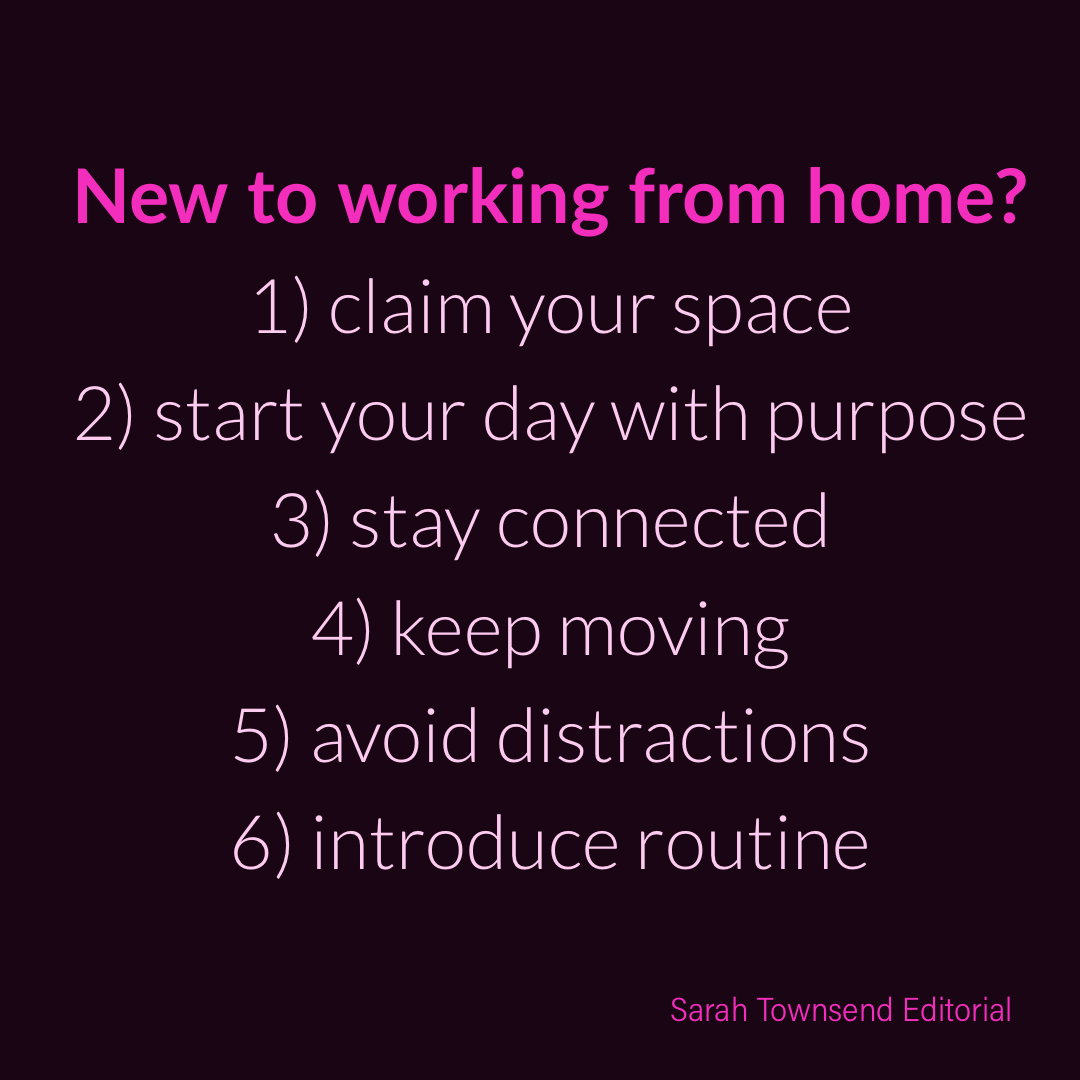
6 simple work from home tips
1. Claim your space
Not everyone is lucky enough to have a spare room they can use as a home office.
Wherever you decide to work from, set some rules around work-free zones for the sake of your family and relationships.
A supportive, adjustable chair, good natural light, a clutter-free table or desk and a door you can close at the end of the day are a bonus.
2. Start your day with purpose
Get up at your usual time. Shower and get dressed, even if you don’t feel like it. (Ban the thought of working in your pyjamas.)
Eat a decent breakfast away from your laptop.
Spend the equivalent of your commuting time reading, exercising, catching an inspiring podcast or listening to music that lifts your mood.
3. Stay connected
Working alone can be isolating – however independent or introverted you are.
Think about joining a Facebook group of likeminded people for support and advice.
There are hundreds of groups out there, based on geographical location, job type or interest.
Experiment to find a group that feels right. Choose one that focuses on the positive, rather than the negative and cynical, which can drag you down.
Or set up an accountability group of colleagues or peers for support, accountability and to help you stay on track.
Use the group chat facility on WhatsApp or Messenger for daily updates and organise a weekly (monthly or fortnightly if you prefer) video call to stay in touch.
4. Keep on moving
Too much sitting is bad for us – particularly if you’re hunched over a laptop, so build regular stretching, standing and movement into your day.
If you have an activity tracker or smartwatch, set it to give you regular reminders to move.
(My Apple Watch is great for this. It even gives me regular reminders to breathe deeply. Sounds obvious but it really does help me calm down on a stressful day.)
Take your phone calls standing up. Pace circuits of your home if you can.
If you’re lucky enough to have a sit–stand desk, try standing up for video calls. It’s energising and good for your physical health. I love it!
Build time into your day for a walk around the block.
Fresh air and exercise are good for focus, productivity and wellbeing – and the thinking time away from your desk (or kitchen table) helps with problem solving and clearing mental blocks.
5. Avoid distractions
Turn off the TV, switch off pop-up notifications and use an app blocker (I use Opal) to stop you checking social media and email every five minutes.
(You know you do it.)
Set an email auto response saying you check your messages just a couple of times a day. The world won’t end while you’re focusing on the task in hand – whatever that may be.
Do household chores in short bursts, if at all.
Unloading the dishwasher or sticking on a wash while you wait for the kettle to boil is a good use of time, and stops you ending the working day to find a pile of chores waiting for you.
6. Introduce routine
It’s easy for work and home life to blur if you don’t have clear boundaries.
Start and end your day at a set time – just as you would if you were going into the office.
Schedule time for lunch, and an outdoor break for fresh air and exercise.
Consider using the Pomodoro time management technique, which splits your day into 25-minute blocks of focused activity with five-minute breaks after each burst.
Finally…
Use these super simple work-from-home tips as a starting point and you’ll find life as a newbie homeworker a lot less daunting.
Grow in confidence and show self-employment who’s boss!
With 20 years of freelance experience + advice from 120 entrepreneurs, Survival Skills for Freelancers is your secret weapon to get more enjoyment from self-employment.
The 2025 edition is out now, with a new lower price (£11.95), updated stats, links, references and resources, and all-new advice from another 20 successful freelancers.
Get your copy in paperback, Kindle or Audible today.
BUY NOW
Tips and tricks for a happy, healthy freelance life
My live interview with ProCopywriters – the professional association for copywriters in the UK – focused on the wellbeing aspects of freelance life…
…the ups and downs, the importance of boundaries and balance, the need for community and the importance of asking for help. All topics covered in my guide to freelance life, Survival Skills for Freelancers.
Ready? Let’s go.
Q Welcome to #ProCopyChat, Sarah! Tell us a bit about yourself.
A Hello! I’ve been a freelance marketing copywriter for 20+ years.
I love freelance life, but it took me the best part of 15 years to get good at the business end of it – and I made a lot of mistakes along the way.
I’ve written a book for freelancers – Survival Skills for Freelancers – to share my experience and help freelancers get more enjoyment from self-employment.
Q Sounds great! Can you tell us a bit more about the book for freelancers, and how it came about?
A Sure! Most of us decide to go freelance because we have a skill we want to share. In most cases, we’re utterly unprepared for how relentless the business end of freelance life can be – let alone the challenges freelancing can present to our mental health.
The book is designed to help freelancers become more successful by working smarter, not harder – and to learn from the things I’ve done that worked, as well as the things that didn’t.
It’s a combination of real-life, heart-on-your-sleeve anecdotes and tried and tested advice – all backed up by research, resources and quotes from 120 freelancers.
And now there’s a brand new 2025 edition.
Q How and why did you become a freelancer?
A I was working as an editor and account manager for a magazine publisher in Clifton, Bristol when I became pregnant.
I knew I didn’t want to go back to full-time work, and liked the idea that I could fit freelance work around family life. My employer promised to provide work to keep me going, so it seemed like a good decision.
I worked on my brand and sent out cold enquiries while I was on maternity leave, then worked three days a week while my daughter was at nursery.
My business grew as my family grew. And here I am – now with grown-up kids – still loving freelance life.
Q What do you believe are the most important qualities to make it as a freelancer?
A I don’t think you have to be a particular type of person to make a successful freelancer. There are always exceptions. But there are traits that help and others that hinder.
Skills and talent alone aren’t enough to guarantee success.
It helps if you’re determined, motivated, organised, ambitious, disciplined, confident, outgoing, flexible, reliable, personable, patient, thick-skinned… it’s a pretty long list!
Q What would you say to anyone reading that list who knows they don’t have all those qualities?
A Don’t worry too much. No one will tick off every quality on the list.
If you don’t have any of them, you might struggle more than most – but I’m neither patient nor thick-skinned and I haven’t let that hold me back!
Q Isolation is a real challenge for many freelancers. How do you recommend we deal with it?
A It absolutely is. So many of the freelancers I talk to loved the idea of working from home but found themselves completely unprepared for the loneliness! It’s easy to feel like no one understands what you’re going through – but they do!
Connection is vital when you’re freelance, and there are three fundamental ways to find it:
- online communities (like this one, or the many Facebook groups that exist for freelancers)
- networking groups and events
- coworking spaces and coffee shop working
The great thing about the online community is that it spills out into real life with events and conferences.
It’s possible to make great real-life friendships with people who are in the same boat as you.
People who really get it.
Q How have you dealt with the unpredictability of freelance life over the years?
A You never really get used to the peaks and troughs of freelancing.
Quiet spells are pretty rare for me now, but I still keep a list of projects I want to work on, blogs I want to write and books I want to read, in case work drops off.
Having too much work can be just as problematic as not having enough, though.
Either you work yourself into the ground, boundaries go out the window and your mental health suffers as a result, or you can do what I do – have an arrangement with a small team of trusted freelancers who you can pass work on to when you need to.
You’re solving the problem for your client and helping another freelancer into the bargain.
Q There’s a lot of talk about imposter syndrome. Do you suffer from it, and how do you deal with it?
A Yes, absolutely – even now.
Self-doubt can hold you back if you let it, so don’t let the fear of failure get in your way. Celebrate your wins – even the little things – so you can see how far you’ve come. And don’t compare yourself to others!
It’s easy to put things off if you keep striving for perfection but there’ll never be a right time and you’ll never be completely prepared. Just do the best that you can do.
Sometimes good enough really is good enough.
Q You have a chapter in your book about avoiding burnout. Can you share a few tips here?
A Freelancer burnout is something I feel very strongly about and I go into a fair bit of detail about it in the book.
In a nutshell, it’s about setting boundaries, asking for help, learning to say no, and taking simple steps to look after yourself.
It takes time to learn what works for you, but most people need fresh air, exercise, a balanced diet and decent quality sleep as a minimum.
It sounds obvious, but if you’re not feeling your best you can’t do your best work.
Above all, it’s important to know that it’s okay not to be okay.
You’re not alone, you’re not the only one who feels this way, and you are perfectly normal. Respect your boundaries, prioritise your own wellbeing, and keep talking!
Q Where can we get hold of your book for freelancers?
A The 2025 edition of Survival Skills for Freelancers – which busts the eight myths of freelance life – is available on Amazon worldwide in paperback and Kindle. The original 2020 edition is still available on Audible.
Grow in confidence and show self-employment who’s boss!
With 20 years of freelance experience + advice from 120 entrepreneurs, Survival Skills for Freelancers is your secret weapon to get more enjoyment from self-employment.
The 2025 edition is out now, with a new lower price (£11.95), updated stats, links, references and resources, and all-new advice from another 20 successful freelancers.
Get your copy in paperback, Kindle or Audible today.
BUY NOW
Social media and website copy for a Cotswold facial aesthetician
Kim Brunwin has helped clients in Gloucestershire and around the Cotswolds feel better about their appearance since 2008.
Having been trained by Nouveau Contour – UK pioneers in permanent makeup – and some of the world’s best permanent makeup artists, Kim offers non-surgical facelift treatments from world-leading beauty-tech companies, CACI and Venus, as well as permanent makeup application.
Kim freelanced at a number of beauty salons across the Cotswolds before opening her own studio at Westend near Stonehouse in 2014.
The need
Kim helps women of all ages to look their best – boosting their confidence and self-esteem in the process. Her permanent makeup and non-surgical facelift treatments are designed to enhance her clients’ natural beauty and leave them feeling fabulous – and it’s this transformation that Kim loves most about her job.
Over the years, her gentle manner, effective treatments and technical perfectionism have earned Kim a large family of dedicated clients who’ve put their trust in her and the treatments she offers.
Kim’s original website was desperately in need of improvement. The budget template BT site, which had cost her £100 almost 11 years ago, had limited copy and graphics, wasn’t SEO optimised, and didn’t reflect Kim’s professional, successful business.
Though her business was already thriving, Kim wanted to raise awareness of the new, world-leading facial aesthetic and body-shaping treatments she had introduced, and to attract the new clients that would help to keep her business fresh.
The solution
Kim’s career as a facial aesthetician was thriving, but her website hadn’t kept up. She knew she needed a new website, and while she’d already hired a web designer and developer, she hadn’t decided whether she wanted to write the site herself or use a copywriter.
I had met Kim three years earlier when she was recommended to me for permanent makeup. We often chatted about my work, and the ways in which professional copywriting had helped my clients to grow their businesses and become more successful. It was only natural that we would meet to discuss her aims for her new website and to allay any concerns she had about the process of working with a copywriter.
Kim was keen to maintain her own voice and personality across the site, and I reassured her that a good copywriter provides a clearer and more articulate version of the client’s own voice.
I explained the importance of telling her story to communicate her capability and credibility, as trust is vital in the beauty industry. I wanted to focus on the wellbeing benefits of the treatments she offers, such as improved self-esteem and confidence.
The results
The resulting website copy clearly showcases the permanent makeup, facial aesthetics and body-shaping treatments – such as Venus Freeze and CACI Synergy – that Kim offers.
It provides reassuring answers to clients’ questions, as well as confidence and trust in the skills and qualities that make Kim stand out from the competition.
Since her new site went live, Kim has had hundreds of enquiries from all around the Cotswolds, and as far afield as Cornwall and Northampton. She’s converted these enquiries into new clients, and is regularly booked solid for up to three months in advance.
Having experienced the success of her new website, Kim hired me to work on the copy for her LinkedIn profile, and we’re now in discussion about creating a Facebook page – an idea that’s on hold while the new enquiries keep flooding in, as Kim knows the only way she can cope with the impact of even more new clients is to employ someone!
My work with Kim is a great example of how investment in professional copywriting can strengthen and develop a personal brand, and help talented individuals take their business to the next level.
In the client’s words…
“Sarah has been the most amazing find! I had spent far too long struggling to create the copy for my business website when I was lucky enough to hear about Sarah’s brilliance as a copy writer and asked if she could help me.
“Sarah transformed my website, bringing it to life and was a delight to work with. I’ve had a massive increase in new clients since my new website went live, which is wonderful.
“I was very impressed with Sarah’s marketing knowledge, how full of ideas she was and how quickly she had a grasp of my business and who my clients are. Sarah is a true genius at what she does and I feel so lucky to have found her. Thank you Sarah!”
Kim Brunwin
www.kimbrunwinaesthetics.co.uk

Want your words to be less BLAH BLAH and more TA-DA?
Book a FREE 20-minute discovery call
And let me take care of your words while you take care of business.
BOOK NOW