

Less vs fewer. A simple tip to get it right every time
There are two types of people – those who are irritated by supermarket Five items or less signs (Fewer! It should be FEWER!) and those who don’t know the difference. Do you know the super simple tip to tell them apart?
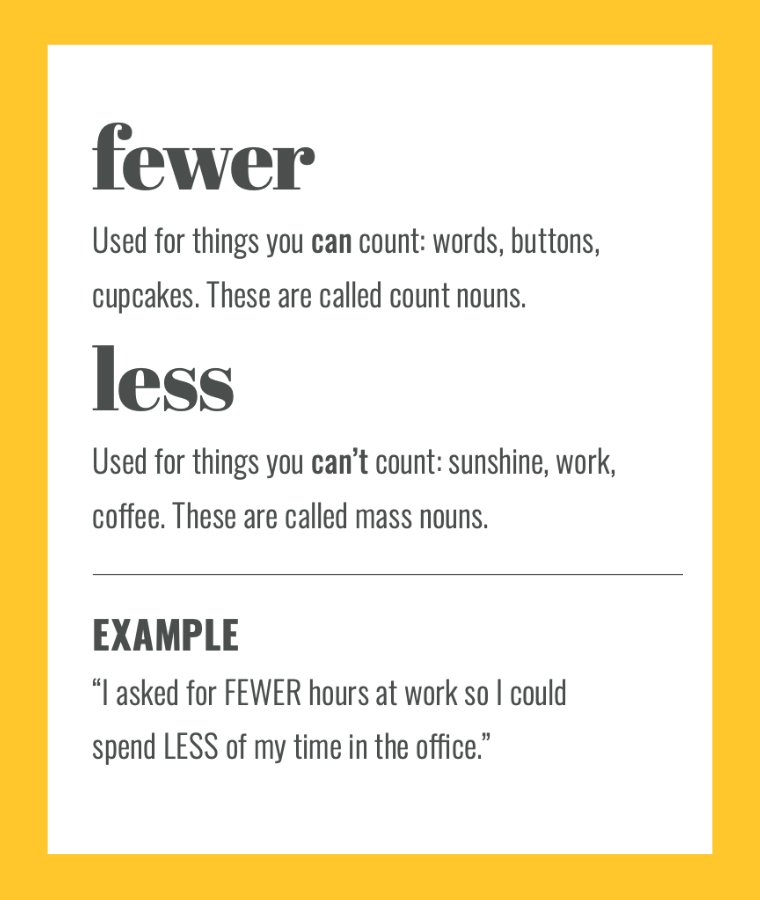
Use LESS for things you can’t count:
- less sunshine
- less work
- less coffee
Use FEWER for things you can count (like the items in your shopping basket):
- fewer words
- fewer buttons
- fewer cupcakes
So there you go. If you can count it, use FEWER. If you can’t, use LESS.
More tips = fewer mistakes + less confusion.
Bonus tip
Once you know that things you can count are called ‘count nouns’ and things you can’t count are called ‘mass nouns’ you can apply the same logic to MANY and MUCH.
Use MANY for things you can count, and MUCH for things you can’t.
For example:
- Using too many words can confuse your message.
- Too much confusion can prevent customers from choosing your business.
Get more simple, memorable spelling tips in The Little Book of Confusables 1 + The Little Book of Confusables 2
My four-times award-winning books take the mystery out of misused words for just just £11.95. You’ll wonder how you managed without them!
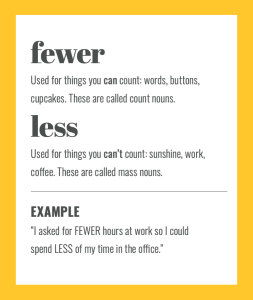
LESS vs FEWER. Excerpt from The Little Book of Confusables by Sarah Townsend.

More than 1,000 misused words demystified
Master 1,000+ confusing words with the multi-award-winning Little Book of Confusables 1 + 2 – jam-packed with memorable, fun spelling and usage tips: from ACCEPT + EXCEPT and OPTIMAL + OPTIMUM, to BARE + BEAR and PURPOSEFULLY + PURPOSELY.
13 common confusables and how to get them right first time
The English language contains numerous words that sound alike but have different meanings. They’re known as homophones and they’re easily confused when writing.
Here are some of the most commonly confused words, together with tips for getting them right first time. Which trips you up?
Its/it’s
ITS describes something that belongs to IT:
“The dog chased its tail”
IT’S is a contraction of IT IS or IT HAS:
“It’s going to be sunny”
You’re/your
YOU’RE is always a contraction of YOU ARE:
“You’re going to be late”
YOUR describes something that belongs to you:
“Remember your wallet”
They’re/their/there
THEY’RE is always a contraction of THEY ARE:
“They’re going to be late”
THEIR describes something that belongs to them:
“They forgot their tickets!”
THERE is a place. Think ‘here’ + T:
“Over here! No – over there!”
They’ll/there’ll
THEY’LL is a contraction of THEY WILL:
“They’ll be late”
THERE’LL is a contraction of THERE WILL:
“There’ll be trouble”
Who’s/whose
WHO’S is a contraction of WHO IS or WHO HAS:
“Who’s tried the new restaurant?”
WHOSE indicates that something belongs to someone. Try replacing it with WHO IS or WHO HAS. If it doesn’t make sense, use WHOSE:
“Whose restaurant is it?”
Stationary/stationery
STATIONARY means ‘not moving’. Remember AR, as in parked car:
“The train was stationary”
STATIONERY is paper, pens and other office supplies. Remember E for envelopes:
“Please bring your own stationery”
Affect/effect
AFFECT is a verb meaning ‘influence’ or ‘make a difference to’:
“The rain affects my hair”
EFFECT is most commonly a noun meaning ‘result’:
“The effect of the rain is wet hair”
Complement/compliment
COMPLEMENT means complete, match or add a little extra. Remember E for extra:
“That top complements your eyes”
COMPLIMENT praise or a flattering remark, such as, “You have lovely eyes” (think eyes = i).
Always ‘compliments slip’ and ‘with compliments’.
Wonder/wander
WONDER means to ponder, or to be curious:
“I wonder how she got on”
WANDER means to drift around:
“I like to wander around the gardens”
Accept/except
ACCEPT means receive:
“Please accept my apologies”
Except means apart from, or excluding (think EX):
“Have any chocolate you like, except the caramels”
Practice/practise
PRACTICE is a noun – think ICE:
“Have you done your piano practice?” or “We refer to best practice guidelines”
PRACTISE is a verb – think IS:
“You need to practise”
Principal/principle
PRINCIPAL means main or chief. Remember ‘pal’:
“The college principal”
PRINCIPLE is a fundamental truth or rule:
“A matter of principle”
It also means morally correct behaviour:
“A man of principle”
To/too
TO indicates direction:
“I’m going to London”
It also indicates the infinitive part of a verb:
“I’m going to have lunch”
TOO means also:
“Can I come, too?”
It also means excessively:
“It’s too loud!”
Get more simple, memorable spelling tips in The Little Book of Confusables 1 + The Little Book of Confusables 2
My four-times award-winning books take the mystery out of misused words for just just £11.95. You’ll wonder how you managed without them!
More than 1,000 misused words demystified
Master 1,000+ confusing words with the multi-award-winning Little Book of Confusables 1 + 2 – jam-packed with memorable, fun spelling and usage tips: from ACCEPT + EXCEPT and OPTIMAL + OPTIMUM, to BARE + BEAR and PURPOSEFULLY + PURPOSELY.
8 tips and tricks to improve your writing in just 8 minutes

The English language is full of quirks that can trip you up – and when you’re writing for business, mistakes can cost you sales.
These simple tips will stop you falling flat on your face.
Tip 1
A lot, as well, thank you, no one and all sorts are all two words.
(Unless you happen to be writing about Liquorice Allsorts, which – let’s face it – is unlikely.)
Tip 2
Don’t use here’s (here is: singular) or there’s (there is: singular) when you mean here are or there are: plural.
“Here are tips”, not “here’s tips”.
Tip 3
Too means also (“can I come, too?”) or excessively (“that’s too loud”).
To indicates direction (“I’m going to London”) or shows the infinitive form of a verb (“I’m going to have some lunch”).
Two is always a number.
Tip 4
It’s usually wrong to say you have two choices – you have one choice, with two (or three, or ten) alternatives or options.
Tip 5
An ellipsis is always three dots – no more, no less (and never a random number just to fill a gap).
Tip 6
Stop confusing you’re and your.
You’re is short for ‘you are’.
Your means belonging to you.
“You’re driving to town in your car.”
Tip 7
Blame pronunciation for this one. Saying could’ve, would’ve, and should’ve often leads to writing could of, would of, should of – which is wrong.
Always write could have, would have, should have.
Tip 8
Use fewer for things you can count, and less for things you can’t. Less food = fewer calories.
Ditto number (for things you can count) and amount (for things you can’t).
Check out my multi-award-winning The Little Book of Confusables and The Little Book of Confusables 2 for more fun, memorable spelling tips.
More than 1,000 misused words demystified
Master 1,000+ confusing words with the multi-award-winning Little Book of Confusables 1 + 2 – jam-packed with memorable, fun spelling and usage tips: from ACCEPT + EXCEPT and OPTIMAL + OPTIMUM, to BARE + BEAR and PURPOSEFULLY + PURPOSELY.
You’re vs your: simple tips to get it right first time
Do you know the difference between YOU’RE and YOUR? These simple tips will help you get it right every time.
In a nutshell, you’re is always a contraction of you are, while your describes something that belongs to you.
When to use YOU’RE
The apostrophe reminds you that you’re is a shortened form of you are. If you can replace the word with you are, use you’re.
When to use YOUR
Usually followed by a noun, describing something that belongs to you: your book, your dog, your job.
We get confused because we know apostrophes are used to indicate possession – that something belongs to someone: Amy’s dog, George’s car. But this doesn’t apply with pronouns – yours, his, hers, its, ours, theirs.
Example:
You’re going to get it right if you remember this – just use your head.
ADVANCED – if you’re already confused, save this for another day.
You’re and you’ll can sound similar in speech, and occasionally get mixed up.
Remember that you’ll means you WILL. Don’t write you’re (you ARE) when you mean you will.
Example:
You’ll be late – *applause*
You’re be late – quack quack oops
Get more simple, memorable spelling tips in The Little Book of Confusables 1 + The Little Book of Confusables 2
My four-times award-winning books take the mystery out of misused words for just just £11.95. You’ll wonder how you managed without them!
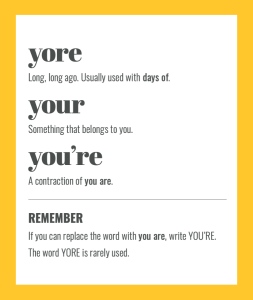
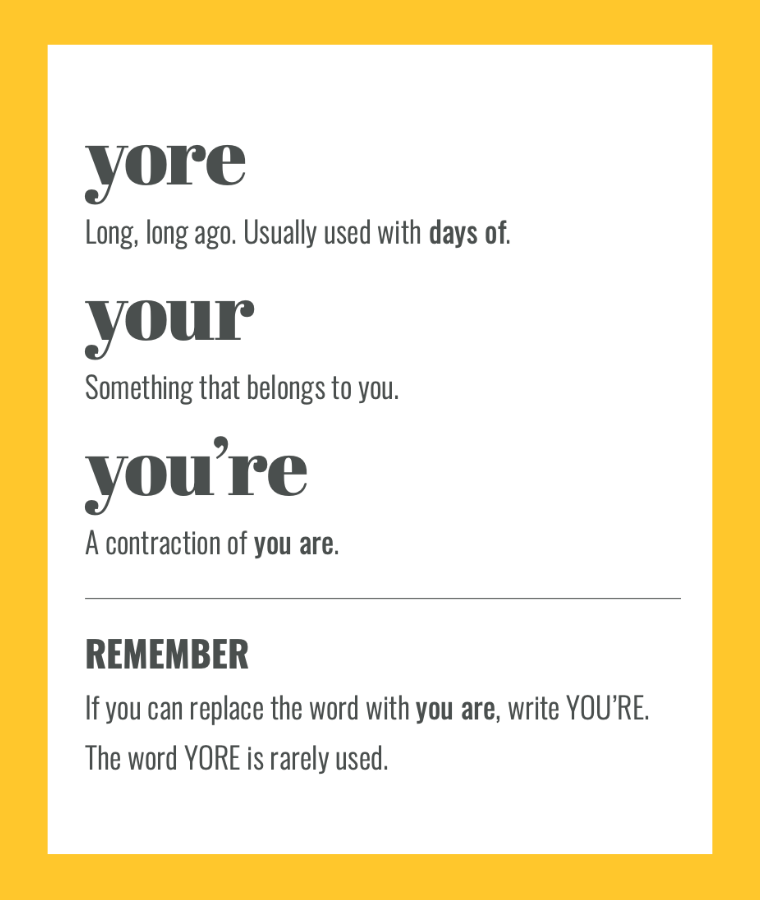
YORE vs YOUR vs YOU’RE. Excerpt from The Little Book of Confusables by Sarah Townsend.
More than 1,000 misused words demystified
Master 1,000+ confusing words with the multi-award-winning Little Book of Confusables 1 + 2 – jam-packed with memorable, fun spelling and usage tips: from ACCEPT + EXCEPT and OPTIMAL + OPTIMUM, to BARE + BEAR and PURPOSEFULLY + PURPOSELY.
It’s or its? Simple steps to help you remember
IT’S or ITS? These straightforward tips will help you remember the difference between these two commonly confused words.
Knowing whether to write it’s or its can trip you up.
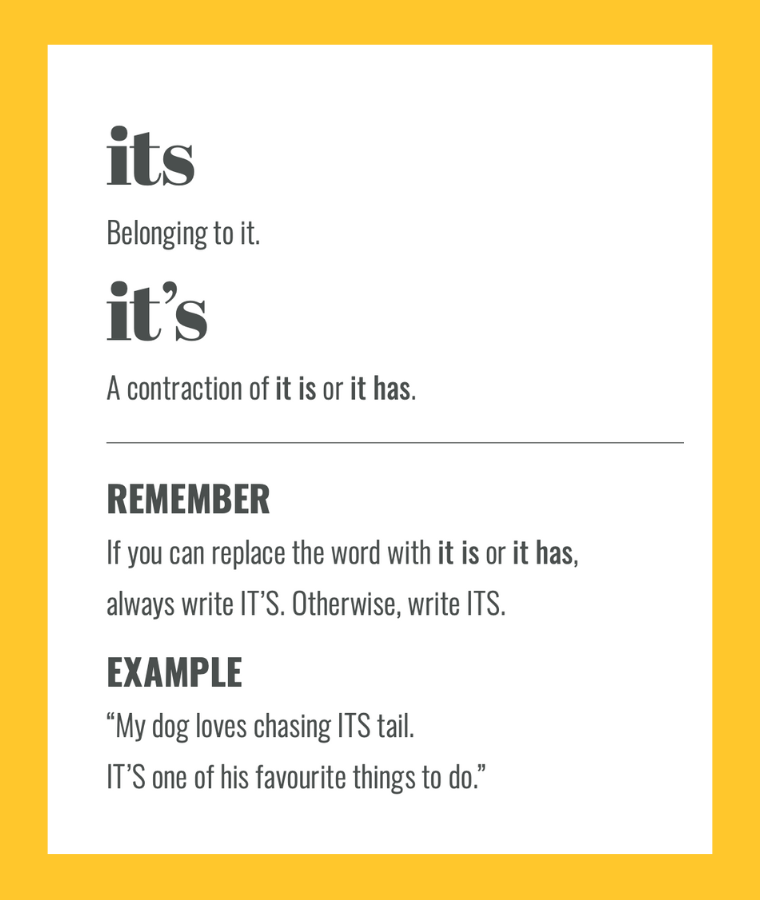
In a nutshell, it’s is always a contraction of it is or it has, while its describes something that belongs to ‘it’.
It’s
The apostrophe reminds you that it’s is a contraction of it is or it has. If you can replace the word with ‘it is’ or ‘it has’ use it’s.
Example:
It’s easy when you remember this rule (it is).
It’s been a busy day (it has).
Its
Usually followed by a noun, its describes something that belongs to ‘it’:
Example:
The dog chased its tail.
We get confused because we know apostrophes are used to indicate possession – that something belongs to someone or something. But this rule doesn’t apply to pronouns – its, yours, his, hers, ours, theirs.
Get more simple, memorable spelling tips in The Little Book of Confusables 1 + The Little Book of Confusables 2
My four-times award-winning books take the mystery out of misused words for just just £11.95. You’ll wonder how you managed without them!
ITS vs IT’S. Excerpt from The Little Book of Confusables by Sarah Townsend.
More than 1,000 misused words demystified
Master 1,000+ confusing words with the multi-award-winning Little Book of Confusables 1 + 2 – jam-packed with memorable, fun spelling and usage tips: from ACCEPT + EXCEPT and OPTIMAL + OPTIMUM, to BARE + BEAR and PURPOSEFULLY + PURPOSELY.