

It’s or its? Simple steps to help you remember
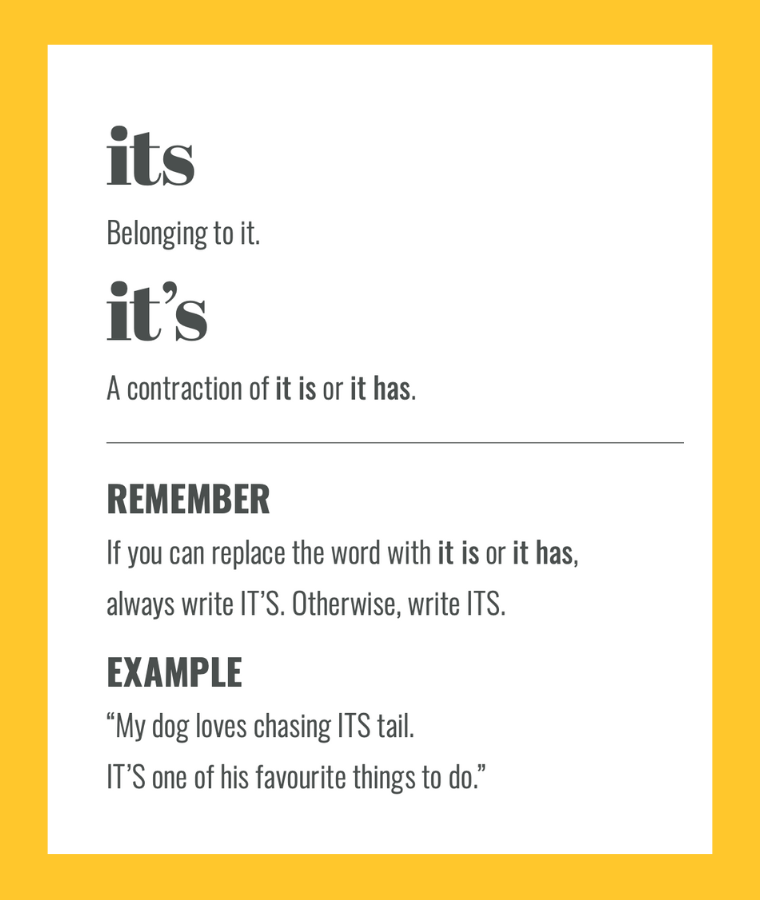
IT’S or ITS? These straightforward tips will help you remember the difference between these two commonly confused words.
Knowing whether to write it’s or its can trip you up.
In a nutshell, it’s is always a contraction of it is or it has, while its describes something that belongs to ‘it’.
It’s
The apostrophe reminds you that it’s is a contraction of it is or it has. If you can replace the word with ‘it is’ or ‘it has’ use it’s.
Example:
It’s easy when you remember this rule (it is).
It’s been a busy day (it has).
Its
Usually followed by a noun, its describes something that belongs to ‘it’:
Example:
The dog chased its tail.
We get confused because we know apostrophes are used to indicate possession – that something belongs to someone or something. But this rule doesn’t apply to pronouns – its, yours, his, hers, ours, theirs.
Get more simple, memorable spelling tips in The Little Book of Confusables 1 + The Little Book of Confusables 2
My four-times award-winning books take the mystery out of misused words for just just £11.95. You’ll wonder how you managed without them!
ITS vs IT’S. Excerpt from The Little Book of Confusables by Sarah Townsend.

More than 1,000 misused words demystified
Master 1,000+ confusing words with the multi-award-winning Little Book of Confusables 1 + 2 – jam-packed with memorable, fun spelling and usage tips: from ACCEPT + EXCEPT and OPTIMAL + OPTIMUM, to BARE + BEAR and PURPOSEFULLY + PURPOSELY.
There vs their vs they’re: top tips to help you get it right
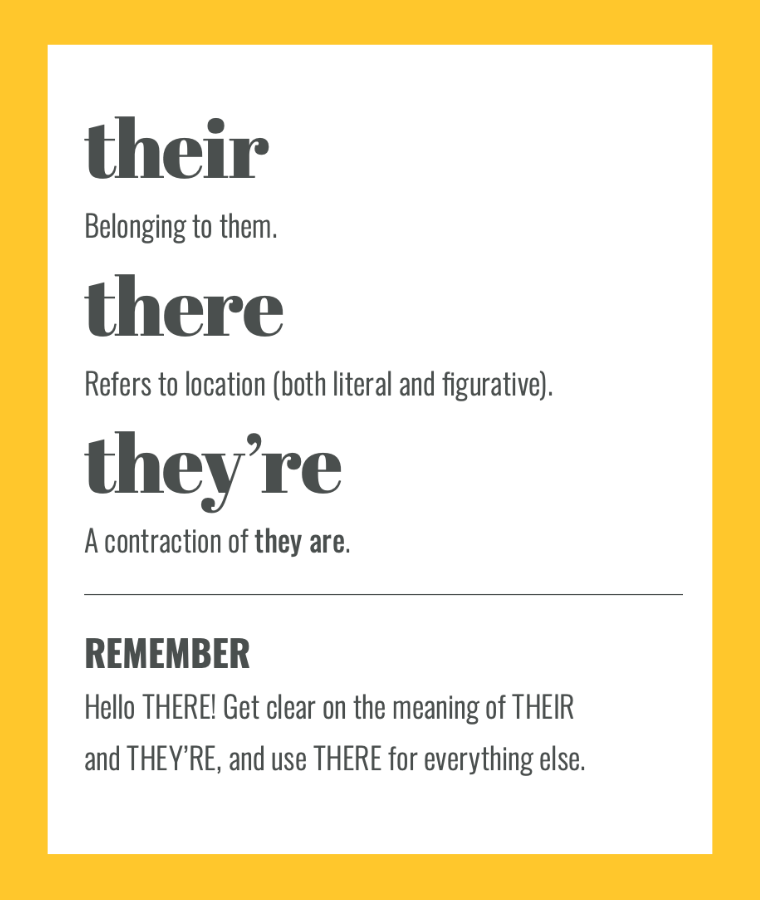
Using the wrong there/their/they’re is a common mistake – here are some simple tips to make sure you get it right.
In a nutshell, if the word means ‘belonging to them’ use their. If you can replace the word with ‘they are’ use they’re. Otherwise, use there.
There
It’s ‘here’ with a T: think here and there.
Example:
Did I leave my phone here? No, it’s over there.
Their
Used to indicate that a noun (thing) belongs to them.
Example:
That’s their house.
They’re
The apostrophe reminds you that ‘they’re’ is a contraction of two words: they are. Think of they’re as they are and you’ll know if your sentence makes sense.
Examples:
Look at the statue over they are: no – should be there
The boys are taking they are cars: no – should be their
They are here already: yes – they’re here already
ADVANCED – if you’re already confused, you might want to skip this.
Remember, there’s means there IS. Don’t write there’s when you mean there ARE.
Example:
There’s lots to do here – *applause*
There’s lots of cars in the car park – quack quack oops
Get more simple, memorable spelling tips in The Little Book of Confusables 1 + The Little Book of Confusables 2
My four-times award-winning books take the mystery out of misused words for just just £11.95. You’ll wonder how you managed without them!
THEIR vs THERE vs THEY’RE. Excerpt from The Little Book of Confusables by Sarah Townsend.
More than 1,000 misused words demystified
Master 1,000+ confusing words with the multi-award-winning Little Book of Confusables 1 + 2 – jam-packed with memorable, fun spelling and usage tips: from ACCEPT + EXCEPT and OPTIMAL + OPTIMUM, to BARE + BEAR and PURPOSEFULLY + PURPOSELY.
Don’t lose the plot: tips to remember lose and loose
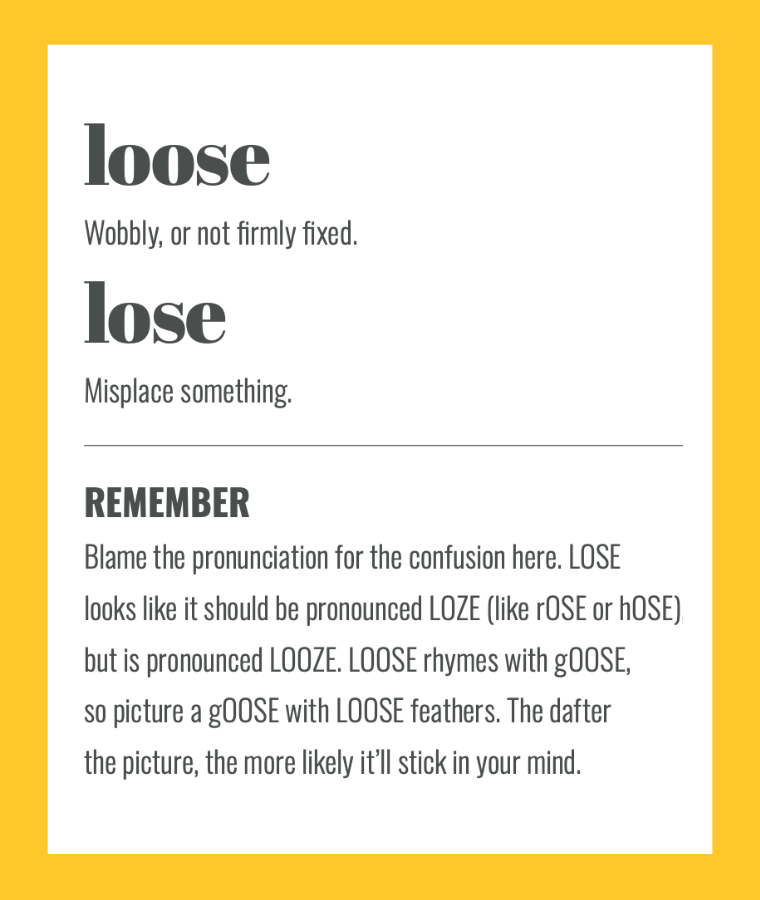
Do you know the difference between LOSE and LOOSE? Don’t learn the hard way, like Jessie J.
Last year, pop singer Jessie J admitted she’d had a tattoo of one of her song lyrics. Nothing unusual about that, maybe. But instead of ‘Don’t lose who you are in the blur of the stars’, the tattoo says ‘Don’t loose who you are in the blur of the stars’.
Imagine being tattooed with a typo. Double ouch.
It’s common for lose and loose to be mixed up, and easy to see why. But how do we avoid it?
Loose rhymes with moose and goose, but lose… well, it doesn’t rhyme with anything with the same ending.
Pose, nose and rose all end the same, but are all pronounced with an ‘oze’ sound. Only lose has an ‘oos’ sound.
What’s more, loose has the same ‘oose’ ending as choose, which rhymes with lose – gah!
When we think lose but write loose perhaps we’re thinking of loos which sounds the same, and contains a double o. But if that’s the case, we need to stop.
These tips should help you remember how to get it right:
- To write lose think of losing the second o. Or think of loser.
- Loose rhymes with moose, so picture a moose with loose antlers.
And Jessie – use a dictionary next time. Mamma Knows Best, remember?
Get more simple, memorable spelling tips in The Little Book of Confusables 1 + The Little Book of Confusables 2
My four-times award-winning books take the mystery out of misused words for just just £11.95. You’ll wonder how you managed without them!
LOSE vs LOOSE. Excerpt from The Little Book of Confusables by Sarah Townsend.
More than 1,000 misused words demystified
Master 1,000+ confusing words with the multi-award-winning Little Book of Confusables 1 + 2 – jam-packed with memorable, fun spelling and usage tips: from ACCEPT + EXCEPT and OPTIMAL + OPTIMUM, to BARE + BEAR and PURPOSEFULLY + PURPOSELY.
Everyday vs every day: tips to remember the difference
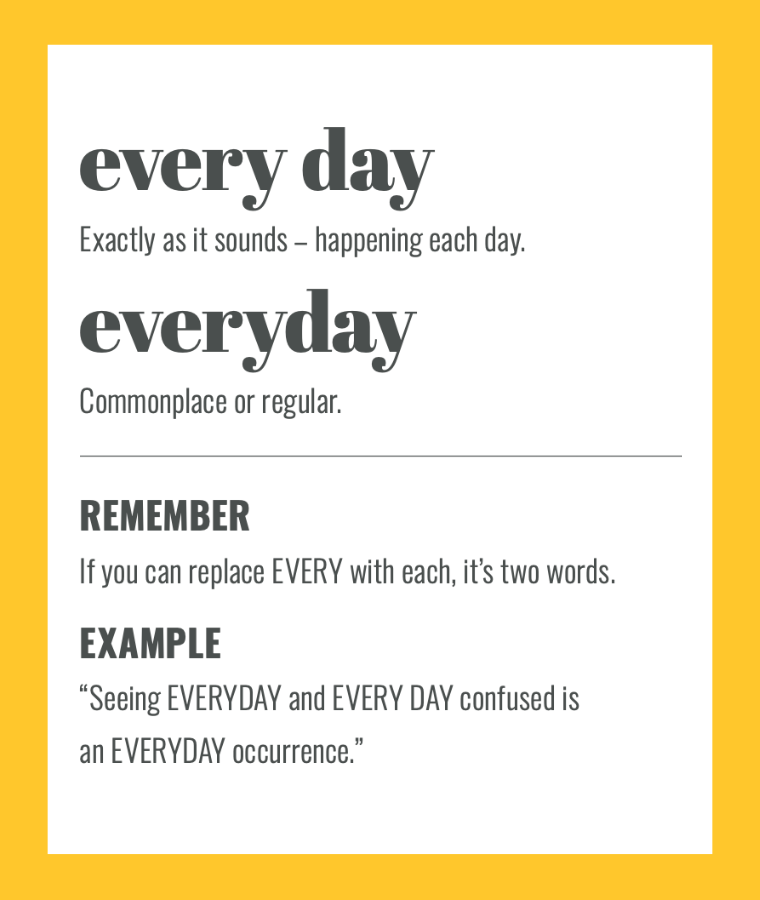
Do you know when to write EVERYDAY and when it should be EVERY DAY? These simple tips will help you get it right.
Driving up the M5 recently I overtook a Poundland lorry emblazoned with the company’s slogan: Amazing value everyday!
If I hadn’t been driving, I’d have thrown large objects in protest. Because what it should say, of course, is Amazing value every day!
Confusing everyday with every day is a common mistake, but there’s a simple tip to make sure you get it right.
If you can replace every day with each day, use every day. For example, ‘I watch TV every day’.
Everyday is an adjective meaning ‘commonplace’, and is used to describe a noun. For example, ‘an everyday occurrence’ means something that happens every day.
Remember, Poundland: your stock may be cheap, but good grammar costs nothing. Unless you paid an expensive ad agency to come up with a bum tagline, of course.
Get more simple, memorable spelling tips in The Little Book of Confusables 1 + The Little Book of Confusables 2
My four-times award-winning books take the mystery out of misused words for just just £11.95. You’ll wonder how you managed without them!
EVERY DAY vs EVERYDAY. Excerpt from The Little Book of Confusables by Sarah Townsend.
More than 1,000 misused words demystified
Master 1,000+ confusing words with the multi-award-winning Little Book of Confusables 1 + 2 – jam-packed with memorable, fun spelling and usage tips: from ACCEPT + EXCEPT and OPTIMAL + OPTIMUM, to BARE + BEAR and PURPOSEFULLY + PURPOSELY.