

BEAR or BARE: simple tips to remember the difference
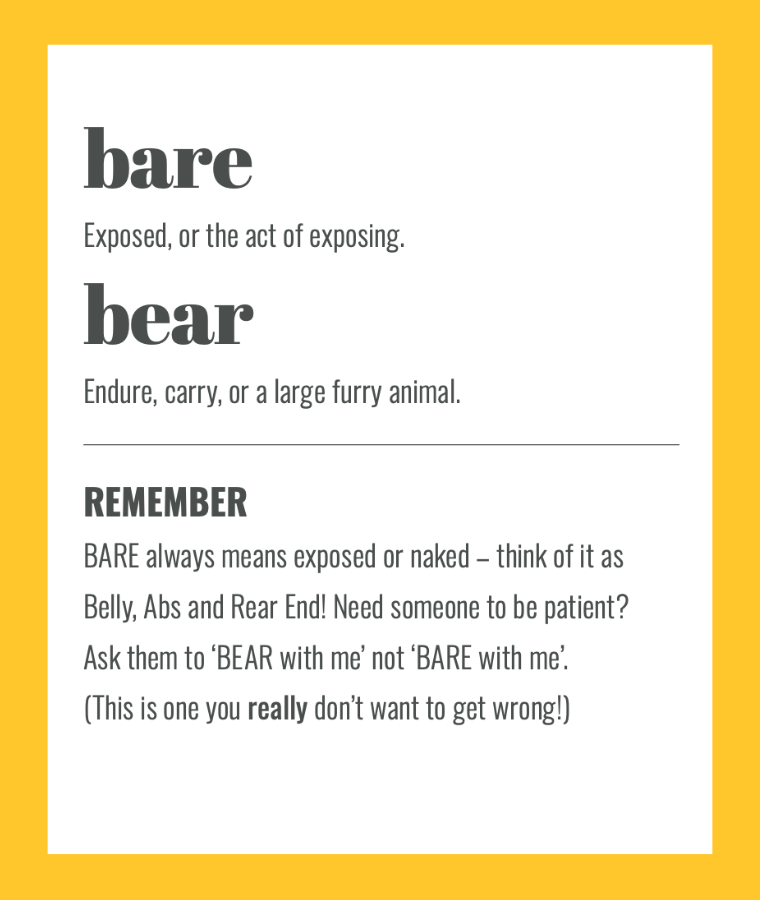
The words BEAR and BARE are easy to confuse – particularly when you’re asking someone to ‘BEAR with me‘, when there’s a world of a difference in meaning! This is one you really don’t want to get wrong!
Here are my simple tips to remember the difference between BEAR and BARE.
When to use BEAR
BEAR can be a noun or a verb.
As a verb, it means to carry or endure. You can use it in a sentence like this:
“Please BEAR with me while I sort things out.”
As a noun, BEAR is a large animal.
For example:
“Winnie-the-Pooh is a famous BEAR.”
When to use BARE
BARE can be a verb or an adjective.
As a verb, BARE means to expose, like this:
“I will BARE my soul and be completely honest.”
As an adjective, BARE means exposed, like this:
“The gorilla beat his BARE chest.”
To remember that BARE means naked, think of Belly, Abs and Rear End.
Now you know the difference between BEAR and BARE you can see why ‘BEAR with me’ (please be patient) and ‘BARE with me’ (let’s get naked) should never be mixed up!
Get more simple, memorable spelling tips in The Little Book of Confusables 1 + The Little Book of Confusables 2
My four-times award-winning books take the mystery out of misused words for just just £11.95. You’ll wonder how you managed without them!
BARE vs BEAR. Excerpt from The Little Book of Confusables by Sarah Townsend.

More than 1,000 misused words demystified
Master 1,000+ confusing words with the multi-award-winning Little Book of Confusables 1 + 2 – jam-packed with memorable, fun spelling and usage tips: from ACCEPT + EXCEPT and OPTIMAL + OPTIMUM, to BARE + BEAR and PURPOSEFULLY + PURPOSELY.
Lessons from a 10.6 MILLION video post on Instagram: pros and cons of having a viral Reel
Going viral. It’s the social media dream. But have you ever wondered what it takes to get a viral video post on Instagram?
My viral post was seen by more people than the population of Sweden. Here’s what I learnt…
You know the theory…
Focus on your audience. Engage, entertain, inform. Add value. Post at the right time. Use the right hashtags.
However great you are at planning your Instagram content we all know there are posts you put thought, time and effort into, and those that are a little more off-the-cuff, shall-I, shan’t-I.
You post the former at the time your audience is most engaged. You’re convinced they’ll resonate and generate off-the-scale engagement – record numbers of likes, comments, saves and shares. Maybe you’ll even grow your following as a result.
You post the latter… whenever. You’re not even sure you should be posting it, but hey – why not?
Isn’t it always the way that the posts we put the most effort into just do okay, while the unplanned posts have unexpected results?!
That’s certainly what happened to me with my Instagram Reel that generated 10.6 MILLION video views. Read on to discover the lessons I learned from the experience – and why having a viral video post on Instagram isn’t all good!
Engagement is validation
Social media is literally addictive.
Those likes, comments, saves, shares and follows on social media give us a buzz that scientists have equated with a dopamine hit.
And engagement is validation! It tells us we’re on the right track. That we’re providing value. That our audience love what we’re doing. They want more of the same – and they’re prepared to stick around to prove it.
Combine the buzz with the validation and you have a powerful combination. Is it any wonder we chase the thrill of the viral Instagram post, and the rewards it can bring?
The potential benefits of having a viral Instagram post are clear. The exposure, the opportunity to supercharge your following, and find more fans of your work – perhaps even opportunities for sponsorship and free products, influencer style!
Was my reality all it’s cracked up to be?
Read on to find out.
Before we start, what constitutes a viral video post on Instagram?
Good question! General consensus seems to be that anything with more than 100,000 likes can be classed as viral. My post ended up with more than 400,000 likes.
My Instagram background
I have two Instagram accounts: my original account @STEcopywriting where I post nature and countryside photography and @thecopywritersday where I generally post about small business life (productivity tips, wellbeing, dealing with the challenges of freelance life) and writing (#confusables, language funnies and practical writing tips).
(For context, the average view count for Reels on @thecopywritersday was around 1,500, with a high of almost 6,000 views.)
I know my content pillars, but is every post strictly in line with them? Of course not. It’s good to mix things up from time to time, right?
This was one of those posts. A wild card, if you like.
The story behind the post
I’ve been gluten intolerant for around five years, so when my 19-year-old son told me I needed to buy gluten-free puff pastry so he could make me a gluten-free pain-au-chocolat, I jumped at the chance.
Are you kidding me?! YES!
I shot a timelapse video of him making it, and decided to share it on @thecopywritersday. Okay, so it wasn’t about small business life or writing, but a naughty-yet-delicious snack that takes just two minutes to make? It’s practically a productivity hack! 😁
Initial engagement was good and the post plateaued at around 4,500 views. I thought no more about it until a month later when it suddenly took off and I started getting between 20 and 40 likes a minute.
Of course – me being me – I got excited as soon as views hit five figures. (I shared an excited post on LinkedIn when it hit 12,000. Should’ve waited!)
Three weeks later, the post had hit 10.6 million views with 412,000 likes and almost 500 comments. My following – which had been languishing at around 4,000 – more than doubled. (I didn’t quite make 10,000 but I wasn’t far off.)
So, let’s get to the pros and cons of having a viral video post on Instagram.
The good of having a viral video post on Instagram
Well, it certainly is a talking point! The fact that an Instagram Reel I created reached more people than the total population of Sweden is utterly bonkers – yet being able to share my experience to help others makes me happy.
Of course, there’s the impact of growing my following and having more people seeing my posts each day – with a new book coming out this summer, that could prove handy.
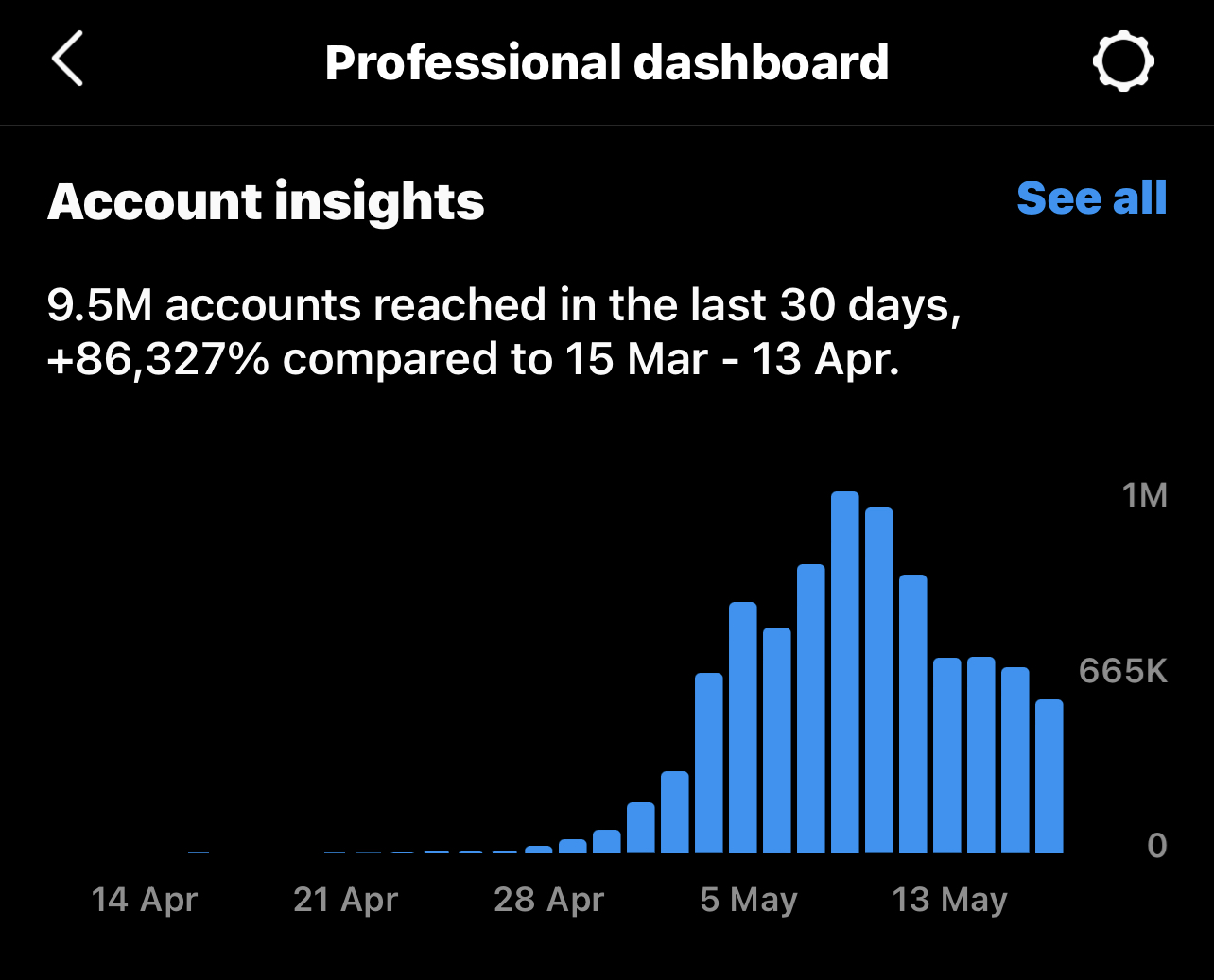
My Instagram insights were off the scale! At one point they told me I’d reached a total of 9.5 million accounts in 30 days – representing an 86,327% increase in reach.
Told you it was bonkers!
The not-so-good of having a viral video post on Instagram
Y’know those dreams where you’re running on the spot and not getting anywhere? Welcome to my following!
While you could say it’s great that my follower numbers more than doubled in less than a fortnight (from 4,200 to 9,900) I’m expecting a mass exodus once these new followers realise I’m not a cooking account!
I still get new followers daily who love my language and small business tips, but my follower numbers are currently decreasing at the same speed they’re increasing. (Will I ever get to the magical 10,000?! Update: I did!)
Also on the subject of follower growth, there’s something comforting about knowing the people who follow you. It feels like a community. Now, I’ve no idea who more than half my followers are – and it’s a strange feeling. (If you’re one of them, drop me a DM and say hey! I’d love to hear from you.)
The second downside is that, while I was getting around 30 likes a minute, any comments and tags from my community of followers were swamped! I missed hundreds of comments – and the chance to respond and strengthen my relationships – as a result.
People told me my views and engagement in general would experience a massive boost as a result of having a viral post.
That simply hasn’t happened.
We know the Instagram algorithm can be tricky. I sometimes wonder if it’s showing my posts to the new followers who don’t necessarily want small business advice or writing tips, rather than the lovely warm and engaged community I had before. It’s intriguing, but I guess I’ll never know.
Conclusion
Like most things in life, having a viral video post on Instagram isn’t a magic formula for success. Going viral with a post that’s in line with the services or products you offer is the dream. Going viral with something that’s not… I’m not sure. It certainly was an incredible experience.
As for the long-term impact on my Instagram account – only time will tell. Why not follow me and be part of the journey?
More than 1,000 misused words demystified
Master 1,000+ confusing words with the multi-award-winning Little Book of Confusables 1 + 2 – jam-packed with memorable, fun spelling and usage tips: from ACCEPT + EXCEPT and OPTIMAL + OPTIMUM, to BARE + BEAR and PURPOSEFULLY + PURPOSELY.
Ditch these four words from your writing – and instantly improve your impact

Want your writing to have more impact? Ditch these four words…
Just as we pepper our speech with filler words like UM, LIKE, SO, and BASICALLY, we do the same with our writing – often without even realising.
Here are four words to ditch from your writing to improve your impact and clarity.
REALLY/VERY
REALLY and VERY are called qualifiers.
They may feel like they’re strengthening your message, but they usually have the opposite effect.
To void using two words where you can use one.
Try swapping:
VERY ANGRY with FURIOUS
VERY BIG with HUGE
VERY SMALL with TINY
You get the picture.
This quote from Dead Poets’ Society sums it up nicely:
“Avoid using the word VERY because it’s lazy. A man is not VERY tired, he is exhausted. Don’t use VERY sad, use morose.”
If you can’t think of a stronger word, take out VERY or REALLY.
JUST
Tune into this one and you’ll be amazed how often you use it.
It’s particularly prevalent in emails:
❌ “I’m JUST checking to see how you got on with my quote.”
✅ “I’m checking to see how you got on with my quote.”
❌ “I’ll JUST leave it with you.”
✅ “I’ll leave it with you.”
❌ “JUST let me know what you think.”
✅ “Let me know what you think.”
Ditch it. You’ll instantly sound more confident and impactful.
THAT
Finally, THAT – a filler word that’s often unnecessary.
If the sentence makes sense without the word THAT, delete it.
❌ “I checked THAT the document was approved.”
✅ “I checked the document was approved.”
❌ “She told me THAT it was great.”
✅ “She told me it was great.”
❌ “The website copy THAT you wrote for me.”
✅ “The website copy you wrote for me.”
Which of these filler words are you guilty of overusing? And what other filler words would you add to the ditch list to improve your impact?
More than 1,000 misused words demystified
Master 1,000+ confusing words with the multi-award-winning Little Book of Confusables 1 + 2 – jam-packed with memorable, fun spelling and usage tips: from ACCEPT + EXCEPT and OPTIMAL + OPTIMUM, to BARE + BEAR and PURPOSEFULLY + PURPOSELY.
How many dots in an ellipsis… and what is the punctuation mark for?

Wondering whether those three little dots are an official punctuation mark – and, if so, how to use it?
I’ve got your back.
What is an ellipsis?
Those three dots are known as an ELLIPSIS (plural ELLIPSES), which stems from the Greek meaning ‘to leave out’.
The ellipsis is one of 14 official punctuation marks in the English language.*
It has a number of uses:
✅ To indicate that a word or phrase is missing from a sentence or quote
“Make it simple, make it memorable… make it fun to read”**
✅ To show hesitation or an unfinished thought (most commonly used in fiction writing)
“But, I thought you said…?”
✅ To create a pause, to increase tension (also commonly found in fiction)
“Sam held her breath as she hid behind the door…”
How many dots are there in an ellipsis?
An ellipsis is always three dots.
❌ Never two
❌ Never five
❌ And never a random number “to fill the space”
(Hands up if you’re guilty of random dotting?!)
Remember this…
A friend who’s a primary school teacher told me her class call the ellipsis a ‘dun, dun, DUUUUUN’ because it often indicates suspense.
So, next time you’re unsure how many dots in an ellipsis, just remember those school kids!
PRO TIP
If an ellipsis follows a complete sentence, it follows the full stop. (This four-dot combo looks so weird to me that I refuse to use an ellipsis at the end of a complete sentence!)
*Bonus points if you can name all 14 punctuation marks. Let me know how you get on!
**The full quote from ad-man Leo Burnett is: “Make it simple, make it memorable, make it exciting to look at, make it fun to read.”
More than 1,000 misused words demystified
Master 1,000+ confusing words with the multi-award-winning Little Book of Confusables 1 + 2 – jam-packed with memorable, fun spelling and usage tips: from ACCEPT + EXCEPT and OPTIMAL + OPTIMUM, to BARE + BEAR and PURPOSEFULLY + PURPOSELY.
6 tips to find your freelance community and say goodbye to isolation
Freelance life can be hella lonely. But you’re not alone!
A 2024 study of 700 freelancers found a mammoth 79% experienced feelings of isolation, loneliness or disconnection.
• You’re not the only one feeling isolated.
• Missing the buzz and banter of working in an office.
• Wishing you someone understood the pressure you’re under (and no, the dog doesn’t count).
• Wondering what the heck you should charge for that new project that’s outside your comfort zone.
As I say in Survival Skills for Freelancers, going solo doesn’t mean going it alone – and finding a community of like-minded individuals to work, collaborate and share with is a gamechanger.
When I started my freelance journey back in 1999, there was no freelance community because there was no social media. And there was no social media because there was barely any internet!
Today, you’re spoilt for choice. So where do you start?
Here are my tips to help you find your freelance community and create a happier, more fulfilled working life.
1) Consider coworking
If staring at the same four walls each day gives you Groundhog Day vibes, consider renting a coworking space two or three times a week.
While you don’t need to be a freelancer to use a coworking space – shared work zones attract flexible workers of all kinds – many freelancers find shared working gives them the lifeline they need to overcome the isolation that can come with the job title.
Some coworking spaces operate on a pay-as-you-go basis where you can drop in and use the facilities when you need to.
Others charge a fixed weekly or monthly fee. Shop around to see what’s best for you.
2) Get social online
Social media offers countless networks of enthusiastic, inspiring creatives just like you – and you don’t even need to move from your desk to join them!
Freelance communities on platforms such as Facebook, Slack and Discord are packed with information, advice, support, opportunities for collaboration… and likeminded people.
Start with thriving Facebook groups such Being Freelance, or look out for industry-specific communities such as Logo Geek (for graphic designers) or Freelance PRs.
3) Give more than you take
As with most things in life, you get out of online freelance communities what you put in – so dig in, introduce yourself, browse members’ posts and engage with discussions.
Resist the temptation to self-promote. Instead, engage with others, be encouraging, helpful and informed, and give more than you take.
Once you’ve established yourself as an active member and become known as friendly, reliable and someone who knows their stuff, you’re more likely to attract likeminded people, which may even pay off in referrals and business.
4) Do your research
Want to expand your network or social circle but don’t know where to start?
Following hashtags on social platforms such as Instagram can help you spot people with similar interests and goals.
Give them a follow and reach out with a comment or DM.
Many real-life friendships develop from online connections – but this happens over time, not overnight, so be prepared to invest time and effort.
5) Go local
Joining a local business network is a great way to meet likeminded individuals – and has the added benefit of encouraging you to leave your desk occasionally!
In-person networking doesn’t need to be intimidating – remember, everyone was new once.
Be yourself, show a genuine interest in others, and focus on making new connections rather than sales.
It might take a while to find a group that feels like home, so be prepared to try a range of networking groups – from formal breakfast gatherings to casual chats over coffee – until you find the right freelance community.
6) Build your support network
Making money isn’t everything. Sure, we all need to pay the bills, but you deserve some me-time, too!
Keeping work and home life separate is super important when you’re freelance. Set firm boundaries – especially around your working hours – and refuse to let your home life come second.
A good support network of non-business friends is essential to your mental wellbeing, so never feel guilty about switching off the laptop, joining a yoga class, or meeting a friend for coffee.
Switching off doesn’t just help you to recharge – it boosts focus, creativity and productivity.
Your brain will thank you for it, and so will your bank balance.
That’s it! What would you add?

Grow in confidence and show self-employment who’s boss!
With 20 years of freelance experience + advice from 120 entrepreneurs, Survival Skills for Freelancers is your secret weapon to get more enjoyment from self-employment.
The 2025 edition is out now, with a new lower price (£11.95), updated stats, links, references and resources, and all-new advice from another 20 successful freelancers.
Get your copy in paperback, Kindle or Audible today.