

PAIR vs PARE vs PEAR: simple spelling tips to remember the difference
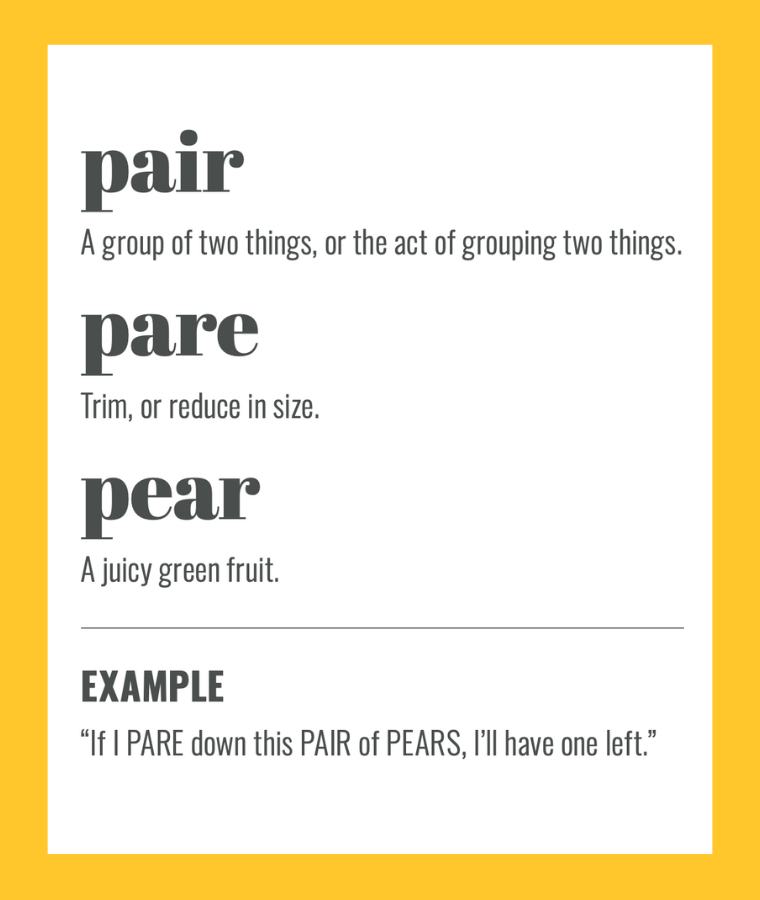
PAIR vs PARE vs PEAR: which is which? These spelling tips will help you remember the difference
The words PAIR, PARE and PEAR are easy to confuse because they’re homophones – words that sound the same but have different meanings.
Here are my simple tips to remember the difference between the words PAIR, PARE and PEAR.
When to use PAIR
PAIR can be a noun or verb. As a noun, PAIR describes a group of two things.
As a noun, you can use PAIR in a sentence like this:
“I swear my washing machine eats socks… There’s always one sock missing from the PAIR!”
As a verb, PAIR describes the act of grouping two things.
As a verb, you can use PAIR in a sentence like this:
“I like to sit in the sunshine and PAIR my socks.”
When to use PARE
PARE is a verb, meaning to trim or reduce in size. It’s often used with the word ‘down’.
Use PARE in a sentence like this:
“Let’s PARE down this budget. We’re spending way too much!”
When to use PEAR
PEAR is a noun, referring to the juicy green fruit.
Use PEAR in a sentence like this:
“I’m a bit bored of apples, but I wouldn’t say no to a PEAR.”
Remember, if you PARE down a PAIR of PEARS, you’ll only be left with one!
Now you know the difference between PAIR, PARE and PEAR! I hope my tips help you remember the difference between these commonly confused words in the future.
Get more simple, memorable spelling tips in The Little Book of Confusables 1 + The Little Book of Confusables 2
My four-times award-winning books take the mystery out of misused words for just just £11.95. You’ll wonder how you managed without them!

PAIR vs PARE vs PEAR. Excerpt from The Little Book of Confusables by Sarah Townsend.

More than 1,000 misused words demystified
Master 1,000+ confusing words with the multi-award-winning Little Book of Confusables 1 + 2 – jam-packed with memorable, fun spelling and usage tips: from ACCEPT + EXCEPT and OPTIMAL + OPTIMUM, to BARE + BEAR and PURPOSEFULLY + PURPOSELY.
WET vs WHET: simple tips to remember the difference
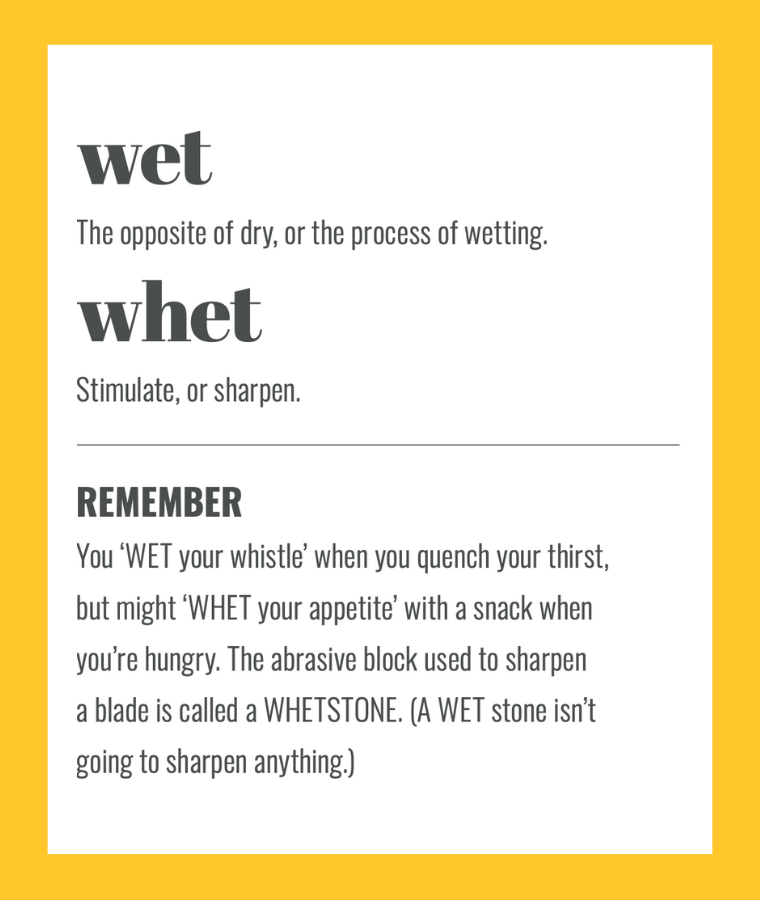
WET vs WHET: which is which? These spelling tips and usage examples will help you remember the difference
The words WET and WHET are easy to confuse because they are homophones – words that sound the same but mean different things. And, while WHET is far less common than WET, there are important differences in meaning that I can help you learn.
Here are my simple tips to remember the difference between WET and WHET.
When to use WET
WET can be an adjective or a verb.
It’s the opposite of dry, or the process of wetting. Here’s how to use WET in a sentence as an adjective:
“All the benches are WET – let’s keep walking.”
Here’s how to use WET in a sentence as a verb:
“Be sure to WET your hair before applying the conditioner.”
When to use WHET
WHET is a verb that means to stimulate or sharpen. Here’s how to use WHET in a sentence:
“The teaser trailer WHET the appetite of movie fans everywhere.”
Pro tip
You ‘WET your whistle’ when you quench your thirst, but might ‘WHET your appetite’ with a snack when you’re hungry.
The abrasive block used to sharpen a blade is called a WHETstone, not a WET stone. (A WET stone won’t sharpen anything!)
Now you know the difference between WET and WHET. I hope my tips help you remember the difference between these commonly confused words!
Get more simple, memorable spelling tips in The Little Book of Confusables 1 + The Little Book of Confusables 2
My four-times award-winning books take the mystery out of misused words for just just £11.95. You’ll wonder how you managed without them!

WET vs WHET. Excerpt from The Little Book of Confusables by Sarah Townsend.
More than 1,000 misused words demystified
Master 1,000+ confusing words with the multi-award-winning Little Book of Confusables 1 + 2 – jam-packed with memorable, fun spelling and usage tips: from ACCEPT + EXCEPT and OPTIMAL + OPTIMUM, to BARE + BEAR and PURPOSEFULLY + PURPOSELY.
EMIT vs OMIT: simple tips to help you remember the difference
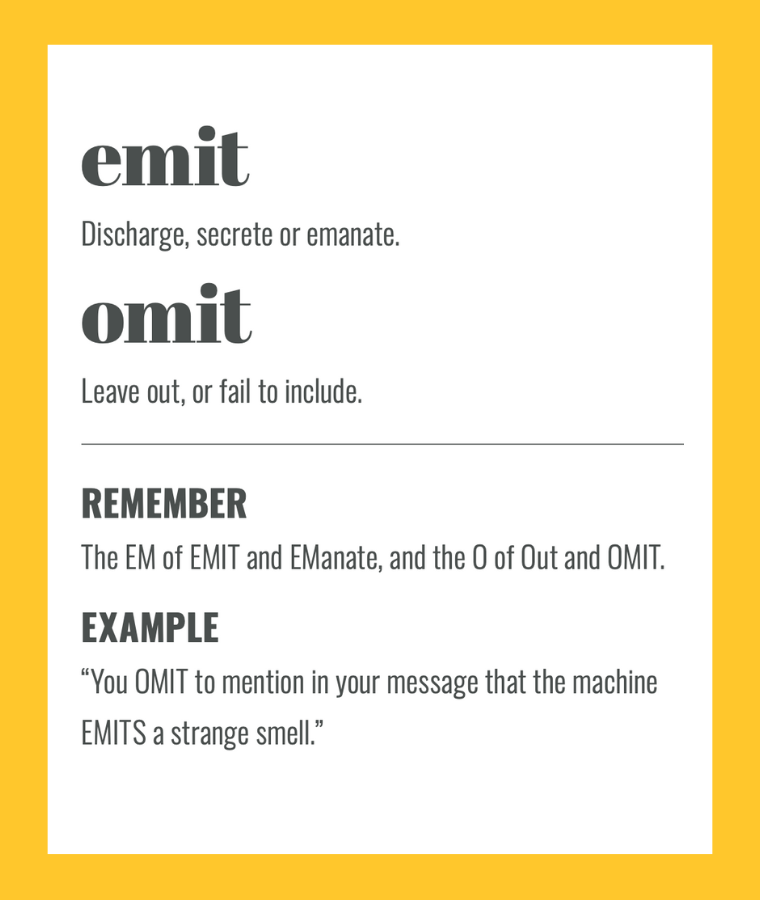
EMIT vs OMIT: which is which? These simple tips and usage examples will help you remember the difference.
The words EMIT and OMIT are easy to confuse. Despite their different spellings, they sound very similar – but there are important differences in their meanings, which you don’t want to confuse!
Here are my simple tips to remember the difference between EMIT and OMIT.
When to use EMIT
EMIT is a verb, meaning to discharge, secrete or emanate.
It can be used in a sentence like this:
“I noticed that the old machine continues to EMIT a strange smell.”
To remember, think of the EM of EMIT and EManate.
When to use OMIT
OMIT is a verb, meaning to leave out or fail to include.
It can be used in a sentence like this:
“She chose to OMIT the vanilla from the recipe.”
To remember, think of the O of OMIT and out.
Now you know the difference between EMIT and OMIT! I hope these tips help you to remember the difference between these commonly confused words in the future.
Get more simple, memorable spelling tips in The Little Book of Confusables 1 + The Little Book of Confusables 2
My four-times award-winning books take the mystery out of misused words for just just £11.95. You’ll wonder how you managed without them!

Confusables: EMIT vs OMIT. Simple spelling tips to remember the difference, from The Little Book of Confusables
More than 1,000 misused words demystified
Master 1,000+ confusing words with the multi-award-winning Little Book of Confusables 1 + 2 – jam-packed with memorable, fun spelling and usage tips: from ACCEPT + EXCEPT and OPTIMAL + OPTIMUM, to BARE + BEAR and PURPOSEFULLY + PURPOSELY.
A LOT vs ALLOT: spelling tips to help you remember the difference
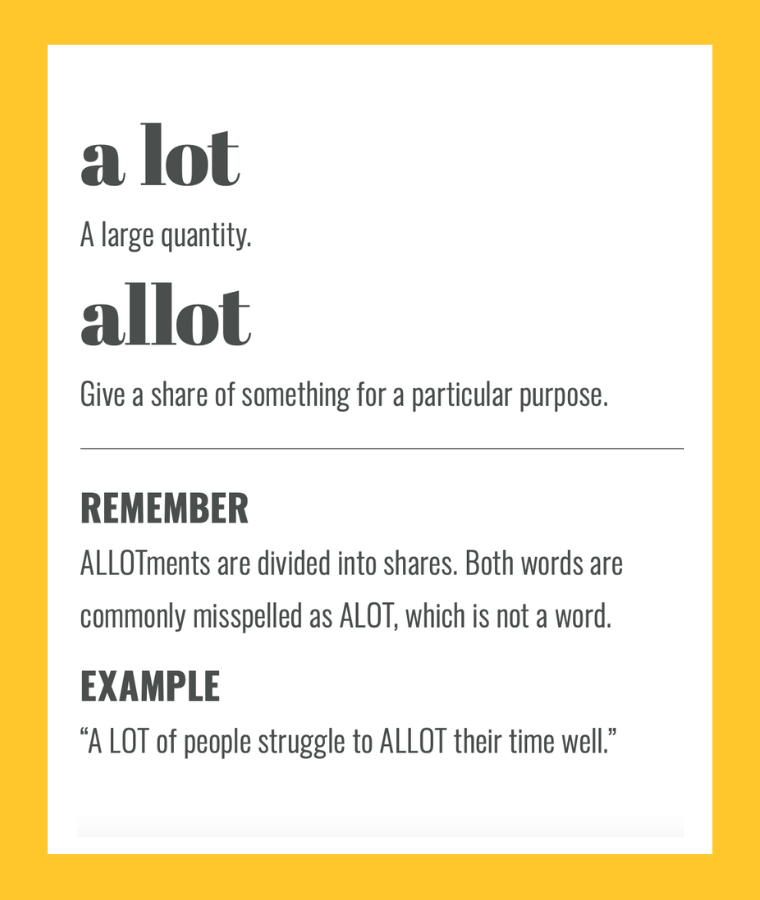
The words A LOT and ALLOT are easy to confuse because they’re homophones – words that sound the same but mean different things. Besides the difference in word class, there are important differences in their meanings, which you don’t want to mess up!
Here are my simple tips to remember the difference between A LOT and ALLOT.
When to use A LOT
A LOT can be an adverb or a noun.
It refers to a large quantity and is synonymous with ‘plenty’. As a noun, it’s used in a sentence like this:
“There’s A LOT to remember!”
Note that it refers to the quantity alone, not what there is A LOT of. As an adverb, it’s used in a sentence like this:
“There’s A LOT of information to remember.”
In this case, ‘information’ is the noun and A LOT specifies how much information there is.
When to use ALLOT
ALLOT is a verb, commonly used with words like ‘time’.
It means to give a share of something for a particular purpose. You can use it in a sentence like this:
“You should ALLOT an appropriate amount of time to digest this information.”
Pro tip
Don’t confuse A LOT and ALLOT with ALOT. ALOT is a common misspelling of A LOT and ALLOT but it’s not a word.
Now you know the difference between A LOT and ALLOT! I hope these tips help you to remember the difference between these commonly confused words in the future.
Get more simple, memorable spelling tips in The Little Book of Confusables 1 + The Little Book of Confusables 2
My four-times award-winning books take the mystery out of misused words for just just £11.95. You’ll wonder how you managed without them!

A LOT vs ALLOT. Excerpt from The Little Book of Confusables by Sarah Townsend. Get simple spelling tips for 500+ commonly confused words.
More than 1,000 misused words demystified
Master 1,000+ confusing words with the multi-award-winning Little Book of Confusables 1 + 2 – jam-packed with memorable, fun spelling and usage tips: from ACCEPT + EXCEPT and OPTIMAL + OPTIMUM, to BARE + BEAR and PURPOSEFULLY + PURPOSELY.
HISTORIC vs HISTORICAL: simple tips to help you remember the difference
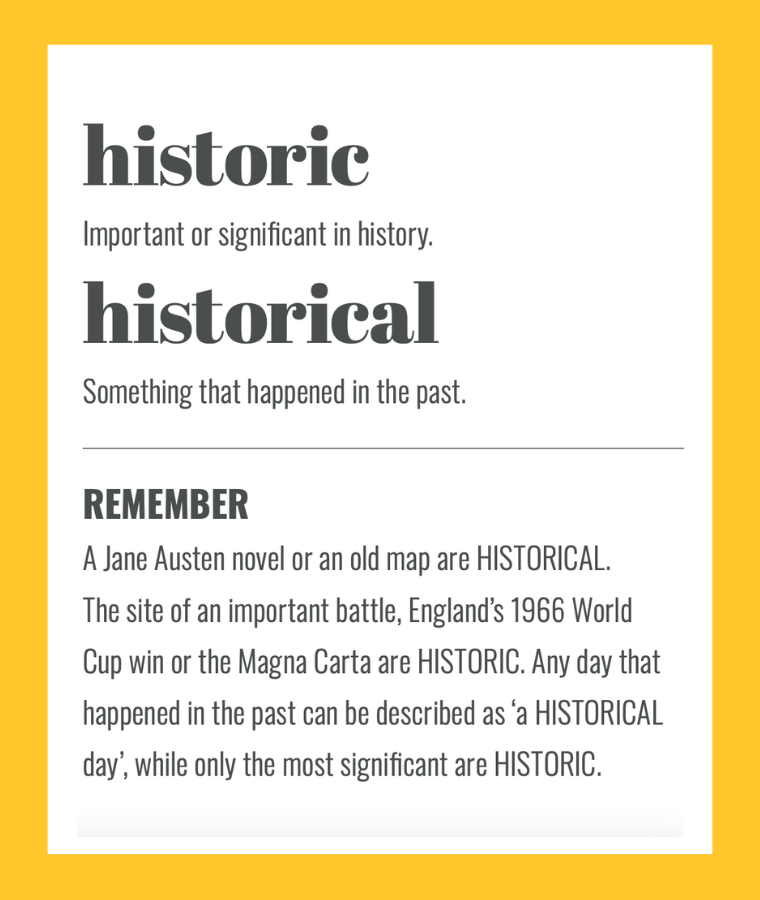
HISTORIC vs HISTORICAL: simple spelling and usage tips to remember the difference
The words HISTORIC and HISTORICAL are easy to confuse because they come from the same root, but there are subtle and important differences in their meanings, which you don’t want to mess up!
Here are my simple tips to remember the difference between HISTORIC and HISTORICAL.
When to use HISTORIC
HISTORIC is an adjective, usually paired with words like ‘defeat’, ‘victory’ or ‘day’.
It refers to an event, place or item that’s significant in history – such as the site of an important battle, England’s 1966 World Cup win or the Magna Carta.
You can use HISTORIC in a sentence like this:
“This day marks 56 years since England’s HISTORIC football match against Germany.”
When to use HISTORICAL
HISTORICAL is an adjective referring to something that happened in the past. You might use it to describe a Jane Austen novel or an old map.
HISTORICAL is commonly used with words like ‘event’ or ‘record’.
You can use HISTORICAL in a sentence like this:
“The article provides a detailed HISTORICAL account of the event.”
Any day that happened in the past can be described as ‘a HISTORICAL day’, while only the most significant are HISTORIC.
Now you know the difference between HISTORIC and HISTORICAL you can rest easy, knowing you’ll never mix up your HISTORIC with your HISTORICAL days again!
I hope my tips help you remember the difference between these commonly confused words in the future.
Get more simple, memorable spelling tips in The Little Book of Confusables 1 + The Little Book of Confusables 2
My four-times award-winning books take the mystery out of misused words for just just £11.95. You’ll wonder how you managed without them!

HISTORIC vs HISTORICAL. Excerpt from The Little Book of Confusables by Sarah Townsend. Get simple spelling tips for 500+ commonly confused words.
More than 1,000 misused words demystified
Master 1,000+ confusing words with the multi-award-winning Little Book of Confusables 1 + 2 – jam-packed with memorable, fun spelling and usage tips: from ACCEPT + EXCEPT and OPTIMAL + OPTIMUM, to BARE + BEAR and PURPOSEFULLY + PURPOSELY.