

Suppose vs supposed: easy ways to remember the difference
When to use SUPPOSE
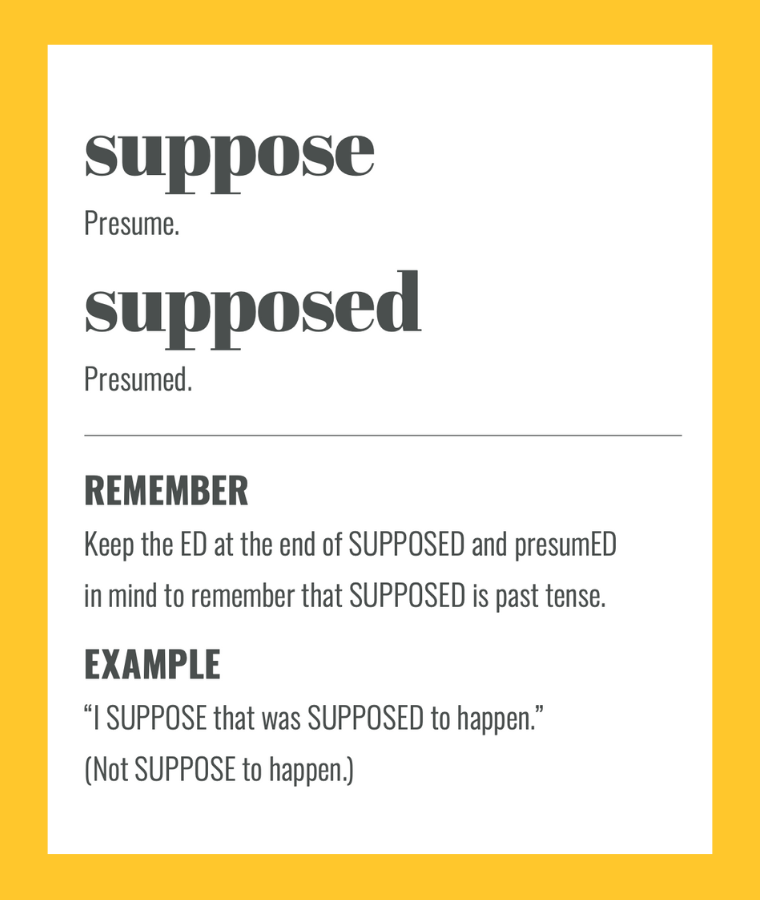
SUPPOSE is a verb, meaning ‘to presume’. It’s often used in a sentence like this: “I SUPPOSE so.” OR “Do you SUPPOSE he’ll be coming along tonight?”When to use SUPPOSED
SUPPOSED can be an adjective or a verb. As an adjective, it describes something that’s generally accepted as truth. It can be used in a sentence like this: “This is the SUPPOSED method.” As a verb, SUPPOSED is the past participle of SUPPOSE, meaning ‘presumed’. SUPPOSE and SUPPOSED are most commonly confused in the expression ‘SUPPOSED to happen’. It’s always wrong to write ‘SUPPOSE to happen’. Remember the ED at the end of SUPPOSED and presumED to remember that SUPPOSED is past tense. Now you know the difference between SUPPOSE and SUPPOSED. I hope these tips help you to remember the difference between these commonly confused words in the future.Get more simple, memorable spelling tips in The Little Book of Confusables 1 + The Little Book of Confusables 2
My four-times award-winning books take the mystery out of misused words for just just £11.95. You’ll wonder how you managed without them!
2023 GOLD award winner at the eLit book awards.
SUPPOSE and SUPPOSED. Excerpt from The Little Book of Confusables by Sarah Townsend.

More than 1,000 misused words demystified
Master 1,000+ confusing words with the multi-award-winning Little Book of Confusables 1 + 2 – jam-packed with memorable, fun spelling and usage tips: from ACCEPT + EXCEPT and OPTIMAL + OPTIMUM, to BARE + BEAR and PURPOSEFULLY + PURPOSELY.
Libel and slander: simple tips to help you remember the difference
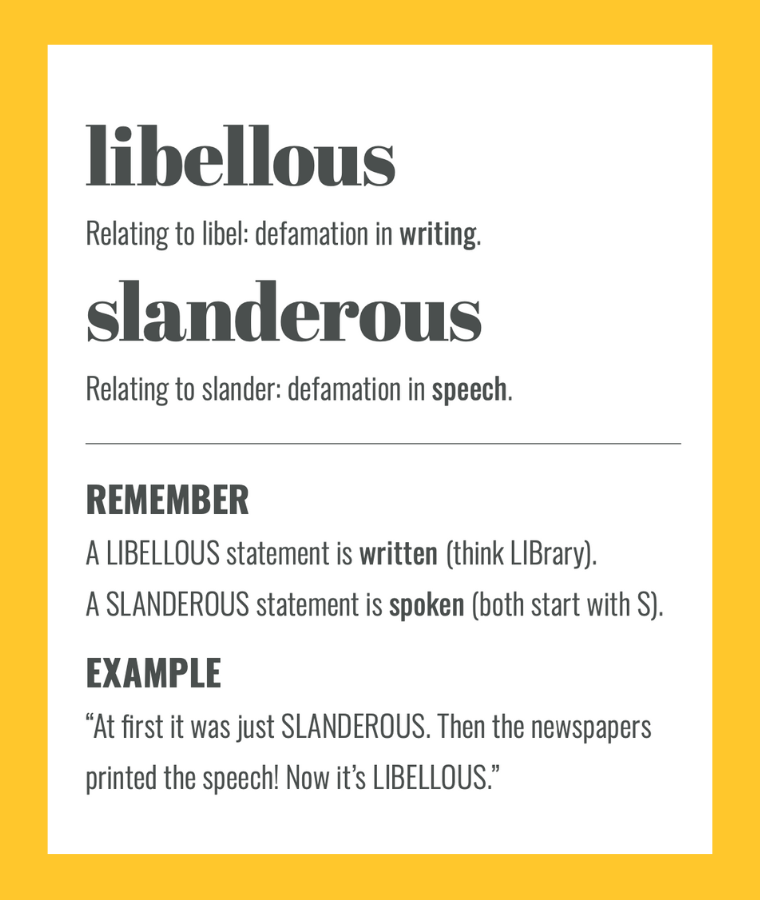
The words LIBEL and SLANDER are commonly confused. Both are legal terms that are easy to get mixed up!
Here are my simple tips to help you learn and remember the difference between LIBEL and SLANDER. First, you need to know that defamation is the act of saying something false and malicious about someone else.When to use LIBEL
LIBEL can be a noun or a verb. It relates to defamation in writing. It can be used in a sentence like this: “They’ve printed it in the papers now – this is LIBEL!” To help you remember that LIBEL – or a LIBELLOUS statement – is written, think of a LIBrary (which is full of written books).When to use SLANDER
SLANDER can be a noun or a verb. It relates to defamation in speech. It can be used in a sentence like this: “What you said isn’t true. It’s SLANDER.” To remember that SLANDER is spoken, think of the S in SLANDER and Spoken. I hope these tips help you remember the difference between LIBEL and SLANDER in the future.Get more simple, memorable spelling tips in The Little Book of Confusables 1 + The Little Book of Confusables 2
My four-times award-winning books take the mystery out of misused words for just just £11.95. You’ll wonder how you managed without them!
2023 GOLD award winner at the eLit book awards.
LIBEL vs SLANDER. Excerpt from The Little Book of Confusables by Sarah Townsend.
More than 1,000 misused words demystified
Master 1,000+ confusing words with the multi-award-winning Little Book of Confusables 1 + 2 – jam-packed with memorable, fun spelling and usage tips: from ACCEPT + EXCEPT and OPTIMAL + OPTIMUM, to BARE + BEAR and PURPOSEFULLY + PURPOSELY.
Holey vs holy vs wholly: simple tips to remember the difference
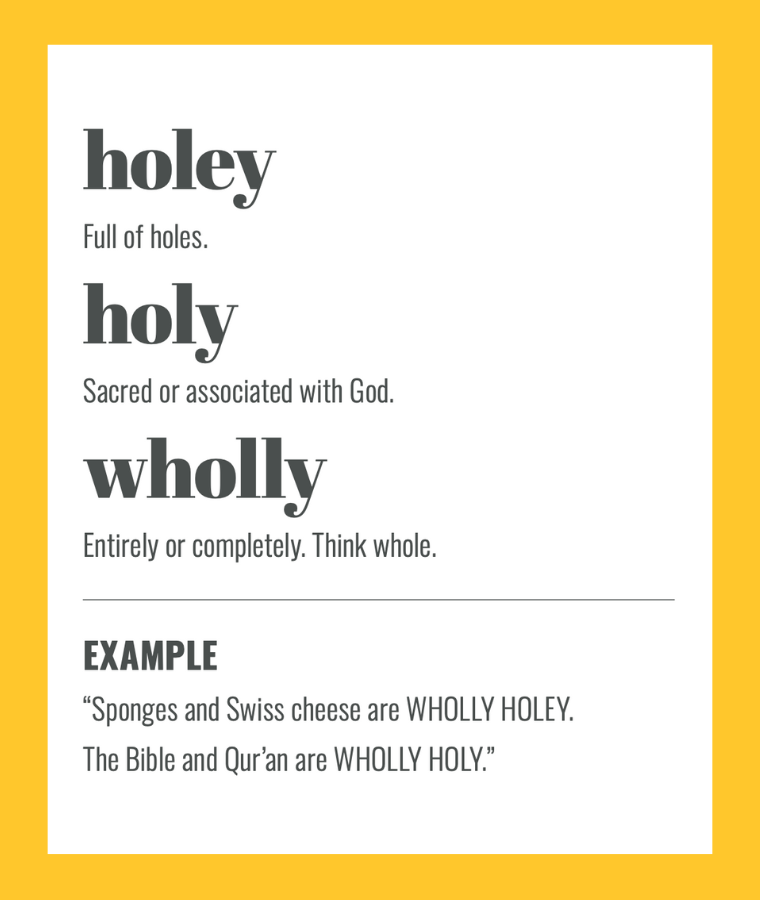
The words HOLEY, HOLY and WHOLLY are easy to confuse. They’re homophones – which means they sound the same – but their meanings are very different.
Here are my simple tips to help you remember the difference between HOLEY, HOLY and WHOLLY.When to use HOLEY
HOLEY is an adjective that describes something that’s full of holes. It can be used in a sentence like this: “This Swiss cheese is very HOLEY.” OR “You’re wearing HOLEY socks!”When to use HOLY
HOLY is an adjective that describes something sacred or associated with God. It’s commonly used with ‘spirit’. It can be used in a sentence like this: “The Bible and the Qur’an are both HOLY books.” OR “She was baptised by the HOLY spirit.”When to use WHOLLY
WHOLLY is an adverb that means entirely or completely. It can be used in a sentence like this: “I am WHOLLY committed to this idea.” OR “Hmm. I’m not WHOLLY convinced by your argument.” Now you know the difference between HOLEY, HOLY and WHOLLY, you’ll remember that sponges and sieves are WHOLLY HOLEY, and that churches and temples are WHOLLY HOLY! I hope these tips help you to remember the difference between these commonly confused words in the future.Get more simple, memorable spelling tips in The Little Book of Confusables 1 + The Little Book of Confusables 2
My four-times award-winning books take the mystery out of misused words for just just £11.95. You’ll wonder how you managed without them!

HOLEY vs HOLY vs WHOLLY. Excerpt from The Little Book of Confusables by Sarah Townsend.
More than 1,000 misused words demystified
Master 1,000+ confusing words with the multi-award-winning Little Book of Confusables 1 + 2 – jam-packed with memorable, fun spelling and usage tips: from ACCEPT + EXCEPT and OPTIMAL + OPTIMUM, to BARE + BEAR and PURPOSEFULLY + PURPOSELY.
Acute vs chronic: simple tips to remember the difference
When to use ACUTE
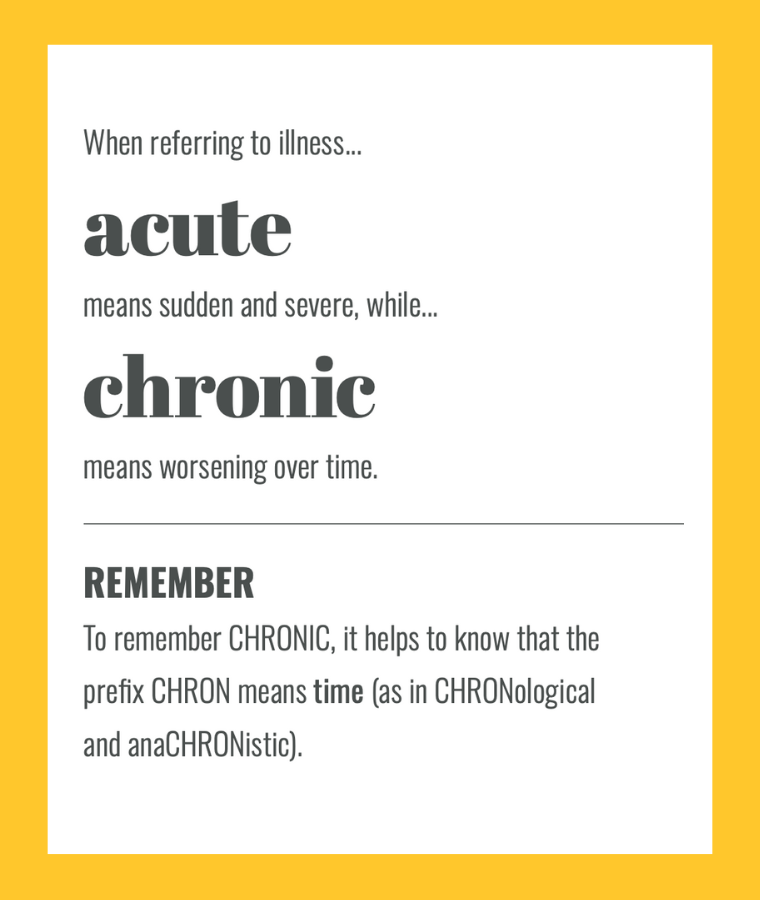
ACUTE can be an adjective or a noun. As an adjective, ACUTE means sudden or severe – often when referring to illness. It can be used in a sentence like this: “I’ve been experiencing ACUTE abdominal pain. It came on so suddenly!” OR “I have an ACUTE sense of smell.” As an noun, ACUTE is a type of accent. It can be used in a sentence like this: “An ACUTE accent is a small mark that changes the pronunciation of word, such as café and financé.”When to use CHRONIC
CHRONIC is an adjective. In a medical context, it means worsening over time or recurring. It can be used in a sentence like this: “The doctor told me I have CHRONIC rhinitis.” To remember CHRONIC, it helps to know that the prefix CHRON always relates to time (as in CHRONological and anaCHRONistic). Knowing the difference between ACUTE and CHRONIC could help you better understand a medical diagnosis – or just keep up with your favourite TV drama! I hope these tips help you to tell these commonly confused words apart in future.Get more simple, memorable spelling tips in The Little Book of Confusables 1 + The Little Book of Confusables 2
My four-times award-winning books take the mystery out of misused words for just just £11.95. You’ll wonder how you managed without them!
2023 GOLD award winner at the eLit book awards.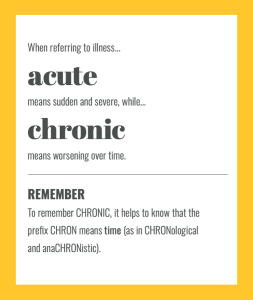
ACUTE vs CHRONIC. Excerpt from The Little Book of Confusables by Sarah Townsend.
More than 1,000 misused words demystified
Master 1,000+ confusing words with the multi-award-winning Little Book of Confusables 1 + 2 – jam-packed with memorable, fun spelling and usage tips: from ACCEPT + EXCEPT and OPTIMAL + OPTIMUM, to BARE + BEAR and PURPOSEFULLY + PURPOSELY.
The biggest mistake you make when writing for your business: and what to do instead

Your words aren’t read by departments, or teams, or brands. They’re read by humans. And if your writing is more robot than human, you’re missing a trick…
You’re bombarded by robot language day in, day out.
🤖 “We would like to apologise for any inconvenience caused”
🤖 “We would be delighted to assist you in this matter”
🤖 “Please do not hesitate to contact myself, should you require any further information”
It has to stop!
Why is human language so important?
No matter what business you’re in – whether you consider yourself to be B2B or B2C – you’re a person trying to help another person.
Human to human (H2H), if you like.
Each message you put out there is your chance to build a relationship. To connect. And if you write like a robot, you can’t connect with a human.
Humans are driven by feelings: something Nelson Mandela summed up beautifully when he said:
“When you talk to a man using a language he understands, that goes to his head. When you talk to a man using his language, that goes to his heart.”
When you consider that up to 95 per cent of buying decisions are based on emotion, you see why heart connections are so important.
If you want your brand to be memorable, your writing needs to be engaging. In other words, it needs to make people feel something – and writing like a robot will have the opposite effect.
What do I mean by robot language?
Robot language is a blend of corporate speak, jargon and business bullsh*t.
(The easiest way to write like a robot? Use generative AI. Don’t do it!)
Business writing doesn’t need to be formal or stuffy – and it should never be boring! But something happens when we’re faced with a blank screen and a burning need to communicate with our clients and customers.
We turn into Apprentice candidates and start spouting words we’d never use in real life.
(Can you relate to overuse of myself and yourself?! I wrote a blog just for you…)
Lazy language. Blah phrases that have become meaningless with overuse: so much so that we no longer hear them or register their meaning.
This robot language does nothing to connect with other humans. Instead, it creates a distance between writer and reader – which is the opposite of the connection and empathy you want your writing to create.
Why human > robot
By comparison, isn’t it refreshing when a business or a brand speaks to you like a human?
❤️ “We messed up! We’re sorry”
❤️ “I’d love to help”
❤️ “Let me know if you need more information”
Human language shouldn’t be rare in day-to-day business interactions, but it is.
That’s why being human – being true to who you are – can help you stand out among the communication chatter, where we’re bombarded with around 5,000 marketing messages Every. Single. Day.
If standing out is this simple, why doesn’t everyone do it?
We’re creatures of habit. We like comfort zones. If we’ve always written this way, change can feel icky – but it’s necessary.
With a hat tip to copywriting legend, Vikki Ross, the easiest way to find your human voice is to ditch formal, stuffy business speak in favour of REAL words that REAL people REALLY use.
Your copy should sound like you. If you wouldn’t say it, don’t write it. (Need help with that? My copy coaching sessions are designed to help you find your human voice and get your writing read.)
Here are five human language tips to get you started:
Human language tips
1) Use contractions
A contraction is a shorter, more conversational word that’s [⬅️ example right there] formed by combining two or more words. An apostrophe is used in place of the missing letters.
Compare:
🤖 A conversation with someone who does not use contractions will not feel natural. It can also feel like you are being told off!
With:
❤️ A conversation with someone who doesn’t use contractions won’t feel natural. It can also feel like you’re being told off!
So, use it’s not it is, you’re not you are, we’re not we are, didn’t not did not and see how much more natural your writing sounds.
2) Have a conversation with your reader
Famous ad executive, Shirley Polykoff, said:
“Copy is a direct conversation with your consumer”
Stop thinking of your audience as a horde (not hoard) of dream clients. Broadcasting to an audience of thousands won’t help you make that connection. Instead, start a one-to-one conversation with your ideal client.
This requires you to have done the groundwork on your target audience.
Who are they? What makes them tick? What keeps them awake at night? What are their greatest hopes? What are their biggest fears? How does your product or service help by solving their problems?
Once you have a clear image of your dream client in mind, give them a name. Let’s say Bob.
Talk to Bob
Picture Bob every time you write, to keep you on track. Imagine him sitting opposite you, sharing a coffee and listening to your ideas.
Would you say this to Bob?
🤖 “We understand the pressure our clients are under…”
No. You wouldn’t. Bob doesn’t care about your clients. He only cares about himself, and how you can make his life easier.
See how the example below sounds more empathetic than the one above?
❤️ “I understand the pressure you’re under…”
Keep Bob (or Jesse or Kiran) in mind and you can’t go far wrong.
3) Break up your text
Ad legend, Leo Burnett, said:
“Make it simple. Make it memorable. Make it inviting to look at. Make it fun to read.”
Think of the last email you received that you really didn’t want to read.
Chances are the information it contained was presented as a block of impenetrable text – a wall of words, if you prefer.
The human brain finds it easier to process information that’s presented in an attractive way – and that means using subheadings, quotes and bullets to break up your text.
Short, punchy sentences and paragraphs help – but mix up the length to make your writing read more like a conversation.
Here’s a great example of how to mix up your sentence lengths to create a sense of rhythm and flow.
Think mobile
Another benefit of using short paragraphs and sentences is that they make your writing more readable for those using mobile devices (smartphones and tablets).
Think this doesn’t apply to you? You may be surprised! Hop onto Google Analytics to see just how high mobile visits are to your website. (This month, 47% of visitors viewed my website on a mobile device.)
Should you use emojis? Sure! Emojis can help your social media posts and email newsletters look more visually appealing – as well as helping to communicate tone.
A word of warning: don’t use emojis to replace words. This can cause problems with the accessibility of your text for those using screen readers. Instead, use them sparingly to enhance your message.
4) Get to the point
Bestselling writer, Neil Gaiman, said:
“Don’t obsess over grammar. If you have to obsess, obsess over clarity”
Your reader is busy. They’re overwhelmed. They’re drowning in information. And you have 8 seconds to grab their attention.
Fail, and you fail to make the sale, to get the sign up, or to convert the casual browser into a paying customer.
Your task is to make your message super clear for your reader, by removing the hurdles and barriers to understanding.
A reviewer of my first book, Survival Skills for Freelancers once said “It’s refreshing to read a book written by a real copywriter, who knows how to get the message from the page to the brain with the least resistance”.
Boost your chances of being understood
- Edit ruthlessly
- Cut the fluff and filler
- Stop saying the same thing twice
- Get super clear on what action you want your reader to take as a result of what they’re reading – and communicate that in a clear call to action
Here’s an example of what happens when you focus on showing off your knowledge and forget your reader just wants to know how you can help them:
🤖 Deep, uninterrupted sleep enhances muscle protein synthesis and growth hormones – both of which are crucial for fat reduction and muscle building.
❤️ Deep sleep helps your body recover after exercise.
Respect your reader’s time by getting straight to the point and making it super clear what you want from them.
5) Ditch these four words
Mark Twain said:
“Substitute DAMN every time you’re inclined to write VERY. Your editor will delete it and your writing will be just as it should be.”
THAT, JUST, VERY and REALLY are filler words. They’re often unnecessary – and removing them from your writing is a great place to start shedding the fluff that gets in the way of human connection.
The sentence below is a great example of bland, fluff-packed writing that can be improved with editing:
🤖 “I JUST thought THAT I would write to suggest THAT we meet up VERY soon to discuss the project further.”
❤️ “Let’s meet to agree next steps.”
Improve your impact
JUST is often used to diminish (“I’m JUST a freelancer” “I JUST do a bit of design work”) and while we use VERY and REALLY to emphasise meaning, the result is often wishy-washy.
Add more power to your writing by replacing two words with one, like these examples:
Very/really important: essential/vital
Very/really good: great/excellent/superb/exceptional
Very/really big: huge/enormous/gigantic/monstrous
In summary
- Use contractions
- Have a conversation with your reader
- Break up your text
- Get to the point
- Ditch THAT, JUST, VERY and REALLY
No more silly mistakes
Of course, when I talk about human language, there’s one thing we all need to avoid: human error! 😮
Part of making sure you’re understood is using the right versions of those commonly confused words that can trip you up and entirely change the meaning of your message.
My Little Book of Confusables contains fun, memorable spelling and usage tips for almost 600 commonly confused words and phrases – from white as a sheep and damp squid to acute/chronic, imply/infer, poisonous/venomous – because we ALL have language blindspots!
You’ll wonder how you ever managed without it!
More than 1,000 misused words demystified
Master 1,000+ confusing words with the multi-award-winning Little Book of Confusables 1 + 2 – jam-packed with memorable, fun spelling and usage tips: from ACCEPT + EXCEPT and OPTIMAL + OPTIMUM, to BARE + BEAR and PURPOSEFULLY + PURPOSELY.