

Too vs to vs two: simple tips to help you remember
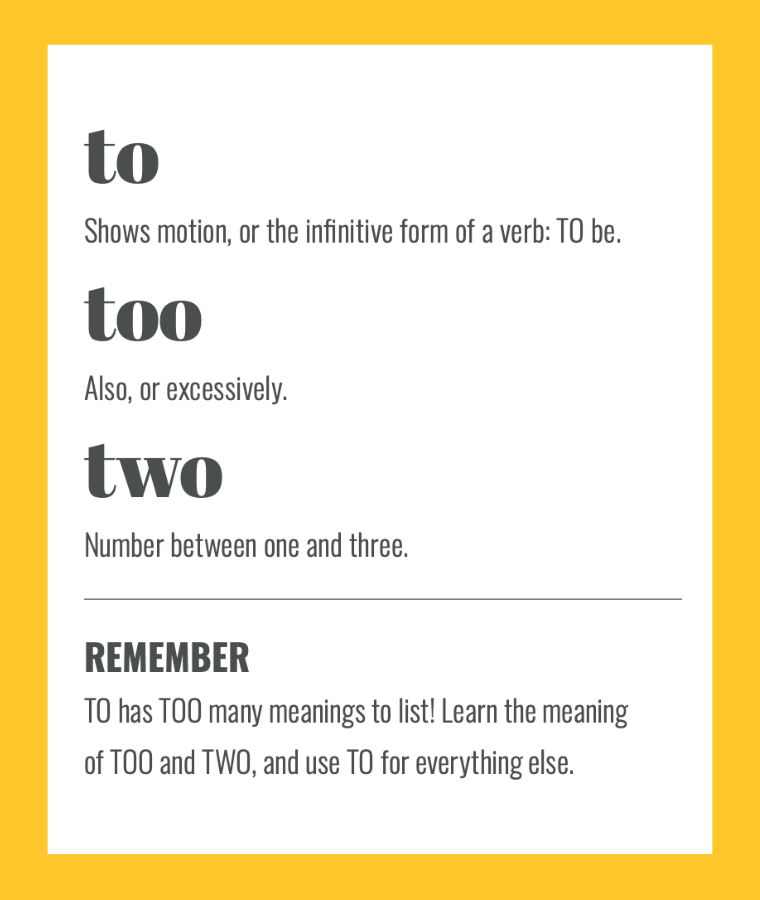
TOO vs TO vs TWO – simple tips to remember the difference
TOO, TO and TWO are easy to confuse. They may sound the same but they have different uses. These simple tips will help you decide which word you need.
When to use too
TOO is an adverb meaning as well or excessively.
For example:
“I’m going to the park too.”
OR
“I can’t go because it’s too far.”
To help you remember which spelling you need, think O + O = as + well
OR
Two Ss in exceSSive and two Os in too
When to use to
To is a useful preposition that has several meanings. It’s also the most common of the three spellings.
It can be used to indicate a direction, goal, place of arrival or a period of time.
For example:
“I’m going to the shop.”
“The shop is open from 7am to 9pm.”
To can also be used to show the infinitive form of a verb, like this:
“I’m going to buy a newspaper” = to buy
“She needs to leave soon” = to leave
When to use two
Though it’s far less likely to be confused with to and too, the spelling two is the easy one to remember, as it’s only ever the number 2 spelled out.
For example:
“The park is two miles away.”
OR
“Just the two of us.”
I hope these tips help you remember the difference between too, to and two. Feel free to share your tips if you have a different way of remembering.
Get more simple, memorable spelling tips in The Little Book of Confusables 1 + The Little Book of Confusables 2
My four-times award-winning books take the mystery out of misused words for just just £11.95. You’ll wonder how you managed without them!
TWO vs TOO vs TO. Excerpt from The Little Book of Confusables by Sarah Townsend.

More than 1,000 misused words demystified
Master 1,000+ confusing words with the multi-award-winning Little Book of Confusables 1 + 2 – jam-packed with memorable, fun spelling and usage tips: from ACCEPT + EXCEPT and OPTIMAL + OPTIMUM, to BARE + BEAR and PURPOSEFULLY + PURPOSELY.
Whose vs who’s: tips to help you learn the difference
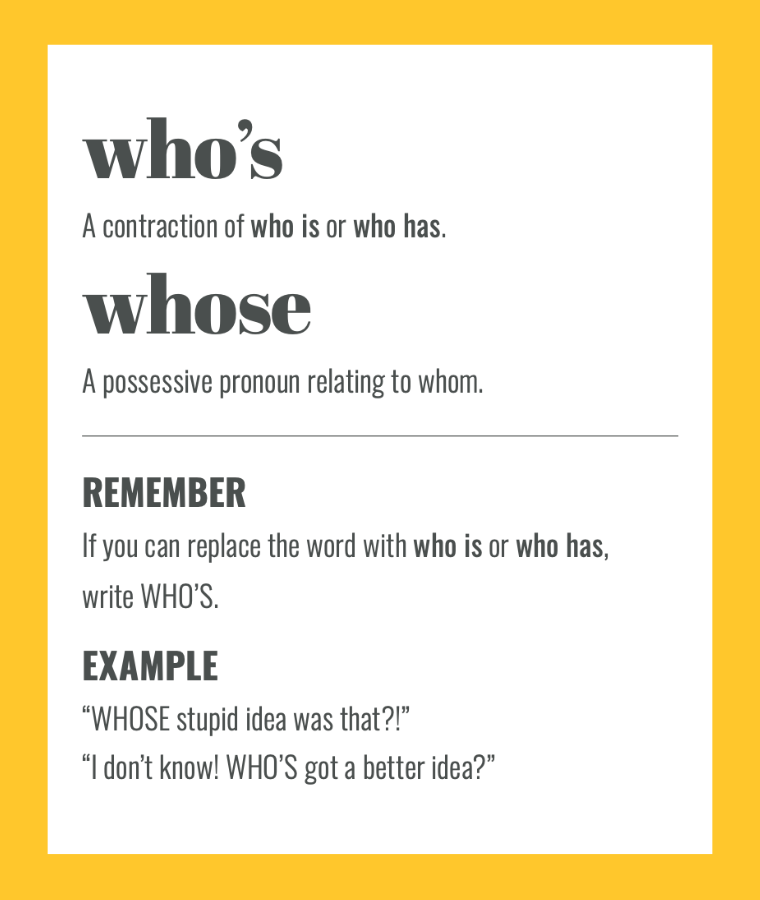
WHOSE vs WHO’S – learn the difference between these two commonly confused spellings.
WHOSE and WHO’S are easy to confuse. Though they sound the same – and both have their root in the word WHO – they have different meanings. These simple tips will help you learn the difference.
When to use whose
WHOSE is a possessive pronoun used to ask or tell whom something belongs to.
For example:
“Whose pencil is this?”
OR
“JK Rowling is an author whose books are loved by millions.”
When to use who’s
WHO’S is a contraction of who + is or who + has.
For example:
“Who’s coming with me?” = “Who is coming with me?”
OR
“Shall I see who’s gone with him?” = “Shall I see who has gone with him?”
In a nutshell, if you can replace the word you’re writing with either who is or who has, always use WHO’S.
I hope this guidance helps you remember the difference between whose and who’s. Let me know how you get on.
Want more writing tips?
For more language love, join my Clever Copy Club and get monthly updates direct to your inbox. Alternatively, email me, follow me on Twitter, connect on LinkedIn or like my page on Facebook.
Get more simple, memorable spelling tips in The Little Book of Confusables 1 + The Little Book of Confusables 2
My four-times award-winning books take the mystery out of misused words for just just £11.95. You’ll wonder how you managed without them!
WHO’S vs WHOSE. Excerpt from The Little Book of Confusables by Sarah Townsend.
More than 1,000 misused words demystified
Master 1,000+ confusing words with the multi-award-winning Little Book of Confusables 1 + 2 – jam-packed with memorable, fun spelling and usage tips: from ACCEPT + EXCEPT and OPTIMAL + OPTIMUM, to BARE + BEAR and PURPOSEFULLY + PURPOSELY.
Hoard and horde: spelling tips to remember the difference
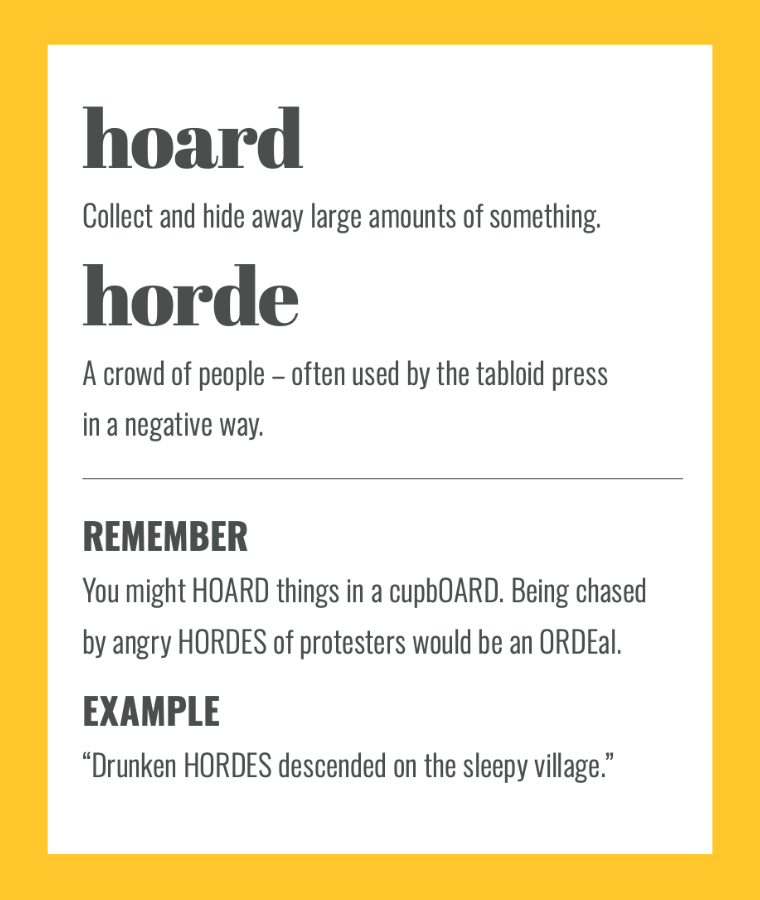
HOARD and HORDE: which is which? Learn the difference between these identical-sounding words.
HOARD and HORDE are easy to confuse. The fact that the two words sound the same – they’re homophones – means people commonly mix them up.
Here, I outline the difference between HOARD and HORDE.
When to use hoard
HOARD is a verb meaning to never throw anything away.
For example:
“I love to hoard old magazines.”
When to use horde
HORDE is a noun, meaning a crowd of people. It’s often used by the tabloid press in a negative way. It’s a little tenuous, but you can use this knowledge to remember which spelling you need, if you think of the word ordeal:
For example:
“She was chased out of the building by a horde of angry people. It was quite an ordeal.”
Want more writing tips?
For more language love, join my Clever Copy Club and get monthly updates direct to your inbox. Alternatively, email me, follow me on Twitter, connect on LinkedIn or like my page on Facebook.
Get more simple, memorable spelling tips in The Little Book of Confusables 1 + The Little Book of Confusables 2
My four-times award-winning books take the mystery out of misused words for just just £11.95. You’ll wonder how you managed without them!
HOARD vs HORDE. Excerpt from The Little Book of Confusables by Sarah Townsend.
More than 1,000 misused words demystified
Master 1,000+ confusing words with the multi-award-winning Little Book of Confusables 1 + 2 – jam-packed with memorable, fun spelling and usage tips: from ACCEPT + EXCEPT and OPTIMAL + OPTIMUM, to BARE + BEAR and PURPOSEFULLY + PURPOSELY.
Marinate vs marinade: simple tips to help you remember
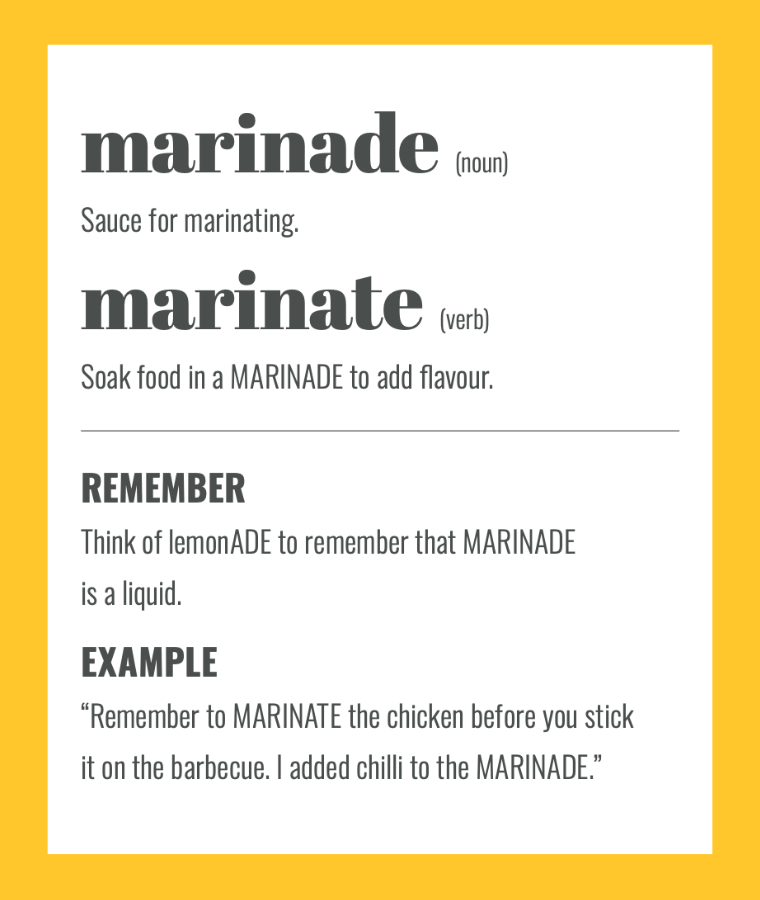
MARINATE vs MARINADE – simple tips to remember the difference
MARINATE and MARINADE are easy to confuse. They may sound similar but they have different meanings. These simple tips will help you decide which word you need.
Marinate
MARINATE is a verb, meaning to soak food in a MARINADE to give it flavour and richness.
“Remember to marinate the chicken before you stick it on the barbecue!”
Marinade
MARINADE is a noun. It’s the sauce or liquid in which a dish is MARINATED, to provide flavour.
“Have you added chillis to the marinade?”
If you find it tricky to remember the difference, think of lemonADE to remember that marinADE is a liquid.
I hope this helps you to remember the difference between MARINATE and MARINADE.
Want more writing tips?
For more language love, join my Clever Copy Club and get monthly updates direct to your inbox. Alternatively, email me, follow me on Twitter, connect on LinkedIn or like my page on Facebook.
Get more simple, memorable spelling tips in The Little Book of Confusables 1 + The Little Book of Confusables 2
My four-times award-winning books take the mystery out of misused words for just just £11.95. You’ll wonder how you managed without them!
MARINATE vs MARINADE. Excerpt from The Little Book of Confusables by Sarah Townsend.
More than 1,000 misused words demystified
Master 1,000+ confusing words with the multi-award-winning Little Book of Confusables 1 + 2 – jam-packed with memorable, fun spelling and usage tips: from ACCEPT + EXCEPT and OPTIMAL + OPTIMUM, to BARE + BEAR and PURPOSEFULLY + PURPOSELY.
Principal vs principle: do you know the difference?
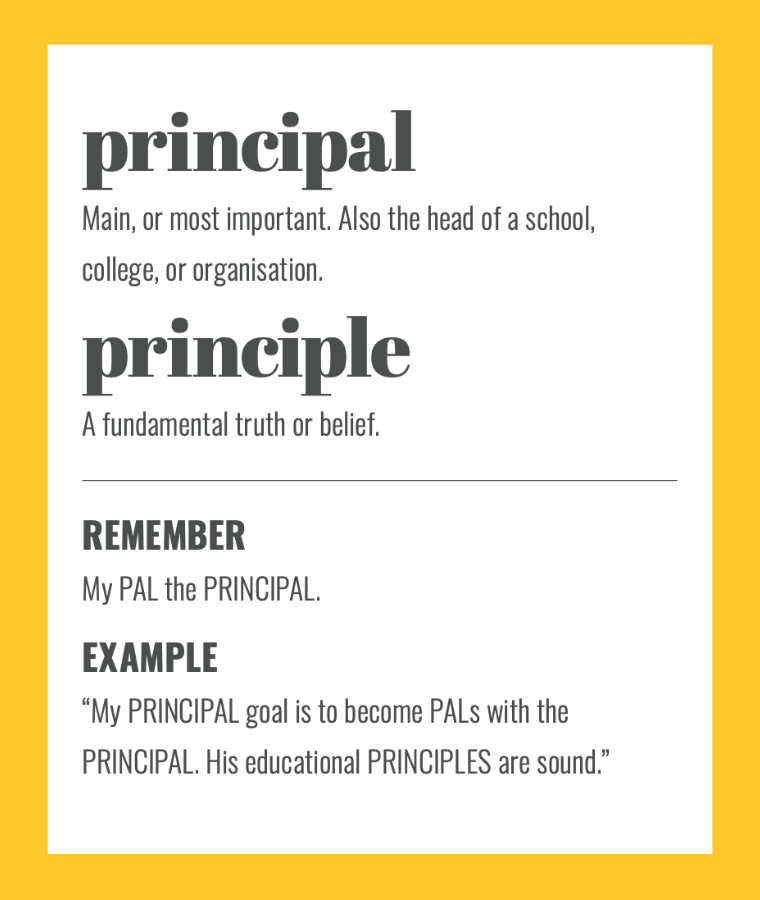
PRINCIPAL or PRINCIPLE: which is which? Simple spelling tips to help you remember the difference.
PRINCIPAL or PRINCIPLE – two words with very different meanings. What do they mean – and how do you decide which spelling you need? It’s easy.
These spelling tips will help you decide whether you need to write PRINCIPAL or PRINCIPLE.
Principal
PRINCIPAL is a noun, meaning the head of a school or college, or the most important person within an organisation.
The easiest way to learn this is to remember that PAL is a noun: your PAL the princiPAL.
For example:
“Ms George is the college principal.”
Spelled this way, PRINCIPAL is also an adjective, meaning the chief or most important.
“Increasing turnover is our principal goal.”
Remember the A in principAl and the A in mAin.
Principle
PRINCIPLE is also a noun that describes a fundamental truth or belief.
For example:
“These are the principles of good grammar.”
OR
“I don’t agree with his principles.”
I hope this helps you to remember the difference between PRINCIPAL and PRINCIPLE.
Want more writing tips?
For more language love, join my Clever Copy Club and get monthly updates direct to your inbox. Alternatively, email me, follow me on Twitter, connect on LinkedIn or like my page on Facebook.
Get more simple, memorable spelling tips in The Little Book of Confusables 1 + The Little Book of Confusables 2
My four-times award-winning books take the mystery out of misused words for just just £11.95. You’ll wonder how you managed without them!
PRINCIPAL vs PRINCIPLE. Excerpt from The Little Book of Confusables by Sarah Townsend.
More than 1,000 misused words demystified
Master 1,000+ confusing words with the multi-award-winning Little Book of Confusables 1 + 2 – jam-packed with memorable, fun spelling and usage tips: from ACCEPT + EXCEPT and OPTIMAL + OPTIMUM, to BARE + BEAR and PURPOSEFULLY + PURPOSELY.