

Strengths, weaknesses… and the key to freelance success

If you want to rock the socks off self-employment you need to play to your strengths and ignore your weaknesses – right? Wrong. Here are 6 reasons why knowing your strengths AND your weaknesses plays a big part in freelance success.
1) Know what makes you special
In business speak, this is known as your USP – your unique selling point. It’s the thing that makes you stand out from the crowd, and the reason clients will choose to work with you over your competitors.
- Perhaps you offer a unique or unusual service.
- Maybe your strength is an ability to work quickly and efficiently.
- Perhaps working alone means you can provide a tailored, personal service to your clients.
- Or perhaps you’re highly experienced in a particular niche or market.
When you’ve identified your USP, reframe it from your clients’ perspective.
What pains do you solve for them? What benefit will they get from working with you? Whatever it is, don’t be afraid to shout it from the rooftops!
2) Play to your strengths
What qualities and strengths do you bring to the table?
Perhaps you’re great at listening to your clients’ needs and coming up with creative solutions to their problems? Or perhaps organisation is your superpower, and you’re great at managing projects, timetables and budgets?
If you find it hard to recognise your positive traits, ask a trusted friend – or, if you’re feeling brave – ask clients why they’d recommend you (the answer may not be what you expect!).
Knowing your strengths – and what they mean to your clients – can help you recognise the clients and projects that are a good fit for you (and the ones to avoid!).
3) Reframe your weaknesses
When I wrote Survival Skills for Freelancers I asked the self-employed community for the one quality they thought was vital to become a successful freelancer. Two answers that came up again and again were patience and thick skin.
I have neither. And that’s okay. Because being aware of the qualities you lack can work in your favour.
Most weaknesses can be reframed as strengths. For example, impatient people are driven. They get stuff done. And my sensitivity makes me a great listener – an essential skill for freelancers.
Would life be easier without weaknesses? Sure, but they haven’t held me back – and they shouldn’t hold you back either.
4) Know your personality
Are you naturally outgoing and extroverted, or more of the shy and retiring type?
Being aware of your personality type enables you to develop working patterns that suit you.
If you’re an extrovert, like me, you may benefit from building time into your day to chat to friends or colleagues online.
Sharing ideas, advice and laughter with others gives extroverts the energy – and the productivity boost – to smash through an afternoon of deadlines with ease.
Introverts, on the other hand, may need quiet time to recharge after a morning of online meetings or networking. For them, being around other people can be draining. Spending the afternoon focused on productive output can be a great way to achieve this.
5) Know your market
Before you spend time and energy on marketing your business, make sure you understand what your audience needs.
A little research into your target market – and some time spent asking the right people the right questions – can give you a valuable insight into the challenges that potential clients face.
Put yourself in their shoes:
- What are they struggling with?
- What pains can you solve for them?
- How can you make their life easier?
- Where are the gaps you need to fill?
Use this inside information to market your services.
6) Offer solutions
Essential purchases aside, people don’t make buying decisions based on facts and logic – they buy based on emotion.
Instead of focusing on practicalities such as your level of experience and qualifications, try answering your client’s primary question: “What’s in it for me?”.
How will working with you make them feel?
- Will it bring a sense of order and control?
- Will it provide peace of mind, knowing an important project is in safe hands?
- Will it help them meet their deadlines, and make them look good to their boss?
Build this into your sales pitch.
As Maya Angelou said, “People will forget what you said, people will forget what you did, but people will never forget how you made them feel”.
As a freelancer, you’re going to be spending a lot of time in your own company! The better you know yourself, the better positioned you are to work on your weaknesses and play to your strengths.
Get comfortable with who you are and you’re on track to freelance success.
Enjoyed this post? You’ll love Survival Skills for Freelancers. Twenty years of real-life freelance experience plus advice from 120 freelancers for just £11.95.
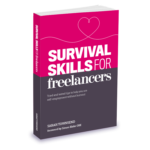
Grow in confidence and show self-employment who’s boss!
With 20 years of freelance experience + advice from 120 entrepreneurs, Survival Skills for Freelancers is your secret weapon to get more enjoyment from self-employment.
The 2025 edition is out now, with a new lower price (£11.95), updated stats, links, references and resources, and all-new advice from another 20 successful freelancers.
Get your copy in paperback, Kindle or Audible today.
How to kick self-doubt to the curb and become your biggest cheerleader

When was the last time you went outside your comfort zone? I mean, really? Or do you – like many freelancers and small business owners – shy away from opportunities for fear of messing up or looking daft?
It’s a common problem – and it’s holding you back.
Many years ago, I watched a Derren Brown show about luck. His point was that people who thought they were unlucky were closed off to opportunities. Like stepping over a stray £20 note on the pavement, they simply didn’t see them. Meanwhile, those who thought they were lucky spotted opportunities All. The. Time.
I decided there and then that I wanted to fall into the second category.
And it works. It really does.
How?
Opportunity knocks
When you open your eyes – and your mind – opportunities are all around you. Whether you grasp them with both hands and use them to develop your skills, your network and your career depends on your mindset.
Perhaps there’s a chance to collaborate with another business owner on Instagram, you’re invited to take part in a live event, or there’s a niche that’s begging for an online course that’s just your speciality.
Without the right mindset, these opportunities will pass you by.
Why?
Because of fear, self-doubt and imposter syndrome.
Imposter what now?!
You know imposter syndrome. It’s that nagging feeling that you’re inadequate, incompetent, and generally undeserving of success – and it runs deep in the world of self-employment.
Sometimes imposter syndrome shows up as a mean voice in your head: “You think you can succeed in business? Who are you kidding?” or “You can’t charge that! Who do you think you are?!”.
Sometimes it’s the crippling anxiety that accompanies the start of a project for a new client. The fear of failure, of disappointing people, and of not being good enough.
Sometimes it’s a feeling that you’ve been faking it and you’ll be exposed as a fraud at any moment. That you don’t deserve success, and you’ve only got where you are today by sheer guts and chance.
You’ve got this
Imposter syndrome and self-doubt stem from a fear of being found out or not measuring up – despite evidence to the contrary.
Of course you know what you’re doing. On a good day, you might even admit you’re damn good at it. Yet still they lurk around the corner, waiting to stop you in your tracks when you least expect it.
If you’re not careful, these powerful feelings will keep you stuck.
They position you firmly in your comfort zone, stops you taking risks, and prevent you from doing those things that are good for business.
The perfection connection
Imposter syndrome’s big sister is perfectionism. As Winston Churchill once said, “Perfection is the enemy of progress,” – and it’s easy to see why.
You can always spend more time polishing that presentation, faffing with that website or sharpening that course content but remember – done is better than perfect.
Whatever it is that’s getting in your way, remember – it doesn’t have to be life-changing or world-class or revolutionary. There will never be a perfect time, and you’ll never be truly ready.
Sometimes you just need to put your big girl pants on and put it out there into the big wide world. Because only when it’s out there can you get feedback, improve, rinse and repeat.
So just do it.
“But what if I fail?”
Here’s a thing – what if you don’t? You can’t make a success of self-employment without taking risks. You may fail big, you may fail often… but failure is how we develop as both individuals and business owners.
We fail, we learn, we grow.
Make fear work for you
It’s easy to feel the fear and freeze, like a rabbit in headlamps – but the flurry of butterflies that descends when we step outside our comfort zone reminds us we’re alive.
Any time you have to do something brave and uncomfortable, like a talk or presentation, remember that being nervous and being excited feel just the same.
Tell your brain you’re excited to be doing something new – something bold – and you’re more likely to enjoy it, and to do well.
Show that fear who’s boss
Being aware of the situations and circumstances that trigger self-doubt can help you feel more equipped to deal with them. A few simple strategies – covered in the brand new 2025 edition of Survival Skills for Freelancers – can help you keep self-doubt and imposter syndrome in check:
- Accept mistakes
- Stop comparing yourself
- Keep negative self-talk in check… and keep talking
- Reward yourself for taking risks
- List the things you’re good at
- Celebrate your successes
You’re not alone
It’s easy to feel like you’re alone with these fears but you’re not. There are hundreds of thousands of small biz owners out there just like you. The secret to facing – and embracing – them is to find those likeminded people.
And when you find them? Reach out, connect, learn, support, collaborate and grow.
You’ve got this.
Grow in confidence and show self-employment who’s boss!
With 20 years of freelance experience + advice from 120 entrepreneurs, Survival Skills for Freelancers is your secret weapon to get more enjoyment from self-employment.
The 2025 edition is out now, with a new lower price (£11.95), updated stats, links, references and resources, and all-new advice from another 20 successful freelancers.
Get your copy in paperback, Kindle or Audible today.
How to use Twitter chats to grow your network and benefit your business
Twitter chats are a free and effective way to grow your business network by connecting with others in your field of expertise or your geographical area. I recommend them in Survival Skills for Freelancers as a great way to connect with fellow business owners and freelancers – and because I couldn’t find a central list to refer people to, I decided to create my own.
The list below is a work in progress. If you know of, take part in – or even host – a Twitter chat, and you’d like me to add it to the list, drop me a DM. Equally, if you spot any mistakes, please let me know!
First, a quick overview:
What are Twitter chats?
Twitter chats are organised online conversations that take place at the same time and on the same day each week.
How do Twitter chats work?
Participants – often freelancers and small business owners – use a designated hashtag (such as #FreelanceChat or #ContentClubUK) to introduce themselves, find new people to connect with, and often answer questions posed by the host.
Twitter chats most commonly last for an hour – sometimes less. Most Twitter chats are hosted by the organiser, though some regularly invite guest hosts to pose the questions and guide the discussion.
What is the benefit of Twitter chats?
Freelance life can be isolating. When you’re working from home day in, day out, it’s easy to fall into the trap of thinking you’re the only person who understands the things you’re going through.
In reality, there are hundreds of thousands of people who are in the same boat, and who struggle with the same issues.
Twitter chats present an opportunity to build your network by connecting with other people who get it. They’re a great way to find new likeminded, inspiring people to follow, to share advice and resources, and to get answers to your burning questions.
How do I find Twitter chats to take part in?
Start with the list below. Find a couple of chats that fit your niche – whether that’s your area of expertise or your geographical location – and take part in a couple. You’ll quickly find the groups that are friendly and welcoming. Set a weekly reminder to take part, and get involved!
Pro tip: approach Twitter chats with a generous mindset. Think about giving and sharing advice and expertise, rather than focusing on what you can get from it. Interact with other people’s posts, retweet, like and comment before expecting others to do the same.
An important disclaimer: Twitter chats take place around the world. I’ve been caught out many times by time differences, and so the published times in this list are all based on UK time – whether the chat originates outside the UK or not. It’s not ideal, but neither is trying to work out time differences when you’re very much not someone who’s good with figures!
|
Niche Twitter hours |
Day |
Time |
Hosted by |
| #AgencyChat | Thursday | 7pm to 8pm | @agorapulse |
| #allinbizhr | Monday | 12pm to 1pm | @ALLinBIZnet |
| #allinbizhr | Friday | 12pm to 1pm | @ALLinBIZnet |
| #ContentClubUK | Tuesday | 11pm to 11.30 | @Fi_digitaldrum |
| #creativebizhour | Monday | 7.30 to 9pm | @lizzie_chantree |
| #ecomchat | Monday | 1pm to 2pm | @danbarker @JamesGurd |
| #EmailHour | Thursday | 8pm to 9pm | @robandkennedy |
| #EthicalHour | Monday | 8pm to 9pm | @EthicalHour |
| #eventprofs | Monday | 8pm to 9pm | @themiceblogHQ |
| #eventprofs | Friday | 8pm to 9pm | @themiceblogHQ |
| #eventprofstalk | Monday | 9pm to 10pm | |
| #FreelanceChat | Thursday | 5pm to 6pm | @PRisUs |
| #FreelanceHeroes | Wednesday | 8pm to 9pm | @FHChat |
| #handmadehour | Wednesday | 7.30 to 9pm | @handmadehour |
| #handmadehour | Sunday | 8pm to 9pm | @handmadehour |
| #IndieHour | Tuesday | 8pm to 9pm | @retailmentoring |
| #ManUKHour | Tuesday | 8pm to 9pm | @ManUKHour |
| #PetworkingHour | Tuesday | 6pm to 7pm | @petworkinghour |
| #remotechat | Wednesday | 6pm to 7pm | @workingrem |
| #SmartNetworking | Monday | 7pm to 8pm | @smart_bn |
| #SEMrushchat | Wednesday | 4pm to 5pm | @semrush |
| #SMESupportHour | Wednesday | 8pm to 9pm | @mbsmih |
| #TwitterSmarter | Thursday | 6pm to 7pm | @MadalynSklar |
|
Geographical Twitter hours |
Day |
Time |
Hosted by |
| #BrightonHour | Monday | 8.30pm to 9.30pm | |
| #BrumHour | Sunday | 8pm to 9pm | @BrumHour @DavidWMassey |
| #CotswoldHour | Thursday | 9pm to 10pm | @ShireMarketing |
| #MalvernHillsHour | Wednesday | 8pm to 9pm | |
| #EveshamHour | Thursday | 8pm to 9pm | |
| #HampshireHour | Tuesday | 8pm to 9pm | @HampshireHour |
| #HerefordHour | Monday | 1pm to 2pm | |
| #Midlandshour | Wednesday | 8pm to 9pm | |
| #NetworkNorthEast | Tuesday | 2pm to 3pm | @Durham_Business @easymarketingne @CannyInsights |
| #Oxbusinesshour | Wednesday | 1pm to 2pm | @CypherHQ |
| #SurreyHour | Tuesday | 7.30 to 8.30pm | @surreyhour |
| #uptonhour | Tuesday | 8pm to 9pm | @uptonhour |
| #WiltshireHour | Monday | 8pm to 9pm | @WiltsHour |
| #WorcestershireHour | Wednesday | 12 to 1pm | @WorcsHour @StuartAllenFCMI |
| #WorcestershireHour | Monday | 8pm to 9pm | @WorcsHour @StuartAllenFCMI |
Grow in confidence and show self-employment who’s boss!
With 20 years of freelance experience + advice from 120 entrepreneurs, Survival Skills for Freelancers is your secret weapon to get more enjoyment from self-employment.
The 2025 edition is out now, with a new lower price (£11.95), updated stats, links, references and resources, and all-new advice from another 20 successful freelancers.
Get your copy in paperback, Kindle or Audible today.
The freelancing fear that strikes terror into the self-employed
The fear of failure keeps you stuck. It stops you taking risks – and prevents you from doing things that are good for your business.
And it paralyses everyone from the newest of newbie freelancers to the most experienced of small biz owners.
So, whaddya do about it?
“But what if I fail?”
Here’s a thing – what if you don’t? You can’t make a success of self-employment unless you try. You may fail big, you may fail often… but failure is how we develop as both individuals and business owners.
We fail, we learn, we grow.
Whether you’re in a steady job you hate, thinking of making the leap into self-employment, or you’re an experienced freelancer tackling something you’ve never done before, show that fear who’s boss!
As Nike would say, just do it.
“But it’s not quite right!”
To quote Winston Churchill, “Perfection is the enemy of progress.”
You can always spend more time polishing that presentation or sharpening that course content but often done is better than perfect.
You can tinker, you can hone, you can faff, you can refine… but hey – semantics!
It all adds up to procrastination.
Whatever it is that’s getting in your way or keeping you stuck, remember – it doesn’t have to be life-changing or world-class or revolutionary. There will never be a perfect time, and you will never be truly ready.
Sometimes you just need to put your big girl (or boy) pants on and put it out there into the big wide world. Because only when it’s out there can you get feedback, improve, rinse and repeat.
HOW IS IT FOR YOU?
Experienced journalist and founder of Freelance Feels, Jenny Stallard, describes herself as a ‘threelancer’. She’s dabbled with self-employment three times – and even now she admits freelance life can be full of fears
“When it comes to freelancing, something scares me every single day,” says Jenny. “Taking the leap into self-employment was the scariest thing, but that’s not all. Freelancing can feel like we are on a cliff path, constantly negotiating the steps between falling off and the softer grass to our other side. From money worries and finding new work, to how much to charge and what to post on social media…”
Make fear work for you
Despite the potential pile-up of panic, Jenny admits the heady mix of fear and excitement is one of the best things about self-employment.
And she’s right.
It’s easy to feel the fear and freeze, like a rabbit in headlamps – but the flurry of butterflies that descends when we step outside our comfort zone reminds us we’re alive.
Any time you have to do something brave and uncomfortable, like a talk or presentation, remember that being nervous and being excited feel just the same.
Tell your brain you’re excited to be doing something new – something bold – and you’re more likely to enjoy it, and to do well.
HOW IS IT FOR YOU?
Author of How to Be a Well Being, Dr Andy Cope studied happiness for 12 years and now delivers keynote speeches on the subject to audiences around the world. “I deliver and teach wellbeing, yet before I go on stage I’m racked with nerves and panic and wonder why the hell I’m doing this, every single time.
“Everyone thinks they’re the only one that’s terrified of stepping outside their comfort zone, but everyone has the same insecurities as you do. The realisation that we all feel uncomfortable, and that we’re all waiting to be found out is, in itself, quite comforting. It’s perfectly okay not to be okay – it’s part of the human condition.
If you never try…
It’s easy to feel like you’re alone with your fears but you’re not. There are hundreds of thousands of small biz owners out there just like you.
The secret to facing – and embracing – your freelance fears is to find those likeminded people.
When you find them, reach out, connect, learn, support, collaborate and grow.
What’s the worst that can happen?
If you fail so spectacularly that you decide freelance life simply isn’t for you, that’s okay! But if you never try, you’ll never know…
Grow in confidence and show self-employment who’s boss!
With 20 years of freelance experience + advice from 120 entrepreneurs, Survival Skills for Freelancers is your secret weapon to get more enjoyment from self-employment.
The 2025 edition is out now, with a new lower price (£11.95), updated stats, links, references and resources, and all-new advice from another 20 successful freelancers.
Get your copy in paperback, Kindle or Audible today.
Creating an eyecatching look for my bestselling book for freelancers
As a freelance marketing copywriter for over 20 years, I work in partnership with a lot of local graphic design businesses. While I’m happy to have so many creative and reliable design partners to recommend when my clients need them, it made choosing who to work with on Survival Skills for Freelancers pretty tricky. This case study shares just some of the reasons why I believe I made the right choice.
The design partner: Maple Rock Design
With over 30 years of combined design experience, Rich Bell and Karen Mitchell at Cheltenham-based Maple Rock Design provide professional graphic design and web development services for businesses around the UK.
Having worked with Maple Rock just a few months earlier on the refresh of my own website, I knew Rich and Karen would be a safe pair of hands for my new book, so we arranged to meet to talk through some ideas.
The need
When I first got the idea for Survival Skills for Freelancers I had no clue how much was involved in the process of self-publishing! (More of a learning vertical, than a curve, I’d say, but that’s a whole other post.)
Being a writer by trade meant I had no difficulty getting to grips with the writing or editing process. Instead – much like the business end of freelance life that the book addresses – it was the many different tasks surrounding the launch that challenged me the most.
Early on in the process of writing Survival Skills for Freelancers, I spoke to a good friend of mine, speaker and coach, Robin Waite. As Robin has written and published four bestselling books, I was keen to get his advice.
One of Robin’s many tips was to get the book cover designed early on. He recommended doing so because it brings the project to life, and helps to keep you motivated throughout the process. He also stressed the importance of cover design in self-publishing success. Selling on Amazon requires getting seen in a sea of 32.8 million book titles, so it’s vital to launch with an eyecatching cover that stands out.
The solution
I arranged to meet Rich in a Cheltenham coffee shop and arrived bursting with ideas, inspiration and a huge book-design to-do list that ranged from cover design and landing page to promotional postcards – as well as integration with my copywriting website.
Looking back, our meeting was one of the highlights of the entire process of self-publishing my bestselling book for freelancers and the self-employed. We had a lively brainstorming session in which Rich was full of practical suggestions and solutions to my design challenges, and I left the meeting feeling inspired and excited for the next stage of the process.
Within a couple of days of our meeting I had drafted copy for the book’s new landing page. I was already working hard behind the scenes to drum up support for the book, but sending a summary in a Word doc just wasn’t cutting it. I needed a professional, great-looking web page to show my credibility and intent – from initial review quotes and sample content to the target audience, details of the book’s release, and where to buy.
Armed with this content, Rich created a look and feel for the landing page that I loved. A few tweaks and the page was ready to be built. And we were on our way.
In the meantime, Karen and I spoke about ideas for the cover. I’d worked up some ideas myself but they were pretty dreadful (think Shutterstock illustration with homemade typography) so I was delighted to get a professional perspective. Though Karen hadn’t designed book covers before, I trusted her to translate my aims for the book into an eyecatching design that complemented my existing branding and would stand out even when viewed as a thumbnail image.
Rather than running through heaps of different designs before settling on the final image, Karen’s initial ideas gave me enough of a steer to visualise exactly what I wanted the cover to look like. I printed out and chopped up the initial visuals, taking elements from each design and creating a new look that was bang in line with how I’d pictured the book looking.
Karen was super supportive throughout the process, creating various images that I could use to build a buzz on my social media, and even resizing the design at the last minute for the printer.
Further down the line, Rich created a postcard design that I could send out with preview copies of the book, and implemented a banner for my copywriting website which would display various review quotes at random, and which now links directly to Amazon, to help visitors to my site buy the book.
I’m in no doubt that the support I had from Maple Rock played a big part in the successful launch of Survival Skills for Freelancers. I’ve had tons of great feedback on the cover design alone, including an email from someone who designs book covers for a living. Great work from a great team.
In Maple Rock’s words…
“We’ve known Sarah for many years and have worked together on a number of projects so I was intrigued when she got in touch about her book. This project gave us the chance to demonstrate our creativity in both web and graphic design, and the opportunity to move into book cover design for the first time.
“When we started the project, we couldn’t have foreseen that Survival Skills for Freelancers would end up becoming a business bestseller! It’s great to have had the chance to work on a project that’s making a difference to the self-employed community, and Karen and I are delighted to have been involved.”
Rich Bell, Director, Maple Rock Design
maplerockdesign.co.uk

Want your words to be less BLAH BLAH and more TA-DA?
Book a FREE 20-minute discovery call
And let me take care of your words while you take care of business.