

Vain vs vane vs vein: simple tips to remember the difference
The words VAIN, VANE and VEIN are easy to confuse because they sound the same – they’re homophones – but their meanings are very different!
These simple spelling and usage tips will help you remember the difference between VAIN, VANE and VEIN.
When to use VAIN
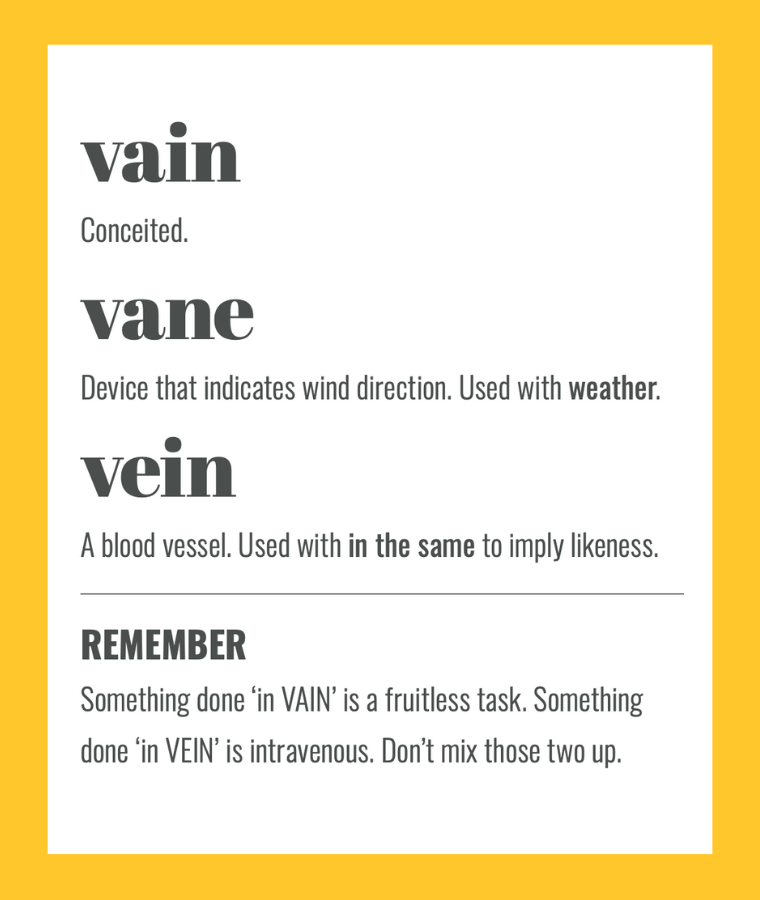
VAIN is an adjective that describes someone who’s conceited – like the guy in the famous Carly Simon song, You’re So Vain. VAIN can be used in a sentence like this: “He was arrogant and VAIN.” VAIN is also used in the phrase ‘in VAIN’, which describes a fruitless task. (Don’t write ‘in VEIN’ unless you mean intravenous. There’s a big difference!)When to use VANE
The word VANE usually proceeds ‘weather’. A weather VANE is a device that indicates wind direction. You’ve probably seen them on the top of churches. VANE can be used in a sentence like this: “The class made their own weather VANES from paper and a straw.”When to use VEIN
VEIN is a noun that describes a blood vessel. It can be used in a sentence like this: “I tried giving blood but they couldn’t find a VEIN!” VEIN is also used in the phrase ‘in the same VEIN’, which implies likeness. I hope these tips help you to remember the difference between these commonly confused words in the future.Get more simple, memorable spelling tips in The Little Book of Confusables 1 + The Little Book of Confusables 2
My four-times award-winning books take the mystery out of misused words for just just £11.95. You’ll wonder how you managed without them!
2023 GOLD award winner at the eLit book awards.VAIN, VANE and VEIN. Excerpt from The Little Book of Confusables by Sarah Townsend.

More than 1,000 misused words demystified
Master 1,000+ confusing words with the multi-award-winning Little Book of Confusables 1 + 2 – jam-packed with memorable, fun spelling and usage tips: from ACCEPT + EXCEPT and OPTIMAL + OPTIMUM, to BARE + BEAR and PURPOSEFULLY + PURPOSELY.
Loved by writers and non-writers alike, these gorgeously accessible books have been described as “An absolute joy”, “The books you never knew you needed” and “Perfect for anyone who ever has to write anything!”.