

A LOT vs ALLOT: spelling tips to help you remember the difference
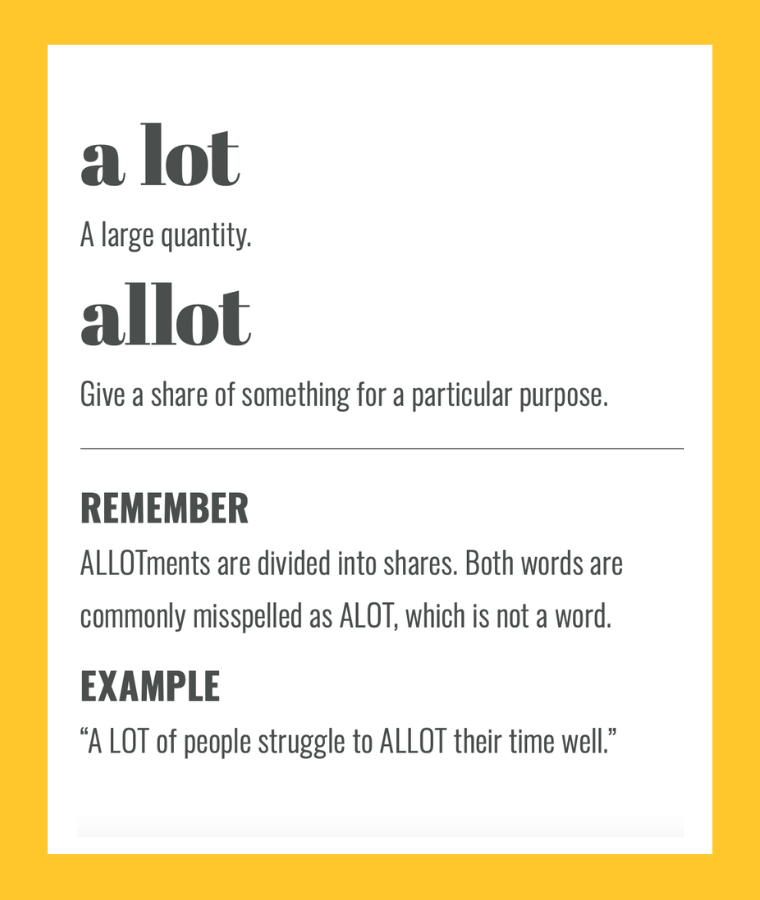
The words A LOT and ALLOT are easy to confuse because they’re homophones – words that sound the same but mean different things. Besides the difference in word class, there are important differences in their meanings, which you don’t want to mess up!
Here are my simple tips to remember the difference between A LOT and ALLOT.
When to use A LOT
A LOT can be an adverb or a noun.
It refers to a large quantity and is synonymous with ‘plenty’. As a noun, it’s used in a sentence like this:
“There’s A LOT to remember!”
Note that it refers to the quantity alone, not what there is A LOT of. As an adverb, it’s used in a sentence like this:
“There’s A LOT of information to remember.”
In this case, ‘information’ is the noun and A LOT specifies how much information there is.
When to use ALLOT
ALLOT is a verb, commonly used with words like ‘time’.
It means to give a share of something for a particular purpose. You can use it in a sentence like this:
“You should ALLOT an appropriate amount of time to digest this information.”
Pro tip
Don’t confuse A LOT and ALLOT with ALOT. ALOT is a common misspelling of A LOT and ALLOT but it’s not a word.
Now you know the difference between A LOT and ALLOT! I hope these tips help you to remember the difference between these commonly confused words in the future.
Get more simple, memorable spelling tips in The Little Book of Confusables 1 + The Little Book of Confusables 2
My four-times award-winning books take the mystery out of misused words for just just £11.95. You’ll wonder how you managed without them!

A LOT vs ALLOT. Excerpt from The Little Book of Confusables by Sarah Townsend. Get simple spelling tips for 500+ commonly confused words.

More than 1,000 misused words demystified
Master 1,000+ confusing words with the multi-award-winning Little Book of Confusables 1 + 2 – jam-packed with memorable, fun spelling and usage tips: from ACCEPT + EXCEPT and OPTIMAL + OPTIMUM, to BARE + BEAR and PURPOSEFULLY + PURPOSELY.