

HISTORIC vs HISTORICAL: simple tips to help you remember the difference
HISTORIC vs HISTORICAL: simple spelling and usage tips to remember the difference
The words HISTORIC and HISTORICAL are easy to confuse because they come from the same root, but there are subtle and important differences in their meanings, which you don’t want to mess up!
Here are my simple tips to remember the difference between HISTORIC and HISTORICAL.
When to use HISTORIC
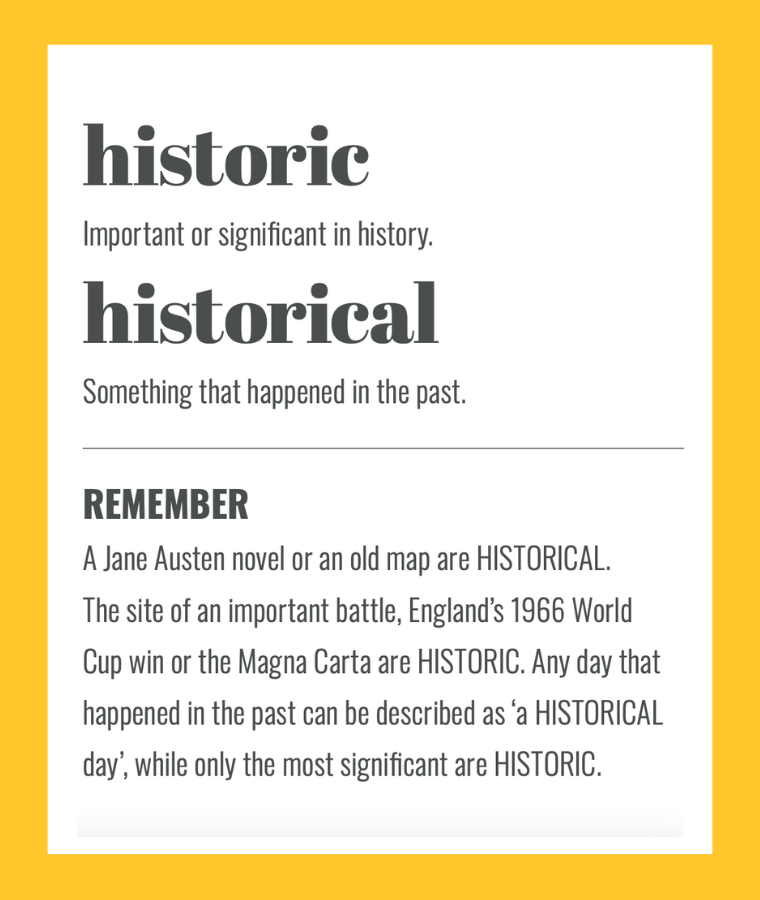
HISTORIC is an adjective, usually paired with words like ‘defeat’, ‘victory’ or ‘day’.
It refers to an event, place or item that’s significant in history – such as the site of an important battle, England’s 1966 World Cup win or the Magna Carta.
You can use HISTORIC in a sentence like this:
“This day marks 56 years since England’s HISTORIC football match against Germany.”
When to use HISTORICAL
HISTORICAL is an adjective referring to something that happened in the past. You might use it to describe a Jane Austen novel or an old map.
HISTORICAL is commonly used with words like ‘event’ or ‘record’.
You can use HISTORICAL in a sentence like this:
“The article provides a detailed HISTORICAL account of the event.”
Any day that happened in the past can be described as ‘a HISTORICAL day’, while only the most significant are HISTORIC.
Now you know the difference between HISTORIC and HISTORICAL you can rest easy, knowing you’ll never mix up your HISTORIC with your HISTORICAL days again!
I hope my tips help you remember the difference between these commonly confused words in the future.
Get more simple, memorable spelling tips in The Little Book of Confusables 1 + The Little Book of Confusables 2
My four-times award-winning books take the mystery out of misused words for just just £11.95. You’ll wonder how you managed without them!

HISTORIC vs HISTORICAL. Excerpt from The Little Book of Confusables by Sarah Townsend. Get simple spelling tips for 500+ commonly confused words.

More than 1,000 misused words demystified
Master 1,000+ confusing words with the multi-award-winning Little Book of Confusables 1 + 2 – jam-packed with memorable, fun spelling and usage tips: from ACCEPT + EXCEPT and OPTIMAL + OPTIMUM, to BARE + BEAR and PURPOSEFULLY + PURPOSELY.