

BEAR or BARE: simple tips to remember the difference
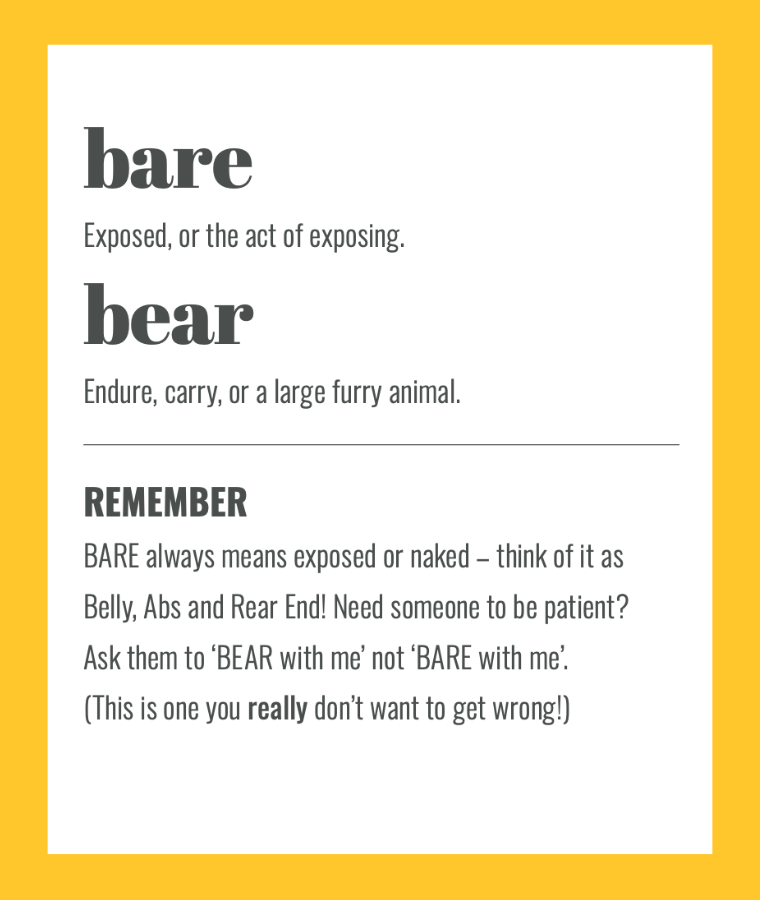
The words BEAR and BARE are easy to confuse – particularly when you’re asking someone to ‘BEAR with me‘, when there’s a world of a difference in meaning! This is one you really don’t want to get wrong!
Here are my simple tips to remember the difference between BEAR and BARE.
When to use BEAR
BEAR can be a noun or a verb.
As a verb, it means to carry or endure. You can use it in a sentence like this:
“Please BEAR with me while I sort things out.”
As a noun, BEAR is a large animal.
For example:
“Winnie-the-Pooh is a famous BEAR.”
When to use BARE
BARE can be a verb or an adjective.
As a verb, BARE means to expose, like this:
“I will BARE my soul and be completely honest.”
As an adjective, BARE means exposed, like this:
“The gorilla beat his BARE chest.”
To remember that BARE means naked, think of Belly, Abs and Rear End.
Now you know the difference between BEAR and BARE you can see why ‘BEAR with me’ (please be patient) and ‘BARE with me’ (let’s get naked) should never be mixed up!
Get more simple, memorable spelling tips in The Little Book of Confusables 1 + The Little Book of Confusables 2
My four-times award-winning books take the mystery out of misused words for just just £11.95. You’ll wonder how you managed without them!
BARE vs BEAR. Excerpt from The Little Book of Confusables by Sarah Townsend.

More than 1,000 misused words demystified
Master 1,000+ confusing words with the multi-award-winning Little Book of Confusables 1 + 2 – jam-packed with memorable, fun spelling and usage tips: from ACCEPT + EXCEPT and OPTIMAL + OPTIMUM, to BARE + BEAR and PURPOSEFULLY + PURPOSELY.