

Brake vs break: do you know the difference?
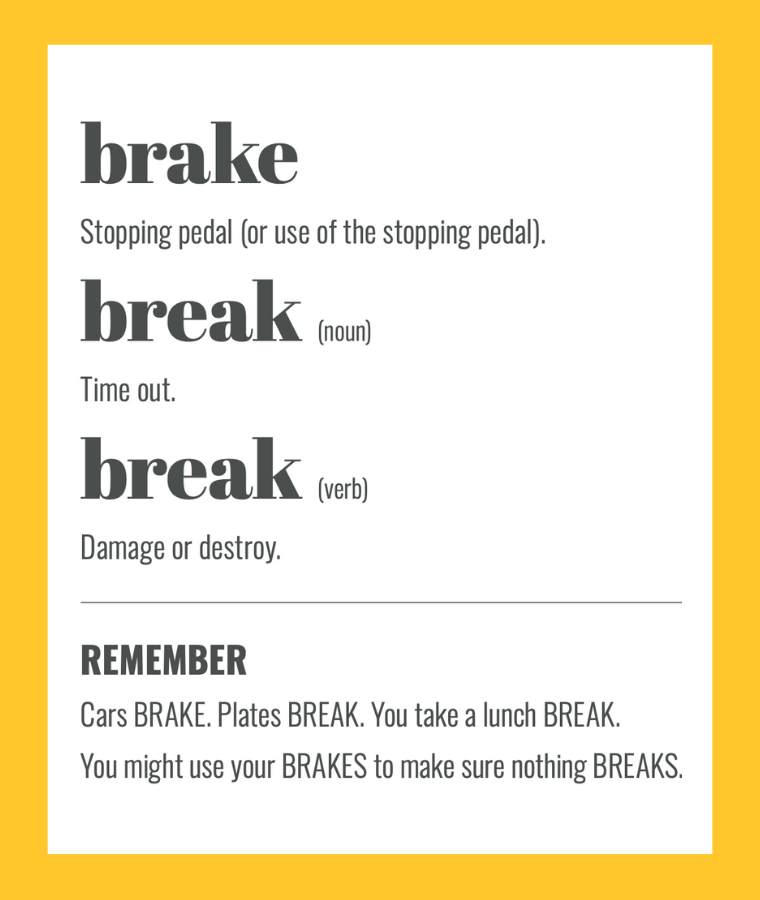
BRAKE vs BREAK: which is which? Tips and tricks to remember the difference
BRAKE and BREAK are easy to confuse – especially if you’re new to the English language. The fact that the two words sound the same – they’re homophones – means people commonly mix them up.
Here are my simple spelling tips to remember the difference between BRAKE and BREAK.
When to use BREAK
BREAK can be both a noun and a verb.
As a noun, BREAK means time out.
“It’s time for your lunch BREAK”
“Let’s take a BREAK”
As a verb, BREAK means damage or destroy.
“I dropped my phone but luckily it didn’t BREAK.”
When to use BRAKE
BRAKE can be both a noun and a verb.
As a noun, a BRAKE is the stopping pedal in a car or other vehicle.
As a verb, BRAKE means to slow down or stop – for example, a car.
Noun: “Remember to use the BRAKE to stop the car in good time.”
Verb: “I had to BRAKE hard to avoid the oncoming cyclist.”
Get more simple, memorable spelling tips in The Little Book of Confusables 1 + The Little Book of Confusables 2
My four-times award-winning books take the mystery out of misused words for just just £11.95. You’ll wonder how you managed without them!
BREAK vs BRAKE. Excerpt from The Little Book of Confusables by Sarah Townsend.

More than 1,000 misused words demystified
Master 1,000+ confusing words with the multi-award-winning Little Book of Confusables 1 + 2 – jam-packed with memorable, fun spelling and usage tips: from ACCEPT + EXCEPT and OPTIMAL + OPTIMUM, to BARE + BEAR and PURPOSEFULLY + PURPOSELY.