

Suppose vs supposed: easy ways to remember the difference
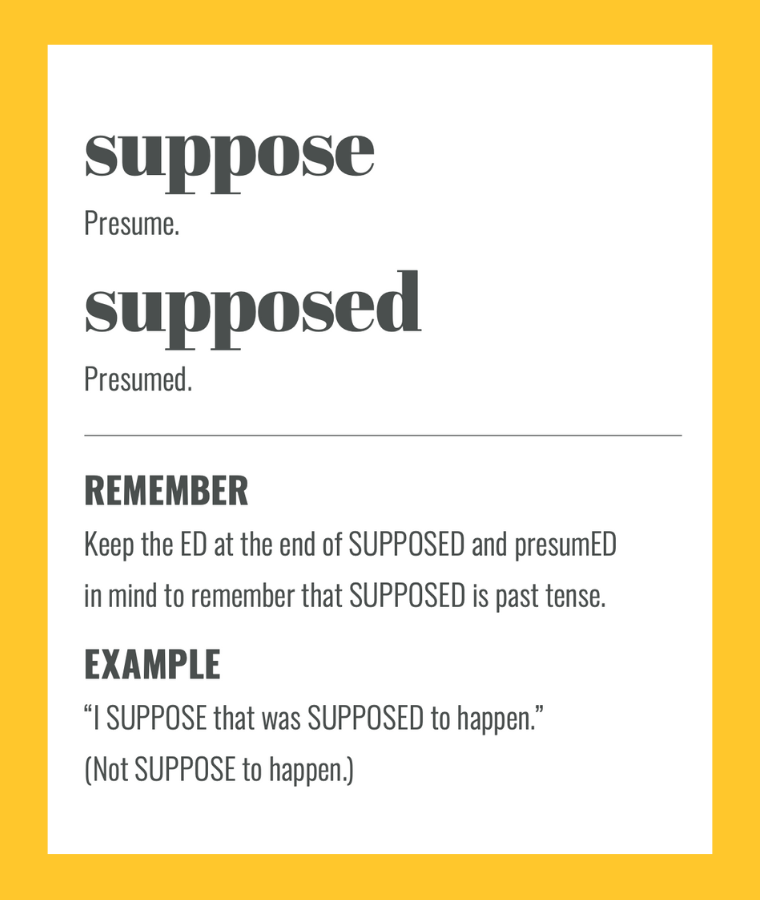
The words SUPPOSE and SUPPOSED are easy to mix up because of their obvious similarity. Here are my simple tips to help you remember the difference between SUPPOSE and SUPPOSED.

When to use SUPPOSE
SUPPOSE is a verb, meaning ‘to presume’. It’s often used in a sentence like this: “I SUPPOSE so.” OR “Do you SUPPOSE he’ll be coming along tonight?”When to use SUPPOSED
SUPPOSED can be an adjective or a verb. As an adjective, it describes something that’s generally accepted as truth. It can be used in a sentence like this: “This is the SUPPOSED method.” As a verb, SUPPOSED is the past participle of SUPPOSE, meaning ‘presumed’. SUPPOSE and SUPPOSED are most commonly confused in the expression ‘SUPPOSED to happen’. It’s always wrong to write ‘SUPPOSE to happen’. Remember the ED at the end of SUPPOSED and presumED to remember that SUPPOSED is past tense. Now you know the difference between SUPPOSE and SUPPOSED. I hope these tips help you to remember the difference between these commonly confused words in the future.Get more simple, memorable spelling tips in The Little Book of Confusables 1 + The Little Book of Confusables 2
My four-times award-winning books take the mystery out of misused words for just just £11.95. You’ll wonder how you managed without them!
2023 GOLD award winner at the eLit book awards.SUPPOSE and SUPPOSED. Excerpt from The Little Book of Confusables by Sarah Townsend.

More than 1,000 misused words demystified
Master 1,000+ confusing words with the multi-award-winning Little Book of Confusables 1 + 2 – jam-packed with memorable, fun spelling and usage tips: from ACCEPT + EXCEPT and OPTIMAL + OPTIMUM, to BARE + BEAR and PURPOSEFULLY + PURPOSELY.
Loved by writers and non-writers alike, these gorgeously accessible books have been described as “An absolute joy”, “The books you never knew you needed” and “Perfect for anyone who ever has to write anything!”.