

Eg and ie: what’s the difference?
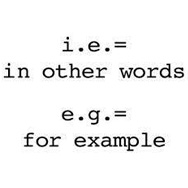
If you’re going to use eg and ie in your writing, make sure you know the difference between these similar abbreviations.
I don’t like abbreviations in writing.
They’re lazy and usually unnecessary.
But that’s just me.
If you’re going to use eg and ie in your writing, these tips will help you get it right.
eg and ie: the difference
• eg means ‘for example‘ or ‘such as‘
• ie means ‘in other words‘
It helps to remember for egsample.
eg and ie in use
Here are some examples of how to use eg and ie correctly – and how to avoid them altogether:
Instead of writing:
I love savoury food, eg cheese, crisps, crackers, and nuts.
You could write:
I love savoury food, such as cheese, crisps, crackers, and nuts.
Or, even simpler:
I love savoury food – cheese, crisps, crackers, and nuts.
Instead of writing:
I’m doing my favourite thing tonight, ie dancing.
You could write:
I’m doing my favourite thing tonight – dancing, in other words.
Even simpler:
I’m doing my favourite thing tonight – dancing.
I hope this helps you to remember the difference between eg and ie in future – and to think about whether you really need to use them.

More than 1,000 misused words demystified
Master 1,000+ confusing words with the multi-award-winning Little Book of Confusables 1 + 2 – jam-packed with memorable, fun spelling and usage tips: from ACCEPT + EXCEPT and OPTIMAL + OPTIMUM, to BARE + BEAR and PURPOSEFULLY + PURPOSELY.